

Audio By Carbonatix
As global methane emissions continue to rise, African policymakers, ahead of COP28, are calling for a transformative approach to finance methane reduction initiatives across the continent.
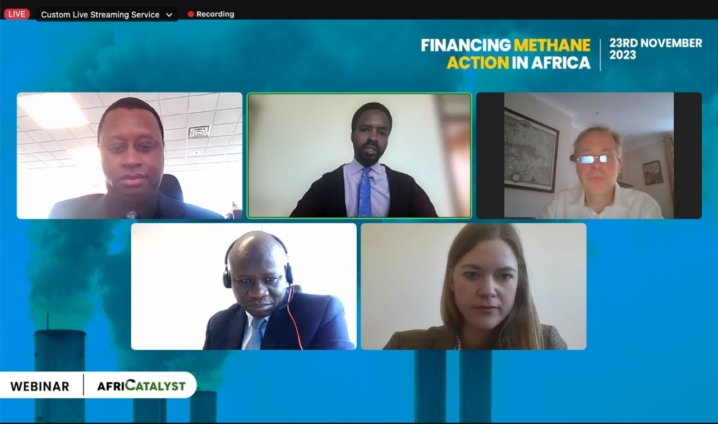
The call for action was emphasized during a high-level panel titled “Financing Methane Action in Africa”, organized by AfriCatalyst, a leading global development advisory firm.
The African Development Bank (AfDB) reports that methane emissions in Africa have reached a critical 4.7 million tons in 2022, yet only 2 percent of climate financial flows are dedicated to combating this challenge. AfriCatalyst CEO, Daouda Sembane, emphasised the need for both international support and local strategies to effectively mobilize resources for methane mitigation.
“Financing methane action faces a number of challenges. First, is the limited awareness and the debate on methane abatement in Africa and how to finance methane abatement efforts across the continent. There is strong evidence that if we do have ambitious methane abatement objectives in Africa, certainly we will be able to make the continent meet its commitments under the Paris Accord,” Daouda Sembene, Africatalyst CEO remarked
At the Africa Climate Summit in Nairobi this September, a unified call emerged from African leaders: a push for developed nations to increase climate financing to Africa. The continent faces a staggering annual loss of 9% of its GDP due to climate disasters.
This economic strain is compounded by the ongoing repercussions of the COVID-19 pandemic and geopolitical instabilities, such as those in Russia-Ukraine and Israel-Palestine. Amidst these challenges, there's a growing recognition of the need for local strategies in mobilizing finance for methane action, viewed as a critical step in turning the tide against climate change in Africa.
“Last year, the African Development Bank allocated 45% of its budget financing to climate action, and we are committed to meeting the Paris Agreement targets by 2025 by applying greenhouse gas accounting tools to estimate methane emissions reduction from each of our projects. We are also championing the Africa Climate Change Fund that will be launching the call for project applications early next year around four key methane emitting areas: agriculture, waste, mining, and energy,” said Dr Al-Hamndou Dorsouma, Division Manager, Climate and Green Growth Development at African Development Bank Group.
As the world focuses on carbon credits, little attention has been paid to initiatives such as a methane tax which could reach up to $70 per tonne. These could play a significant role in unlocking new streams of financing for climate action.
However, without careful implementation and collaboration with key private sector players, methane tax could inadvertently place a financial burden on consumers.
“There is a need to scale up the applicability and accessibility of carbon markets, how do we do cross-border financing and not deal with unintended consequences. Any investment in methane abatement should be seen not as a fossil fuel - oil and gas - issue, rather as decarbonization efforts,” emphasized Mark Jonathan Davis, Chief Executive Officer at Capterio.
The perception of risk attached to Africa by global rating agencies plays a significant role in hindering investment, despite it being untrue. “Africa is the least risky region to do investment in infrastructures - the default rate for financed projects is only 5.5%, the lowest in the world,” Abdoul Salam Bello, Executive Director of the Africa Group II, at the World Bank Group observed.
To attract additional investment in methane action, Africa will need to change global perceptions of risk and make methane projects risk-free and attractive to investors.
“We need to change the narrative of risk by harnessing digital technologies, exploring concessional funding, and establishing a one-stop shop for all investing instruments,” added Bello.
Katherine Stodulka, Director for the Blended Finance Taskforce & Partner at Systemiq, further implored, “Multi development banks (MDBs) should push rating agencies to understand the benefits of investment projects in Africa, the low levels of default, and to have a clear dialogue with African countries that urgently need the investment to carry out methane action.”
As the world gears up for COP28 in Dubai, AfriCatalyst is set to release a landmark report titled “Mobilizing Finance for Methane Action in Africa” offering policy recommendations to empower African delegations in securing more favourable financing terms. The report is expected to be a crucial tool for negotiations, providing actionable solutions for African leaders.
Latest Stories
-
‘Life Is Short’ gospel music hitmaker Bernice Offei dies at 63
29 minutes -
Ghana’s economy has moved from standing on broomsticks to concrete pillars – Mahama
41 minutes -
Systemic vulnerabilities within banking industry remain broadly subdued- BoG
43 minutes -
Ghana, Côte d’Ivoire’s export sectors face heightened risks due to El l Niño – Fitch Solutions
55 minutes -
Norway’s Princess Astrid dies two days after attending brother King Harald’s funeral
1 hour -
NCA awards 700MHz spectrum to MTN Ghana for US$109.9m
1 hour -
Saudi Arabia shuts key oil pipeline after drone attack launched from Iraq
1 hour -
Passenger train derails in France leaving at least 44 injured
1 hour -
Ukraine faces ‘toughest winter’ since Russia’s full-scale invasion, UN official tells BBC
1 hour -
Close race in Sweden as hard right eyes role in government
1 hour -
Adutwum’s spokesperson challenges Haruna’s claim he inherited current CSSPS
1 hour -
ECG’s problems are about management, not ordinary workers – TUC
2 hours -
Don’t wait for the floods to recede before going green – Prof Naana Jane
2 hours -
Big Chef Season 5: Final 10 face Omo Tuo Challenge
2 hours -
We won’t be at war with President Mahama; we need to sit up – GFA Communications Director
2 hours