

Audio By Carbonatix
President John Mahama has rejected claims that the involvement of some Africans in the transatlantic slave trade diminishes the crime of slavery or weakens the case for reparations.
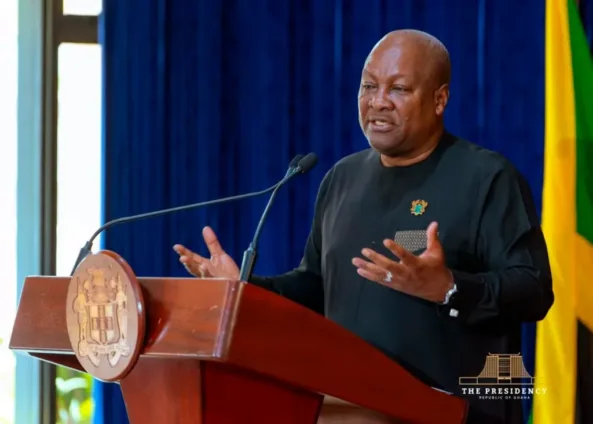
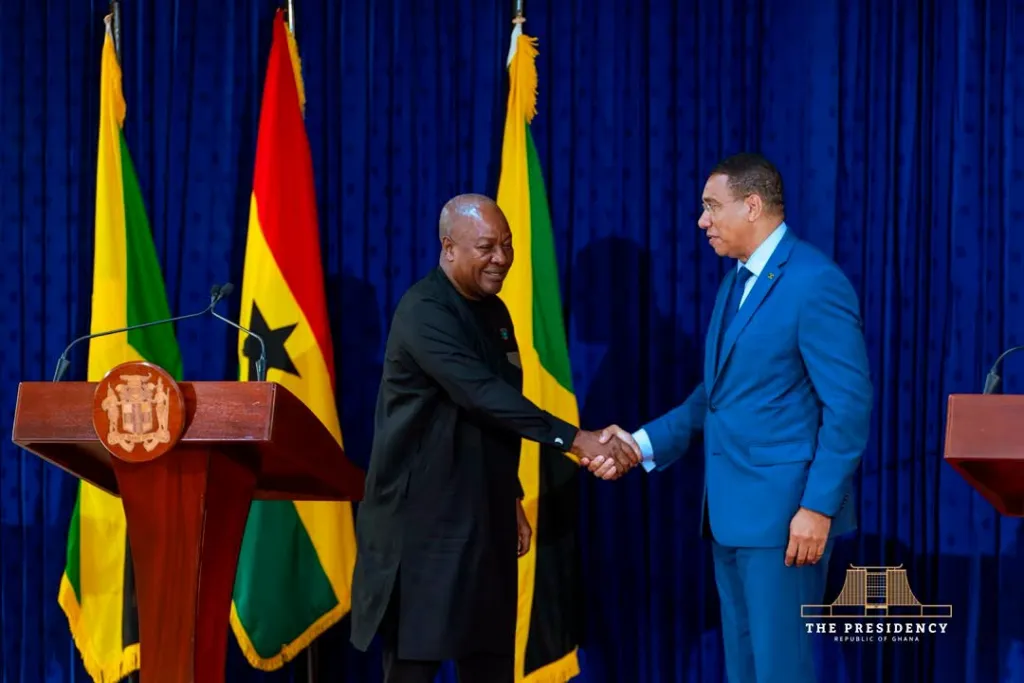
Speaking at a high-level dialogue on reparations at the University of the West Indies in Jamaica during his state visit, President Mahama said the role played by some Africans as intermediaries did not absolve those who conceived, financed, and institutionalised the transatlantic slave trade.
Drawing a parallel with the Holocaust, he argued that the participation of some Jewish individuals in assisting Nazi operations did not erase the reality of the genocide or lessen its status as a crime against humanity.
"The Holocaust occurred, and I believe that there was a Holocaust and six million Jews were killed. Some of the most brutal prison guards were Jews. Some of those who went into the communities and showed where Jews were hiding and delivered them to the Nazis to be exterminated were Jews," he said.
"But it doesn't mean the Holocaust didn't happen and that the Holocaust wasn't a crime against humanity."
President Mahama said the same principle applies to the transatlantic slave trade, insisting that the involvement of some Africans does not diminish the scale or severity of the atrocity.
"So even the argument that Africans were involved in enslaving Africans does not stop it from being the gravest crime against humanity," he stated.
He called for a broader examination of the legal, financial, and commercial structures that sustained the slave trade for centuries.
"You must look at all the legal underpinnings. You must look at everything that was established to support the slave trade in terms of the insurance of the cargo, the auctions, and all that," he said.
According to the president, the transatlantic slave trade was a highly organised system involving governments, institutions, and commercial interests, making it impossible to dismiss its historical significance because some Africans participated in it.
"It was a very systematic trade, and so you cannot wish it away just by saying that some agents whom you use as agents to bring you slaves as commodities participated in it, and because they were Africans, then it means that the slave trade didn't happen," he said.
"No, we reject that," he stressed.
Need to tell the truth about slavery
President Mahama stressed that understanding the full history of slavery is essential to shaping Africa's future, saying independent African nations must tell their own history truthfully.
"We are now independent. We should be able to tell our children the truth," he said.
He recalled that during his school years, history lessons focused largely on abolitionists while giving little attention to the scale and brutality of the slave trade itself.
"When I was growing up in primary school, the abolitionists were put as the most important thing that happened in the slave trade," he said.
"We were taught about the slave trade. The gravity of what happened in the slave trade was never really spelled out. It was the bravery of the abolitionists and how they were the knights in shiny armour who came and stopped it and saved Africans."
While acknowledging the role of abolitionists, President Mahama said history books often celebrated them without providing a complete account of the suffering endured by millions of enslaved Africans.
"So all these people who were involved in the abolition movement were lionised in our history books. Now we can begin to tell our children the truth," he said.
He also welcomed growing global interest in the history and legacy of slavery, saying a United Nations resolution on reparations had renewed efforts to better understand the transatlantic slave trade and its lasting consequences.
"I think that since the resolution was passed on the General Assembly, it's piqued interest in trying to understand and know what exactly happened," he said.
President Mahama expressed confidence that increased public awareness would help societies better understand their past and chart a more informed future.
"I believe that awareness is being created. People are aware of what happened. And it helps for you to know where we have come from, because that informs where we are going," he stated.
Latest Stories
-
Yaw Ampofo Ankrah hasn’t taken or received any money to facilitate visas – Lawyer insists
17 minutes -
World Cup visa scandal: Senyo Hosi urges focus on constitutional accountability
17 minutes -
La Beach demolition: Senyo Hosi condemns lack of consultation
28 minutes -
Russian glide bomb attack on Zaporizhzhia kills at least 15 people
43 minutes -
Jinapor warns underperforming energy sector CEOs of consequences, says no protection for failure
45 minutes -
Fire destroys head of tipper truck on Lower Volta Bridge
49 minutes -
Palmer signs new Chelsea contract until 2034
51 minutes -
World Cup visa scandal: Mahama will act on corruption allegations – Abass Nurudeen
53 minutes -
Abass Nurudeen accuses Minority of ‘scandal scavenging’ over World Cup visa controversy
54 minutes -
US Embassy recognised NSA, GFA and GTA as separate entities for visa applications – Sports Minister’s aide
1 hour -
Only 30% of Ghanaian teachers satisfied with their jobs – CAPCOE data reveals
1 hour -
Communities affected by construction of Akosombo Dam urge government to speed up compensation process
2 hours -
World Cup visa scandal: Sports Ministry not shielding anyone – Sports Minister’s special aide
2 hours -
World Cup visa scandal: Over 30 people misrepresented as GTA board members to US Embassy – Vincent Assafuah alleges
2 hours -
Fire destroys wooden structure near Yesu Mo Villa at Bush Road
2 hours