

Audio By Carbonatix
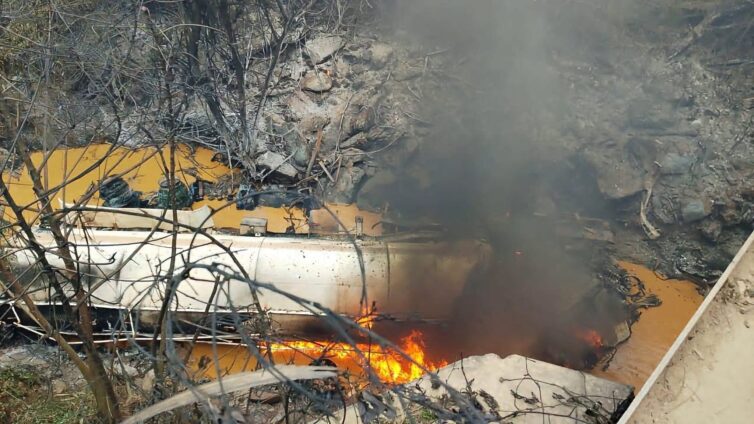
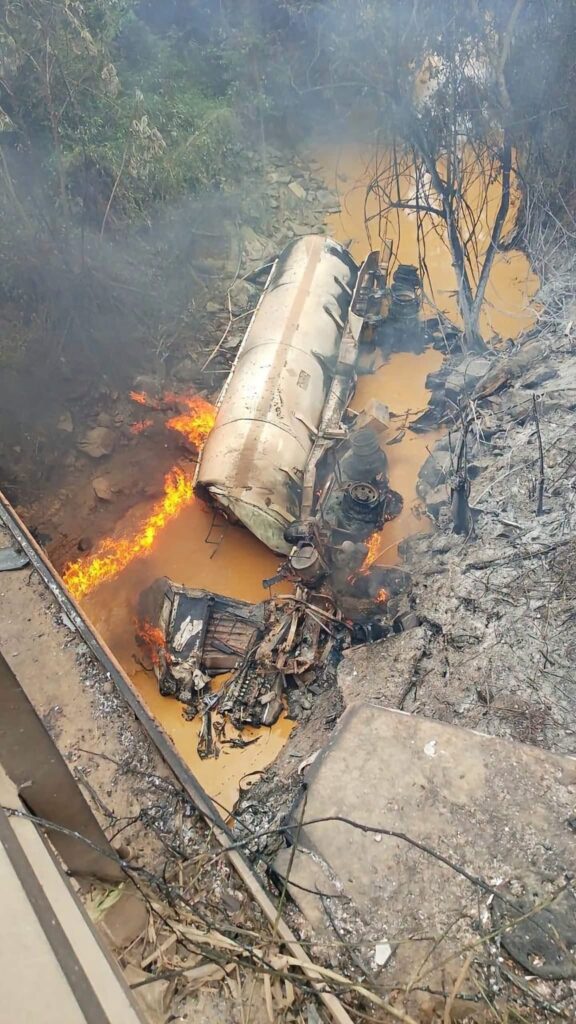
At about 11 a.m. on Monday, August 3, the Ghana National Fire Service received a distress call. Another disaster had struck the Accra-Kumasi Highway.
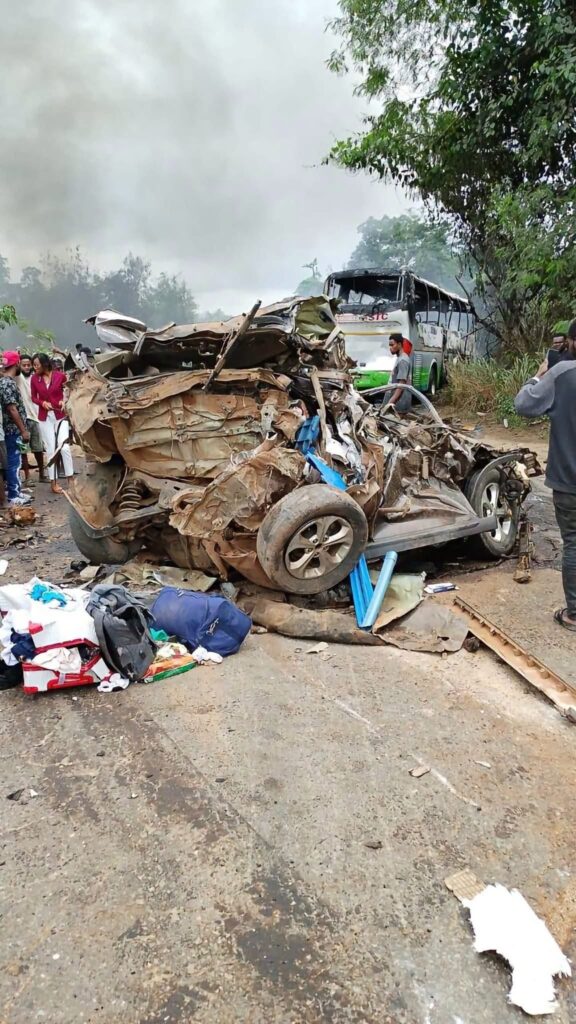
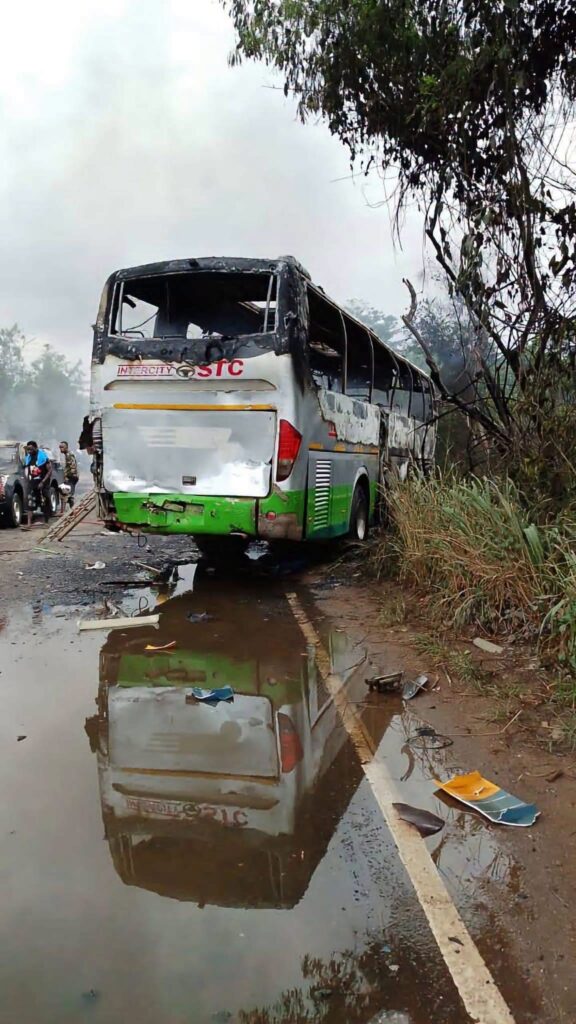
At Birimso Bridge, near Bunso Junction in the Eastern Region, an STC bus, a fuel tanker, a Mitsubishi pick-up and a Kia Sorento had collided. The impact triggered a massive fire.
The fuel tanker, STC bus and Mitsubishi pick-up were destroyed. Two people, both occupants of the tanker, died. Six others, including two women, were rescued and taken to the Hawa Memorial Hospital for treatment.
The Fire Service says its crew arrived just three minutes after receiving the distress call. It was, by all accounts, a rapid emergency response. But that is not the part of the story that should leave Ghanaians comfortable.
The more disturbing question is why, after decades of knowing the dangers of this highway, authorities continues to wait for the next crash before demonstrating its ability to respond to one.
The Birimso tragedy is not an isolated event.
It is another entry in a long and increasingly intolerable record of crashes on one of the most important roads in the country.
And the political response has become painfully predictable: condolences, investigations, warnings to motorists, promises of road works and then silence until the next disaster.
A highway that has become a recurring crime scene
The Accra-Kumasi Highway is not an ordinary road. It connects the country’s two largest economic centres and carries passengers, food, agricultural produce, fuel, manufactured goods and commercial freight.
Traffic counts have shown thousands of vehicles travelling along sections of the corridor every day, with volumes approaching 22,000 vehicles daily around Ejisu.
Yet portions of this critical national artery remain undivided, forcing vehicles travelling in opposite directions to share the same carriageway.
That creates the conditions for the most terrifying kind of road crash: the head-on collision.
In April 2021, the Eastern Regional Commander of the Police Motor Traffic and Transport Department, Chief Superintendent Stephen Ahiatafu, described the Nsawam-Nkawkaw stretch as “bloody.”
He said it accounted for 42 of the 97 fatal crashes recorded in the Eastern Region in the first quarter of that year.
His solution was straightforward: Dualise the road.
Five years later, the question is no longer whether authorities understand the problem.
The question is why the solution has remained trapped in years of announcements, contracts, designs, bypasses, rehabilitation programmes and political promises.
The driver is blamed. The road gets away with it.
Dangerous overtaking is repeatedly identified as one of the immediate causes of crashes on the corridor.
In March 2026, a crash near Frimpongso Junction was attributed to dangerous overtaking.
Weeks later, another crash near Suhum killed one person and injured nine others, with preliminary investigations again pointing to wrongful overtaking.
These explanations may be correct.
Drivers who overtake recklessly must be held accountable. Speeding must be punished.
Fatigue must be confronted. Vehicles must be roadworthy.
But there is a dangerous simplicity in reducing the Accra-Kumasi carnage to bad driving. Because the fundamental problem is obvious:
On an undivided highway, a driver who overtakes has to enter the path of oncoming traffic.
When that manoeuvre goes wrong, there is often nothing between two vehicles travelling towards each other at high speed.
No median. No concrete barrier. No opposing carriageway. No second chance.
The road converts human error into death.
Modern road safety is built around the principle of a forgiving road, infrastructure designed to reduce the severity of crashes when motorists inevitably make mistakes.
Ghana has instead built a system in which a driver’s mistake can become a family’s funeral. That is not merely a driver problem, but it is an engineering and governance problem.
The highway carries long-distance buses, private vehicles, commercial vehicles, heavy trucks and petroleum tankers. At some points, motorists contend with damaged road surfaces, inadequate shoulders, broken-down vehicles and congested sections.
In 2020, for instance, a crash near Oforikrom involved a commercial bus that reportedly encountered broken-down trailers obstructing the road and veered off while trying to avoid them.
The condition of the road itself has also repeatedly been acknowledged by authorities.
In 2019, sections between Konongo and Odumasi were identified as dangerous, with erosion eating into the shoulders and creating deep trenches close to the carriageway.
A contract was awarded to repair the affected portions. But the same stretch remained part of the broader dualisation agenda.
Then, in September 2024, the Roads Ministry acknowledged deterioration on the Apedwa-Ejisu section, including potholes, cracks, rutting and depressions. Government responded with another rehabilitation programme — pavement strengthening, asphalt overlays and road furniture.
The question is not whether rehabilitation is necessary because it is.
The question is why Ghana keeps pouring resources into patching a road it has repeatedly acknowledged needs a fundamental transformation.
Ghana has promised this road for years. The most damning part of the story is the timeline.
This is not a problem the government discovered yesterday.
In 2005, the government signed a memorandum of understanding with Arterial Roads Company Limited for the dualisation of the Accra-Kumasi Road under a public-private partnership arrangement. That arrangement was eventually terminated in December 2017.
In 2012, Cabinet approved a Build-Operate-Transfer arrangement for dualising the Accra-Kumasi trunk road.
In 2018, the Akufo-Addo administration announced that construction of the dualisation would commence by the end of the year.
By 2019, government was still talking about dualisation while awarding emergency repairs to dangerous portions of the existing road.
By 2020, residents around Kyekyewere and Asuboi were threatening demonstrations because people were dying on the highway and the promised dualisation had not materialised.
Then came another solution. Bypasses. Four of them.
In 2022, the government announced four major bypasses from Osino through Anyinam, Enyiresi and Konongo as part of the Accra-Kumasi Highway dualisation programme.
The projects included:
- 11.6km Osino bypass
- 6.1km Anyinam bypass
- 10.6km Enyiresi bypass
- 13.5km Konongo bypass
The Roads Ministry said eight contracts worth about GH¢2 billion had been signed, with the stated objective of reducing congestion and accidents.
In 2023, the Ghana Highway Authority said eight contractors had mobilised to site and commenced earthworks.
In January 2024, the then Roads Minister, Kwasi Amoako-Atta, inspected the projects and expressed satisfaction with their progress.
And still the highway continued to claim lives.
By 2026, the bypasses were still part of a project whose completion was being targeted for 2027 but has been abandoned.
For a country where the problem was identified decades ago, that is a painfully slow response to a danger that does not wait for government schedules.
Then came the grandest promise: a new expressway
Now Ghana has another answer. A new Accra-Kumasi Expressway.
The proposed project is not simply another patching exercise on the existing road. It is envisaged as a new, modern corridor. Government says it will complement rather than replace the existing highway.
By May 2026, the Ghana Armed Forces had begun clearing sections of the proposed corridor. The planned expressway is approximately 198.7 kilometres and is designed as a six-lane highway with interchanges.
In July 2026, the government announced that US$1.7 billion had been deposited at the Bank of Ghana for the project and ring-fenced for use after the main construction contract is awarded.
Feasibility studies and detailed engineering designs were expected to be completed by the end of August, with procurement scheduled to begin in September.
Money is not a road. A feasibility study is not a road.
A design is not a road. A contract is not a road. A sod-cutting ceremony is not a road.
Land clearing is not a road. A promise is certainly not a road.
The people travelling on the Accra-Kumasi Highway today are not travelling on feasibility studies. They are travelling on the existing highway.
And that is where political accountability becomes unavoidable
Successive governments cannot continue to inherit the same road-safety crisis, announce the same solutions and then expect to be judged by the announcements.
The political parties may change. The governments may change. New promises will be made.
Meanwhile, the old highway continues carrying the country’s people and commerce and continues producing the dead.
This is where the politics of infrastructure must change.
Ghanaians should stop measuring road projects by the number of ceremonies surrounding them.
The real measure is simple: How many lives did the project save?
The bypasses cannot become another political photo opportunity.
Government said the bypasses would reduce congestion and accidents. That creates a clear obligation. Finish them.
If they are delayed, explain why.
If contractors are owed, say so.
If designs have changed, publish them. If costs have increased, account for every cedi. If deadlines are missed, somebody must answer for them.
The public deserves more than another minister standing beside a half-built road explaining that the project is “progressing steadily.”
Because while the project progresses steadily, the crashes can happen suddenly.
And yesterday’s Birimso disaster demonstrated that reality with brutal clarity.
Until promises become asphalt, concrete barriers, safe shoulders, bypasses, enforcement and functioning emergency systems, every new fatal crash on the Accra-Kumasi Highway will leave Ghana confronting the same question:
How many more Ghanaians must die before a promise finally becomes a road?
Latest Stories
-
Election Watch Ghana raises concern over low female representation in NPP leadership
6 minutes -
Four drinks that help manage blood sugar
6 minutes -
Ray Michael Djan Jr puts Ghanaian creativity on global stage with Chelsea anthem
16 minutes -
Matilda Dibloni Kokar elected USAG president after two-year dormancy
19 minutes -
NPP delegates wanted youthful energy with Kojo Bamba’s election – Political scientist
22 minutes -
Zenith Bank supports Childhood Cancer Unit at Greater Accra Regional Hospital
22 minutes -
KMA empowers 64 persons with disabilities; Mayor unveils plan for sustainable skills centre
24 minutes -
DJs Union urges musicians to prioritise respect, communication amid industry tensions
32 minutes -
“Ghanaian DJs deserve their flowers” – Lasmid
32 minutes -
Zenith Bank supports childhood cancer unit at Greater Accra Regional Hospital
34 minutes -
‘Who’s in charge doesn’t really matter; we’re all servants’ – John Boadu on leader of NPP
37 minutes -
SLTF to advance fees for first-year students facing admission payment deadlines
56 minutes -
Ghana Institute of Architects calls for action to make adequate housing a human right
56 minutes -
BoG, Police arrest seven over alleged misuse of Ghana Cedi as bouquets
56 minutes -
NCPTAs appeal to striking teachers to return to classroom
57 minutes