

Audio By Carbonatix
African Development Bank Group President Dr Akinwumi Adesina (www.AfDB.org) has warned that a new EU carbon border tax could significantly constrain Africa’s trade and industrialization progress by penalizing value-added exports including steel, cement, iron, aluminium and fertilizers.
Adesina said, “With Africa’s energy deficit and reliance mainly on fossil fuels, especially diesel, the implication is that Africa will be forced to export raw commodities again into Europe, which will further cause de-industrialisation of Africa.”
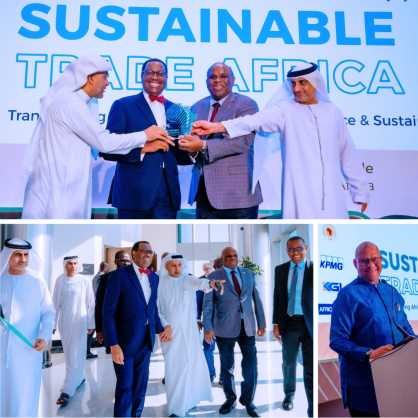
“Africa could lose up to $25 billion per annum as a direct result of the EU Carbon Border Tax Adjustment Mechanism,” the Bank President told delegates at the Sustainable Trade Africa Conference held at the UAE Trade Centre in Dubai.
“Africa has been short-changed by climate change; now it will be short-changed in global trade,” the Bank President said.
“Because of weak integration into global value chains, Africa’s best trade opportunity lies in intra-regional exchanges, with the new Africa Continental Free Trade Area estimated to increase intra-Africa exports over 80% by 2035.”
Adesina stressed that Africa was already being overlooked in the global energy transition, according to data from the International Renewable Energy Agency.
“Africa received just $60 billion or 2% of the $3 trillion of global investments in renewable energy in the past two decades, a trend that will now impact negatively on its ability to export competitively into Europe,” said Adesina as he called for what he termed the Just Trade-for-Energy Transition (JTET) policies, which would enable Africa’s renewable ambitions without restricting its trade prospects.
Africa will need to use natural gas as a transition fuel to reduce the variability of renewable energy and stabilize its energy systems in support of its industrialization, Adesina said.
The Chief Executive Officer of the UAE Trade Centre, Walid Mohammed Hareb Alfalahi said Africa is the new frontier for investment contrary to widespread perception that the continent is a dangerous and difficult place to do business.
“What you hear about Africa is not the reality. I see the potential in Africa. I see the possibilities to do more,” said Alfalahi as he recounted his positive experience of investing in a number of projects on the continent.
Adesina said a report by Moody’s Analytics showed that Africa had the least default rate on investment in infrastructure compared to other parts of the world.
According to the report, Africa’s default rate stands at 5.5 per cent, compared to Latin America’s 12.9 per cent, followed by Asia at 8.8 per cent, Eastern Europe 8.6 per cent, North America 7.6 per cent, and Western Europe 5.9 per cent.
Adesina also highlighted some of the mega projects that had attracted investor interest through the Africa Investment Forum that was created by the African Development Bank and seven other founding partners. The projects include Mozambique’s $24 billion liquefied gas project, the $15.2 billion Abidjan to Lagos Highway corridor covering 5 countries and the $3.6 billion Tanzania to Burundi and DR Congo railway line.
“I’m talking about a different Africa. There is no project that as partners, we cannot handle,” said Adesina.
The conference, moderated by the African Development Bank President’s Senior Adviser for Communication, Dr Victor Oladokun, was also addressed by the President of the African Export-Import Bank, Afreximbank, Professor Benedict Oramah. He warned, “Preliminary results of a study recently commissioned by Afreximbank reveal that rapid decarbonisation by fossil fuel-exporting countries in Africa could cut merchandise exports by $150 billion.”
President Adesina’s speech (https://apo-opa.co/3RvZdrC)
Distributed by APO Group on behalf of African Development Bank Group (AfDB).
Contact:
Chawki Chahed
Communications and External Relations Department
media@afdb.org
About the African Development Bank Group:
The African Development Bank Group (AfDB) is the premier multilateral financing institution dedicated to Africa's development. It comprises three distinct entities: the African Development Bank (AfDB), the African Development Fund (ADF) and the Nigeria Trust Fund (NSF). The AfDB has a field presence in 41 African countries, with an external office in Japan, and contributes to the economic development and social progress of its 54 regional member states. For more information: www.AfDB.org
Latest Stories
-
Banks’ sustainable success will be defined less by interest margins – PwC
46 minutes -
Baffoe-Bonnie was part of ‘grand conspiracy’ against Torkornoo – Afenyo-Markin
50 minutes -
The GIPA Act: Resetting Ghana’s investment framework
2 hours -
GIPA secures investor leads at Invest Fest 2026
2 hours -
Ghana’s missing billions: What 16 years of Auditor-General reports show
2 hours -
Police disown viral flyer on AirPods, earphones use while driving
2 hours -
Stop using media to challenge judicial decisions – Thaddeus Sory to lawyers
2 hours -
The next generation expects more than degrees from universities
2 hours -
Ebenezer Dwomoh to stage fourth stand-up comedy special in Kumasi
2 hours -
Central Regional Minister urges traditional leaders to hold public officials accountable
2 hours -
Ada Traditional Council suspends four members for defying cancellation of 2026 Asafotufiami durbar
2 hours -
Association of Small-scale Industries, GEA strengthen artisans through mentorship, coaching
2 hours -
Two arrested over alleged galamsey activities in Tanoso
2 hours -
Ghana rises to sixth-largest gold producer globally after record 2025 output
2 hours -
Five injured in road crash at Ahwerase
2 hours