

Audio By Carbonatix
The Founder and Leader of the Movement for Change (M4C), Alan Kyerematen, says he will partner the Ghana Trades Union Congress (TUC) for rapid socioeconomic development if elected President.
According to him, the policy proposals of the Movement were in line with many of the key pillars of the TUC’s manifesto.
“Be rest assured that when I become President… You will have a reliable and trusted partner in development.”
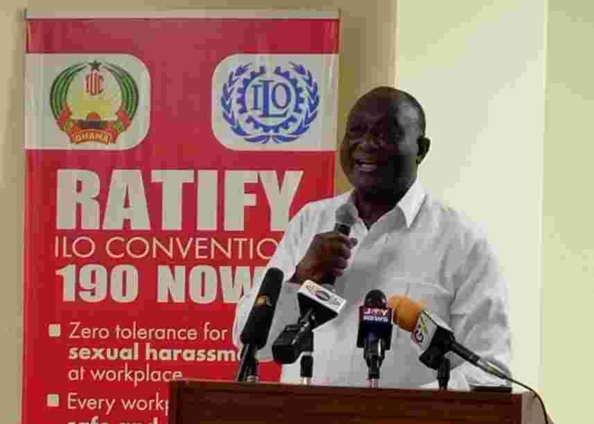
Mr Kyerematen gave the assurance when he engaged the leadership of the Ghana Trades Union Congress (TUC) and outlined his vision for the country through his Great Transformational Plan (GTP) in Accra.
Mr Kyerematen said the GTP sought to build a prosperous, united and peaceful country that provided equal opportunities for all particularly young people, women and other vulnerable groups to realise their full potential.
He said the GTP was anchored on 15 pillars, which had been categorised into six different, but interrelated clusters, namely economic, governance, infrastructure, social services, environmental and natural resources, and behaviourial and attitudinal clusters.
Dr Anthony Yaw Baah, Secretary General of the TUC, said the Union had develop its manifesto and stated its position on issues affecting the country, which had been the basis for engaging with the political parties, independent candidates and Civil Society Organisations that were important stakeholders in the development of Ghana.
He bemoaned the poor state of the Ghanaian economy, which he said was not doing well because of its low growth, high unemployment among the youth, the depreciation of the cedi, and high inflation, among others.
He said Ghana’s economic woes were due to poor economic management and what had worsen the problem was the heavy debt burden that successive generation would have to pay.
“So, as usual, our solution to this problem is to run to the IMF…we have been to the IMF seventeen times and it looks like we are preparing to go the eighteenth time.
“We have said time and again that Ghana’s economic and social problems will not be solved by IMF programmes, we have to change direction,” he said.
Latest Stories
-
NAGRAT urges gov’t to communicate early if September deadline cannot be met
31 minutes -
We trust government to meet September deadline on teachers’ promotions – NAGRAT
43 minutes -
“We dare not fail” – Gov’t promises to honour teachers’ promotion pay deal
49 minutes -
The GH¢19.8 billion mirage: Inside Ghana’s state enterprise turnaround
58 minutes -
Luv FM High School Debate: KNUST SHS and Osei Adutwum SHS set up thrilling final after dramatic semi-finals
1 hour -
KNUST AI Coordinator urges structured adoption of AI in teacher education
1 hour -
Nepal rescuers blast hillside in search of hydropower workers as families wait anxiously
2 hours -
Teachers who pass promotional exam to get January 2026 start date after gov’t resolves promotion dispute – Dr Apaak assures
2 hours -
NSMQ 2026: St. John’s School rally from slow start to book semi-final spot
2 hours -
Promotion pay row: Gov’t gives teachers September 2026 to complete salary adjustments
2 hours -
Financial irregularities plummet by 62.9% as state tightens fiscal controls
2 hours -
DVLA to expand mobile services to underserved communities in Ghana’s Eastern Corridor of the Northern Region
2 hours -
GUTA urges GPHA to act swiftly to end Tema Port congestion to avert rising business costs
2 hours -
Port congestion could undermine 24-hour economy policy – GUTA
2 hours -
NSA opens three-day window to resolve national service biodata mismatches
2 hours