

Audio By Carbonatix
The Institute of Economic Affairs (IEA) says it is time for Ghana to take ownership of its natural resource wealth to derive more benefits for the nation..
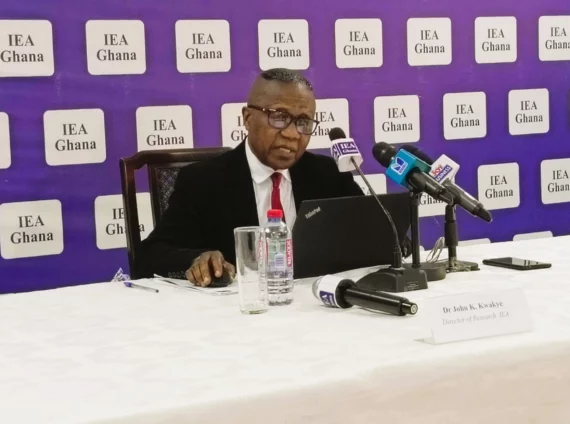
Dr. John K. Kwakye, Director of Research at IEA Ghana, said this during a press briefing on Wednesday to present the Institute’s reflections on President Akufo-Addo’s State of the Nation Address (SONA) on February 27 and the Monetary Policy Committee (MPC) Decision delivered by the Bank of Ghana Governor on March 25.
During the SONA, President Akufo-Addo praised Ghana for recovering its position as Africa’s largest gold producer, surpassing South Africa with gold production of four million ounces.
Dr Kwakye responded: “Taking Ghana’s reported annual production of four million ounces and multiplying by the current world price of US$2,200 per ounce gives US$8.8 billion. The question is, how much of this belongs to Ghana? Ghana’s share is not likely to exceed 20 per cent, or about US$1.8 billion, while the much bigger share of about US$7.0 billion goes to foreign companies.”
President Akufo-Addo also spoke about the development of a local gold refinery to increase the value of the commodity.
The Institute said the policy was long overdue and suggested that it be extended to all the country’s natural and agricultural commodities.
“We should construct cocoa processing factories and refineries for oil, bauxite, lithium, etc., to take advantage of the vast difference between the prices of the refined products and the raw commodities,” Dr Kwakye said.
The President again noted that the Domestic Debt Exchange Programme (DDEP) had made considerable progress.
Dr Kwakye commented on this, saying, “We should not lose sight of the immense hardship the DDEP has brought on bond holders, including pensioners and the financial sector, which was heavily exposed to Government debt. Even BoG was not spared the adversity.”
The Institute reiterated that Parliament should impose a debt ceiling of 60 per cent of GDP in the Fiscal Responsibility Act, in addition to the existing deficit ceiling, to ensure long-term debt sustainability.
Regarding taxes, the IEA noted that the government was elected on the premise of moving from taxation to production.
However, the Government had done the opposite, with the country experiencing “proliferation of taxes”.
The Institute contended that taxes including the E-levy, COVID-19 Levy, Growth and Sustainability Levy, Sanitation Levy, the failed Emissions Levy, Betting Levy, and VAT on power consumption were “multiple, nuisance or outdated taxes” that could not be justified.
The Institute pointed out that the government did not make an equal effort to reduce its expenditure, despite its size and multiple flagship initiatives.
“The fiscal consolidation being implemented under the IMF program has to be even handed; it must fall equally on expenditure and not just taxes,” Dr Kwakye emphasised.
Latest Stories
-
Skytrain Trial: Court rejects Ameyaw Ekumfi’s bid to halt proceedings
2 minutes -
Aggrieved Gold Coast customers petition Mahama over GH¢3.6bn outstanding payments
8 minutes -
ECG loses about 27% of electricity through technical, commercial losses – Engineer
9 minutes -
Declare foreign currency before checking in luggage – Customs cautions travellers
16 minutes -
State of emergency is no ‘magic wand’ for galamsey – Lands Ministry
22 minutes -
Bringing 10 bags of clothes as gifts? Customs explains when duties may apply
22 minutes -
Precious Mawunya-ko appointed PRO for 5th Praise Achievement Awards
25 minutes -
Don’t let poor English define your potential – Prisons Service DG to Ghanaians
26 minutes -
GRIDCo’s operating profit plunges 89% despite net profit surge in 2025
28 minutes -
IGP summons Volta Police Commander over alleged extortion of traders on Aflao–Accra route
29 minutes -
Amin Adam: Gold programme lost money despite 62.9% rise in prices
32 minutes -
Amin Adam challenges GoldBod’s GH¢5.45bn surplus
41 minutes -
Ghana’s power sector losing 27% of electricity supplied – Electrical Engineer
45 minutes -
GH¢1.5m raised to renovate historic Wa Naa’s Palace
48 minutes -
‘Still a work in progress’ – Eric Tinkler admits Kotoko have plenty to improve
49 minutes