

Audio By Carbonatix
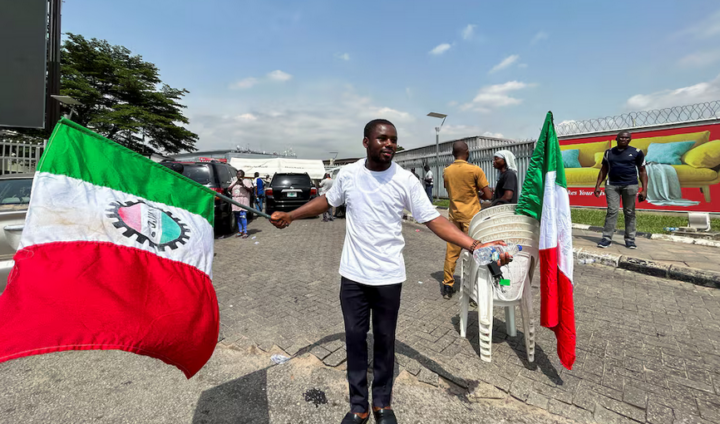
Nigeria's main labour unions on Monday shut down the national grid and disrupted flights across the country as they began an indefinite strike over the government's failure to agree a new minimum wage.
The strike began after talks broke down between the government and the country's two biggest union federations, the Nigerian Labour Congress (NLC) and the Trade Union Congress (TUC), over increasing the minimum wage. It is the fourth since President Bola Tinubu took office last year.
The Transmission Company of Nigeria (TCN) said union members drove operators away at the country's power control rooms and shut down at least six substations, eventually shutting the national grid at 02:19 am (0119 GMT).
Nigerian airline Ibom Air said it was suspending flights until further notice due to the strike, while another, United Nigeria, said airports across the country had been shut down and striking workers had permitted none of its flights to operate.
Electricity and aviation unions said in a statement on Monday they had directed members to withdraw their services in compliance with the indefinite strike.
Oil unions also threatened to halt oil production, but Nigeria's oil regulator chief Gbenga Komolafe said contingencies were in place to ensure output was not disrupted.
Since taking office Tinubu, has embarked on Nigeria's boldest reforms, which has fuelled a rise in inflation to an almost 30-year high and worsened a cost-of-living crisis in Africa's most populous nation.
He has been under pressure from unions to offer relief to households and small businesses after scrapping subsidies on petrol, which kept fuel cheap but cost the government $10 billion a year.
"We have a responsibility to strike a measured and realistic balance in this effort to arrive at a new minimum wage for Nigerians," said Information Minister Mohammed Idris, after talks with union leaders reconvened on Monday afternoon.
Unions declared the indefinite strike on Friday after talks for a new minimum wage meant to cushion the impact of reforms collapsed. They had demanded a sixteen-fold raise in the minimum wage to 494,000 naira ($333.23) a month from 30,000 naira, and vowed to continue the strike until a new minimum wage was in place.
Unions have also demanded the reversal of an electricity tariff hike effected in April for better-off consumers who use the most power, as the government tries to wean the economy off subsidies.
The TCN said it was making efforts to recover and stabilise the national grid, but unions were obstructing grid recovery nationwide.
On Thursday, Nigeria's privatisation body said the country had secured a World Bank loan of $500 million for its electricity sector.
($1 = 1,482.4800 naira)
Latest Stories
-
Ghana should join BRICS as partner, not member – NPP Bono East Regional Secretary
22 seconds -
Ghana High Commission warns nationals in South Africa over protests in Johannesburg, Durban
28 seconds -
Mahama praises Roads Minister for keeping Big Push contractors on their toes
6 minutes -
World Cup Visa Scandal: ‘My client has not collected money for visas’ – Ampofo Ankrah’s lawyer
18 minutes -
US immigration officials defend ICE agents who shot man in same car as child
27 minutes -
Commentator Katie Zacharia picked as new White House press secretary
31 minutes -
Drone strike by Sudan paramilitary kills 41 near Ethiopian border, rights group says
37 minutes -
King warns malicious online actors are evolving tactics
44 minutes -
Several injured as Saudi capital airport reportedly hit again
47 minutes -
Christa Pike discharged from hospital and returned to prison, her lawyers say
49 minutes -
Ghana’s BRICS move requires clear strategy to manage risks – Godfred Bokpin
3 hours -
Pay teachers realistic income – Duncan Amoah to gov’t
3 hours -
Bechem to become chicken capital of Ghana – Mahama projects
3 hours -
Mentapulse Africa’s Health and Labour Summit calls for better working conditions to retain skilled professionals
3 hours -
Two-week strike will not derail academic calendar – GNAT President
3 hours