

Audio By Carbonatix
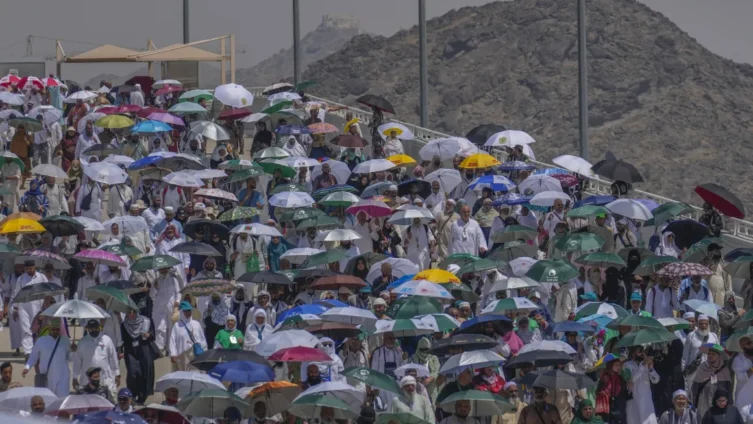
Hundreds of people have died, and thousands have been treated for heatstroke while performing the annual Muslim Hajj pilgrimage to Mecca amid extreme temperatures of up to 49 degrees Celsius (120 degrees Fahrenheit).
Some 165 Indonesians are among the dead, CNN Indonesia reported, citing the country’s Consulate General’s Hajj Management Office in Saudi Arabia. Additionally, at least 41 Jordanians, 35 Tunisians and 11 Iranians have died, according to authorities in each country.
A further 22 Jordanians are missing and 26 Iranians have been hospitalized, the Iranian Red Crescent said Wednesday, according to Iran’s semi-official Tasnim news agency.
Some of the Iranians died due to heatstroke while others had underlying conditions, the Iranian Red Crescent said.
The death toll is likely to rise, as Saudi Arabia and Egypt have yet to release official figures. Additionally, the governments are only aware of pilgrims who have registered and traveled to Mecca as part of their country’s quota – more deaths are feared among unregistered pilgrims.
The Saudi government said on Monday that more than 2,700 people had been treated for heatstroke. Meanwhile, hundreds of people have taken to social media to post about their loved ones being unaccounted for.
More than 1.8 million people are taking part in this year’s Hajj, one of the world’s largest religious gatherings, according to the Saudi General Authority for Statistics.
While deaths among pilgrims are not uncommon (there were more than 200 last year), this year’s gathering is being held amid particularly high temperatures.
Hajj season changes every year according to the Islamic calendar and this year it fell in June, one of the hottest months in the kingdom.
On Monday, Saudi Arabia advised pilgrims against performing the “stoning of the devil” ritual between certain hours after temperatures reached an extreme 49 degrees Celsius (120 degrees Fahrenheit).
Hajj officials have asked pilgrims to carry umbrellas and stay hydrated amid the harsh conditions while the Saudi army has deployed more than 1,600 personnel with medical units specifically for heatstroke and 30 rapid response teams. Another 5,000 health and first aid volunteers are taking part.
Performing Hajj is one of the five pillars of Islam, which requires every Muslim who is physically and financially able to make the journey to the holy city of Mecca at least once in his or her life.
The pilgrimage includes numerous detailed rituals including wearing a special garment that symbolizes human equality and unity before God, a circular, counter-clockwise procession around the cube-shaped Kaaba building, and the symbolic stoning of evil.
A source of prestige and revenue
The Hajj is a source of prestige for Saudi Arabia’s king, who holds the title of Custodian of the Two Holy Mosques as the guardian of Islam’s holiest sites. But the pilgrimage is also a significant source of revenue for the Saudi economy.
Soon after King Salman bin Abdulaziz took power in 2015, Saudi Arabia launched a $21 billion project to expand the Grand Mosque in Mecca to accommodate 300,000 additional worshippers. A year later, then Deputy Crown Prince Mohammed bin Salman identified the pilgrimage as a key component of a plan to diversify the Saudi economy by 2030.
Experts say that with oil sales generating close to a billion dollars a day for the kingdom, the pilgrimage’s economic benefit is marginal by comparison. But its great, untapped potential could bring significant riches to the kingdom in the long term.
Pilgrimage revenues were forecast to average about $30 billion a year and create 100,000 jobs for Saudis when the kingdom attracted around 21 million worshippers annually during the 10-day Hajj as well as the yearlong Umrah pilgrimage, according to official data cited by Reuters. The government is targeting 30 million pilgrims by 2030.
Latest Stories
-
Mövenpick Ambassador Hotel will deepen community engagement as it marks 15 years – General Manager
4 minutes -
Mad rush for GH¢15 KFC deal as massive queues hit branches nationwide
12 minutes -
Firefighters contain raging fire at Labadi Wireless
22 minutes -
Photos: Police engage religious leaders at National Police Headquarters
33 minutes -
Gov’t invests GH¢443m in Free Primary Health Care – Dr Asare Bampoe
1 hour -
ECG announces power outages in parts of Accra West and Central regions
1 hour -
Otumfuo calls for urgent action to end maternal deaths in Ghana
2 hours -
Prioritise Bawumia’s interest and vote on merit – NPP elder urges delegates
2 hours -
Jason Arday death ‘tragedy on so many levels’ says PM
3 hours -
Rotary Club donates phototherapy machine to Ussher Hospital
3 hours -
Analysis: Jason Arday’s death will send shockwaves through a divided academia
3 hours -
CJ’s vacation warrants not limited to politically sensitive cases – Victoria Bright
4 hours -
Parts of Accra to experience power interruption on Sunday for emergency GRIDCo tower restoration
4 hours -
Dafeamekpor defends Ayine’s handling of Aksa case, faults past AGs
4 hours -
Luv FM High School Debate: Afigyaman, OKESS seal Round of 16 spots in style
4 hours