

Audio By Carbonatix
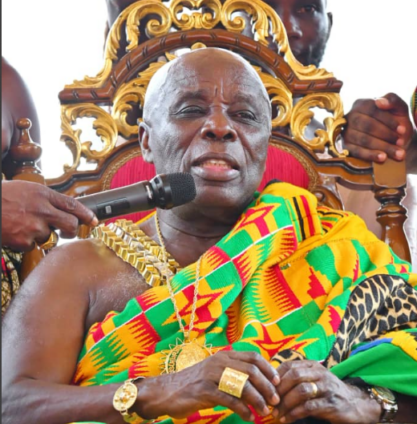
The Okyenhene Osagyefuo Amoatia Ofori Panin is tasking religious leaders to play active role in environmental stewardship in the wake of the devastating effect of climate change on global economies and human survival.
According to Osagyefuo, Ghana remains a religious nation with majority of its citizens deeply believing in either the Christian faith, Islam and/or traditional beliefs. He says, one of the cardinal principles underpinning these religions center on environmental stewardship, yet our actions often fall short of these teachings.
Delivering a public lecture organized by the Graduate Students Association at the University of Ghana, under the theme: Transformational Leadership in Contemporary Ghana, Okyenhene stressed that, transformational leaders are passionate, energetic, innovative, and have the ability to create a sense of commitment and purpose among followers.
He indicated that, religious leaders must endeavor to inspire their followers to lead by the dictate of their religion in conserving the environment.
Osagyefuo said, in Christianity, the Bible emphasizes the importance of caring for creation. He referenced the words in Genesis 2:15 which states that "The Lord God took the man and put him in the Garden of Eden to work it and take care of it." He said this verse underscores a Christian’s duty to nurture and protect the environment.
The Okyenhene further cited the Quran in Surah Al-A'raf 7:31, which also highlights the principle of moderation and the avoidance of waste, which is essential for environmental sustainability.
Additionally, the Prophet Muhammad (PBUH) emphasized the importance of planting trees and preserving nature, stating, "If a Muslim plants a tree or sows seeds, and then a bird, or a person, or an animal eats from it, it is regarded as a charitable gift (Sadaqah) for him" (Sahih Bukhari).
Touching on our traditional beliefs, he explained that the Akan people hold the earth, known as Asaase Yaa, in high regard. Asaase Yaa is considered a deity representing the fertility of the earth and the provider of life. Traditional practices and taboos, such as the prohibition of farming on certain sacred days, reflect a deep respect for the environment and a commitment to its preservation.
Osagyefuo questioned whether Ghanaians are truly living up to their religious principles when it comes to environmental stewardship. He noted that, the evidence suggests there is much room for improvement, adding that, the earth's ability to support life is being severely compromised.
"Despite the strides made by transformational leaders, several challenges persist in Ghana's leadership landscape. One significant challenge is illegal mining, or "galamsey," which has devastated the environment and posed a threat to sustainable development.
"My own efforts to combat galamsey have been vigorous, including calling for all-hands-on-deck approaches, destooling chiefs involved in illegal mining, and supporting government initiatives to end the menace.
"However, the fight against galamsey remains ongoing, and more robust measures are needed to protect our environment and communities," Okyenhene noted.
He further expressed concerns about the effectiveness of Ghana’s decentralization systems and whether or not the current local governance structures really promote development at the grassroots.
He pointed that, the Local Governance framework is intended to bring governance closer to the people, ensuring that local authorities are more responsive to the needs and aspirations of their communities.
However, the current practice often falls short of the constitutional mandates outlined in Articles 243(2)(b) and 251(1) of the 1992 Constitution.
"Article 243(2)(b) stipulates that the District Chief Executive (DCE) is responsible for the day-to-day performance of the executive and administrative functions of the District Assembly.
"Similarly, Article 251(1) establishes the Executive Committee of a District Assembly, which is charged with performing these functions. However, in practice, the DCE often assumes roles beyond these mandates, overshadowing the contributions of assembly members who are members of the executive committee to whom these functions have been given," Okyenhene noted.
Latest Stories
-
Ghana to export 300 teachers to the Bahamas under new agreement
50 minutes -
US launches fresh strikes as Iran closes Strait of Hormuz
2 hours -
Man arrested on suspicion of murder of Ann Widdecombe, police say
2 hours -
Argentina midfield great Rattin dies aged 89
3 hours -
2026 World Cup: England come from behind to beat Norway and reach semi-final
3 hours -
A Ghanaian passport must mean something
3 hours -
When Ghana rolled up its sleeves
3 hours -
IPR Ghana inspires Good Shepherd R/C JHS students to champion environmental sustainability
4 hours -
Kenpong suffers serious injuries after freak domestic accident
4 hours -
Sixteen starve to death in Uganda as drought kills crops
5 hours -
Iran supreme leader calls for revenge for father’s killing
5 hours -
Black Maidens seal U-17 Women’s World Cup qualification after shootout win over Senegal
7 hours -
Illegal sand winners will face the law – Ningo-Prampram MP warns
7 hours -
Trump administration subpoenas New York Times journalists over Air Force One reporting
7 hours -
Aseidu Nketia urges greater investment in Ghana’s youth to unlock demographic dividend
8 hours