

Audio By Carbonatix
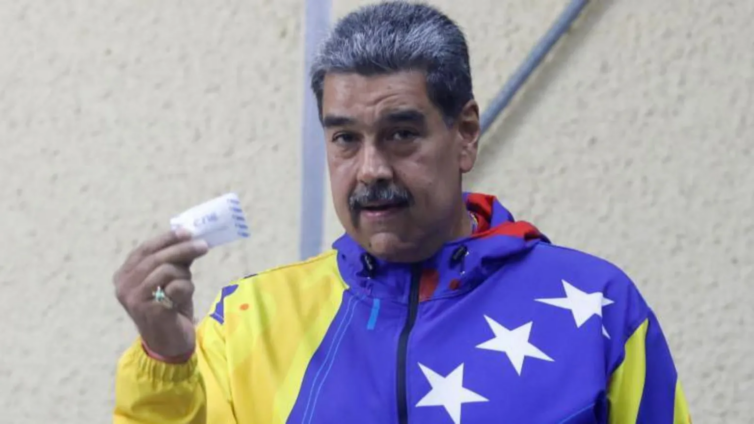
President Nicolás Maduro has won Venezuela's presidential election, according to partial results published by the electoral council.
The head of the National Electoral Council (CNE), Elvis Amoroso, who is a close ally of Mr Maduro, said that with 80% of votes counted, President Maduro had 51.2% of the vote, compared to 44.2% for his main rival.
The Venezuelan opposition has alleged widespread fraud in the counting of votes, and has vowed to challenge the result.
It had united behind opposition candidate Edmundo González in order to unseat Mr Maduro after 11 years in power.
The opposition deployed thousands of witnesses to polling stations across the country to be able to announce its own vote count.
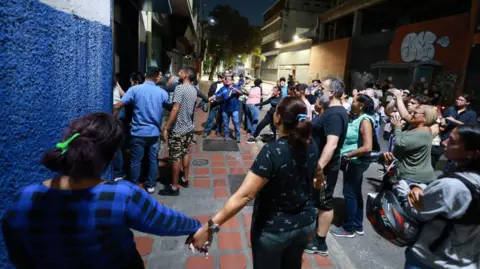
However, an opposition spokeswoman said that their witnesses had been "forced to leave" at many polling stations.
The opposition had also called on supporters to keep a vigil at voting centres to verify the counting process in the "decisive hours" after closing, amid widespread fears the government would attempt to steal the vote.
Opinion polls had given Mr González a wide lead over Mr Maduro.
Many voters said that they wanted change after 25 years in which the socialist PSUV party has been in power - first under the leadership of the late President Hugo Chávez, and after his death from cancer in 2013, under Nicolás Maduro.
Under their leadership, the PSUV has gained control not just of the executive and the legislative, but also of much of the judiciary.
The last election in 2018 was widely dismissed as neither free nor fair and there had been widespread fear in the run-up to this election that the poll could also be beset by irregularities.
Those fears were further stoked by President Maduro, who said he would win "by hook or by crook".
The opposition nevertheless struck a positive note going into the election, arguing that if their supporters turned out en masse, it would make it very hard for the government to "steal the election".

Voting in Venezuela is electronic. Voters punch in a button assigned to their preferred candidate on a voting machine.
The electronic results are sent to the CNE headquarters, but the machine also prints out a paper receipt which is then placed in a ballot box.
By law, parties are allowed to send witnesses to the count of these paper receipts carried out at each polling station, but many were prevented from doing so.
The opposition said it had been given access to less than a third of the printed receipts.
Their plan had been to monitor these tallies to see if they squared with the results announced by the CNE.
Latest Stories
-
SSNIT says La Beach clearance was to protect hotel investments, beaches to remain public
44 minutes -
APSU congratulates St Augustine’s College after back-to-back National Investment Quiz wins
48 minutes -
Renewed flood intervention at Mallam Junction raises hopes among residents, businesses
1 hour -
St Augustine’s College retain National Investment Quiz title after nail-biting grand finale
2 hours -
Education infrastructure investment will drive Banda’s development – Ahmed Ibrahim
2 hours -
Teacher unions strike: Gov’t presents fresh proposals as talks end inconclusively
2 hours -
51,000 teachers’ promotion arrears to be validated for October payment – Education Minister
3 hours -
Kwabena Boamah appointed Board Chair for Impact Investing Ghana
3 hours -
Striking teacher unions to meet Fair Wages and Salaries Commission on October 6
3 hours -
EOCO working with AG to arraign Nana Baffour Awuah before weekend court
3 hours -
Duraplast reassures customers after fire, announces October 5 reopening
4 hours -
Call off strike, gov’t will not renege on promotion arrears pledge – Haruna Iddrisu to teacher unions
4 hours -
Committee set up to validate teachers eligible for 20% deprived-area allowance – Education Minister
4 hours -
Five-member committee to search for new Black Stars coach after Sports Ministry-GFA meeting
4 hours -
Pinktober: Breast cancer survival exceeds 90% when detected early – Breast Society of Ghana
4 hours