

Audio By Carbonatix
The delivery of Iranian missiles to Russia has changed the debate about Ukraine using Western-provided long-range missiles against targets inside Russia, UK Foreign Secretary David Lammy has told the BBC on a visit to Kyiv.
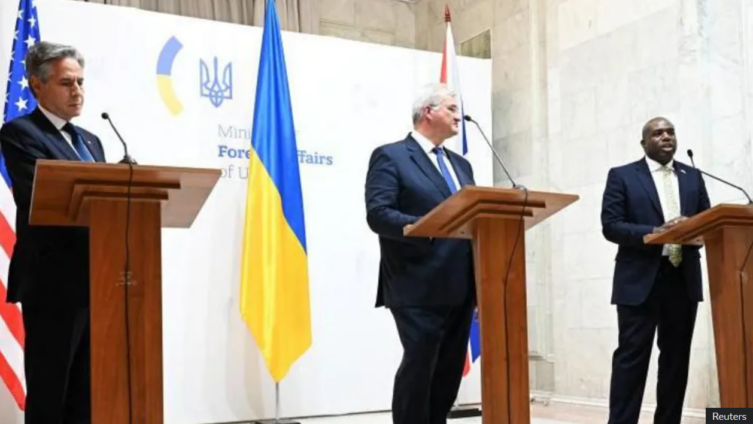
Lammy travelled to the Ukrainian capital with US Secretary of State Antony Blinken after talks in London.
They met President Volodymr Zelensky, who has repeatedly called for allies to loosen limits on the use of Western-supplied weapons.
The US and UK have not given Ukraine permission to use long-range missiles against targets inside Russia for fear of escalation.
At a news conference in Kyiv on Wednesday, Blinken said US President Joe Biden would likely discuss the use of long-range missiles with UK Prime Minister Sir Keir Starmer at the White House on Friday.
Asked about the risk of escalation, the US secretary of state added: "We've now seen this action of Russia acquiring ballistic missiles from Iran, which will further empower their aggression in Ukraine. So if anyone is taking escalatory action, it would appear to be Mr Putin and Russia."
Lammy would not be drawn into whether the US and UK would be allowing Ukraine to use long-range missiles, but said: "I am not prepared to give Putin the advantage."
Biden has said his administration is considering lifting the restrictions, but no decision has yet been made public.
On Wednesday, Zelensky said Kyiv's victory in the war against Russia "depends mostly on the support of the United States".
Ukrainian Foreign Minister Andrii Sybiha said steps towards lifting long-range missile restrictions "are important in the context of reports of a possible transfer of ballistic missiles to Russia by Iran".
"We must act boldly," he added.
In an interview with the BBC, Lammy said Iran providing Russia with ballistic missiles "clearly changes the debate" as they would allow Moscow's forces "to have further penetration into Ukraine".
"That is very dangerous," Lammy said, adding: "As we see the Russians working with their partners, we see this transfer of ballistic missiles from Iran to Russia, it is important that we do more to support Ukraine to win in their efforts."
On Wednesday, Lammy said the UK would provide £600m ($780m) in aid to Ukraine to support the country's "humanitarian, energy and stabilisation needs". Blinken announced a further $700m in assistance to Ukraine, including funding for the energy sector and demining.
The new aid came after the US, UK, France and Germany imposed further sanctions on Iran for supplying Russia with ballistic missiles for use in Ukraine. The UK government summoned Iran's top diplomat over the accusations.
Ukrainian Prime Minister Denys Shmyhal thanked Lammy for the UK’s military support for Ukraine throughout the war.
But he added: “We hope that long-range equipment for strikes on the territory of our enemy will be reached and we will have it and we hope for your help and support in this issue.”
Asked by reporters on Tuesday if the US would lift restrictions on Ukraine's use of long-range weapons, President Biden said his administration was "working that out now".
Earlier this year, the US loosened some of the restraints, allowing Ukraine to use long-range missiles to strike areas along Russia's border where troops are firing from.
Kyiv's other allies have also been supplying some long-range weapons - with restrictions on how and when they can be used inside Russia, out of concern such strikes could prompt retaliation that draws Nato countries into the war or provokes a nuclear conflict.
The Kremlin said on Wednesday that Russia would respond "appropriately" if the US were to allow Ukrainian missile strikes on its territory.
During a visit to the UK before travelling to Kyiv, Blinken accused Iran of supplying short-range ballistic missiles to Russia, saying they could be deployed against Ukrainians within weeks. Lammy described Iran's move as "a significant and dangerous escalation”.
The missiles are likely to boost Russia's arsenal, enabling it to hit Ukrainian cities close to Russia's borders or areas it already controls at the same time as it deploys its longer-range missiles deeper into Ukrainian territory.
Iran's Foreign Minister Abbas Araghchi denied his country was supplying missiles to Russia, accusing Western countries of "acting on faulty intelligence and flawed logic".
The UK has given Ukraine Storm Shadow missiles, which have a range of about 250km (155 miles). So far, they have been used only against Russian targets in occupied Ukrainian territory.
But Ukrainian leaders say they need the missiles to target air bases used by Russian warplanes to launch devastating glide bombs against Ukraine. These weapons are often launched from deep inside Russian territory.
Latest Stories
-
White House bars CNN from travelling with Trump on Air Force One
20 minutes -
Fennis wins second consecutive ITF J60 title in Accra
25 minutes -
Spain beat England in thriller after Kane penalty miss
31 minutes -
GPL 2026/27: Zaidan’s late goal ends Hearts of Oak unbeaten start
34 minutes -
CEOs demand clarity on pay harmonisation, board autonomy as FWSC engages SOEs bosses over IPEC transition
36 minutes -
2026 Women’s Super Cup: FC Savannah, Epiphany Warriors maintain top spots ahead of final group games
46 minutes -
‘Is EOCO responsible for determining lawyers’ fees?’ – Baffour Awuah
46 minutes -
David Beckles claims second J60 Accra title
1 hour -
No France cocaine suspect linked to Mahama, Vice President’s security details – NACOC
1 hour -
Anwelle Foundation launched in Jirapa to tackle poverty, youth unemployment
2 hours -
Joy Sports Editor Fentuo Tahiru Fentuo to moderate inaugural Music Meets Football Summit in Zambia
2 hours -
Court premises too volatile for Baffour Awuah’s attempted arrest by EOCO – Inusah Fuseini
2 hours -
Drug bust: Under no circumstances will NACOC leadership be compromised – Twum-Barimah
2 hours -
VIDEO: EOCO’s attempted arrest of Baffour Awuah was flawed beyond saving – Law Lecturer
2 hours -
Genuine Ghanaian exporters may face heightened foreign inspections over drug busts – Lawyer
2 hours