

Audio By Carbonatix
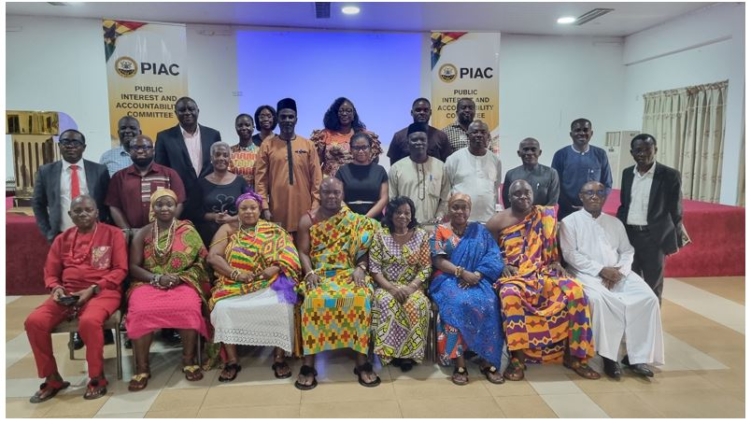
The Public Interest and Accountability Committee (PIAC) has engaged representatives from its 13- Constituent Bodies to discuss how to strengthen efforts to deepen public accountability in the management and use of the country’s petroleum revenues at its Annual General Assembly (AGA) in Accra.
PIAC, a statutory body tasked with additional public oversight responsibility to support the work of Parliament over the collection, allocation, and utilization of Ghana’s petroleum revenues, provides the platform at its yearly (AGA) for its constituent bodies to discuss best practices and reforms in the management and use of the country’s petroleum revenues.
Dominating discussions at the meeting held on Wednesday, 4th September was the need for PIAC and its 13- Constituent bodies to strengthen the transition from transparency to accountability, and how to rally citizens to support PIAC’s advocacy efforts.
Speaking at the meeting, the Chairperson of PIAC, Emerita Professor Elizabeth Ardayfio-Schandorf, said the Committee recognizes the need to collaborate with its Constituent bodies to be able to effectively disseminate its work to citizens, so they are informed to demand accountability in the use of petroleum revenues.
PIAC, she noted, remained committed to upholding the tenets of transparency and accountability to ensure that revenues are utilized efficiently for the benefit of all citizens.
The Annual General Assembly
PIAC’s AGA assembles representatives from all the 13 constituent bodies. It provides a platform for the Committee to inform constituents about the work of PIAC, explore collaborative options, and solicit feedback on ways of improving PIAC’s work.
PIAC and its Constituent bodies
The membership of PIAC is drawn from 13 constituent bodies, generally representing the Ghanaian society. This comprises professional institutions, pressure groups, religious bodies, and traditional groups. The institutions are Independent Policy Research Think Tanks, Civil-Society Organisations and Community-based Organisations, the Trade Union Congress, the National House of Chiefs, the Association of Queen Mothers, the Association of Ghana Industries, and the Chamber of Commerce and Industry. The rest are Ghana Journalists Association, Ghana Bar Association, Institute of Chartered Accountants, Ghana, Ghana Extractive Industries Transparency Initiative, Christian Groups, Muslim Groups, and Ghana Academy of Arts and Sciences.
The Petroleum Revenue Management Act (PRMA), 2011 defines the tenure of each constituent body, each of which nominates a member for a period that is either a fixed three (3)-year tenure, or a two (2)-year tenure renewable for another term only.
Highlights of the 2023 PIAC Annual Report
The PIAC Chair presented the highlights of the 2023 PIAC Annual Report. She touched on crude oil and gas production, accrued petroleum receipts, allocations, and distributions from the Petroleum Holding Fund (PHF).
She noted that crude oil production saw a decrease of 6.78 percent in 2023, the fourth consecutive year of reduction in annual production volumes since 2010, attributable to a lack of investment in discovering new fields and the natural aging of existing fields.
She also presented findings and recommendations by the Committee in the Report.
Feedback from Constituents
As part of the meeting, the opportunity was given to representatives of the various constituent bodies to give feedback to PIAC and to explore ways in which there can be stronger collaboration to fulfill the mandate of the Committee.
Among others, the representatives highlighted the need for PIAC to keenly monitor the ongoing review of the PRMA to ensure that it is further strengthened with an enforcement mandate to be able to implement its recommendations.
The need for more public education to carry citizens along in the work of PIAC was also raised. This could be done through an improved dissemination of PIAC Reports and its activities, and more improved collaboration with the media.
Ultimately, the Constituent Bodies want to see a PIAC more strategized to operationalize the spirit and letter of the PRMA to ensure there is increased transparency and also get duty bearers to be more accountable.
Latest Stories
-
Okraku credits Black Princesses technical team for Korea Win
21 seconds -
U20 Women’s World Cup: Bjorkgren hails Black Princesses’ win over Korea
11 minutes -
ODRO’S Foundation supports persons living with disabilities in Cape Coast
24 minutes -
Saalim Bamba suspends NPP Nasara campaign after convoy accident
35 minutes -
CDD-Ghana pushes for independent authority to regulate political financing
43 minutes -
Ghana music industry needs collective public-private investment – UK High Commissioner
1 hour -
“We don’t have the mindset of sabotage” – NPP on MMDCE election proposal
1 hour -
From Kumasi to the world: Mirakilouz Beatz’s rise in music production
1 hour -
Low pay making it harder for universities to attract PhD holders – UTAG-UG
1 hour -
Richard Nii Armah Quaye, Ga Mantse to launch scholarship scheme for Ga-Dangbe students
2 hours -
Julius Emunah parts ways with Hearts of Oak as Managing Director
2 hours -
Weija Dam flooding will persist without political will to relocate residents – NADMO
2 hours -
UMB, 3TREES launch paint outlets across constituencies ahead of Ghana’s 70th anniversary
2 hours -
CSSPS: Education Ministry orders action against alleged payment demands in Ashanti Region
2 hours -
SSNIT honours 16 stakeholders at 2025 Awards
2 hours