

Audio By Carbonatix
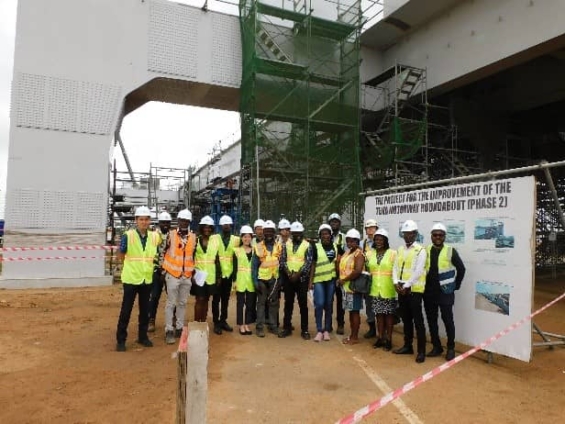
A delegation from the Japanese Embassy in Accra and the Japan International Cooperation Agency (JICA) together with journalists from some media organisations in Ghana toured the Tema Interchange (Phase II) and two start-ups helping address critical challenges in the health and transportation sector: Sora Technology and Transonica Company Limited respectively.
At the Tema Motorway Roundabout, the delegation visited “The Project for the Improvement of the Tema Motorway Roundabout Phase II”, which commenced in 2022, following the signing of a JPY 3.65 billion equivalent to 33-million-dollar grant. It is funded by the Government of Japan.
The project will address traffic congestion at the five-legged Tema intersection where traffic from Accra and Tema Port converges during peak hours. It will alleviate traffic congestion and reduce travel time four times the current situation
“In June 2020, the first phase of the project was completed. It covered the construction of an underground tunnel and a midlevel interchange,” Assistant Resident Supervisor on the project, Yaw Tenkorang Osei, explained.

He mentioned that the Phase II of the project includes the construction of a third-tier flyover, which will be a composite bridge structure from the Harbour Road (south side) to Ashaiman (north side) on the N2 stretch of the interchange. According to him, the Phase II will be completed by December, but a part of the interchange will open to traffic in November.
He expressed his gratitude to the Japanese Government for the project and the opportunity that was provided for him and many other Ghanaian engineers and construction professionals to learn and apply latest Japanese technologies such as the use of high quality steel with low maintenance cost and long lifespan.
The delegation visited Sora Technology, a company that employs drones and Artificial Intelligence, AI, in Larval Source Management (LSM). This method eliminates mosquito larvae in water bodies before they mature into adults. Traditional LSM methods involved indiscriminate spraying of insecticides in water bodies through manual labor.
However, SORA Technology has developed a cost-effective and environmentally friendly approach that reduces the need for manpower and insecticide through the use drones and AI.
Sora uses drones to survey targeted areas and identify water bodies where mosquito larvae breed. Its AI algorithms will analyze the data to pinpoint high-risk breeding sites. Insecticides are sprayed only in these high-risk areas, effectively suppressing mosquito populations, reducing the risk of malaria transmission among local populations and saving cost and man hours.
Head of Africa Business at Sora Technology, Mary Yeboah Asantewaa said: “We are able to combine sensors, the environmental viables with the images to tell you that waterbody A has larvae, waterbody B doesn’t have. We call it reclassification. After we classify the waterbody, we transfer it onto our mobile app or database to navigate the sprayer to the high-risk zone.”
Journalists also visited Transonica Company Limited, a business which won second place in the JICA Next Innovation with Japan (NINJA) competition in 2021. Mr. Daniel Kwantwi, CEO of Transonica, was inspired by the use of the cashless system to pay for transport fares in Japan when he was studying at the University of Tokyo.
He was a beneficiary of JICA’s African Business Education Initiative for Youth (ABE) scholarship. Currently, Transonica has introduced a card payment system for bus fare and shopping at the University of Ghana, Legon campus.
Mr. Kwantwi revealed that about 13,000 users are already registered on the company’s platform. He mentioned that there were plans to replicate the platform on other campuses and outlets across Ghana. “We want to reduce the inefficiencies. What we do is that we install our machines inside your buses, and you are able to use that to collect your money. We want to make sure making transactions would not be a hustle. We want to make sure that every Ghanaian, irrespective of class, is able to go cashless,” he explained.
A Senior Representative at JICA, Oda Ryotaro, reiterated the commitment of Japan to fostering sustainable development and technological advancement in the country.
“As JICA continues to invest in these key areas and many others, the collaborative efforts promise to drive sustainable growth and prosperity for the country, building on a legacy of partnership that spans more than six decades in line with Ghana’s overall developmental agenda,” he concluded.
Latest Stories
-
‘It’s not a matter of evidence; it was a metaphor’ – Afenyo-Markin defends ‘drug lab’ comment
5 minutes -
Borrowing costs cut by more than half – Finance Minister
8 minutes -
KNUST students urged to look beyond Ghana for AI and robotics opportunities
11 minutes -
Odeibea Foundation extends energy equity initiative with solar streetlights in Akpato and Worwonyo
12 minutes -
Customs increases surveillance at ports, warns importers against concealing restricted items
14 minutes -
WERise urges women entrepreneurs to scale businesses, increase revenue and create jobs
15 minutes -
POWA calls for end to gendered attacks on Lordina Mahama, Samira Bawumia
20 minutes -
Zigx Foundation supports 50 vulnerable mothers in Akwapim North
20 minutes -
Nhyiramma Foundation calls for greater support for widows and single mothers
22 minutes -
Ghana must stop turning rivers into gutters through encroachment – Kwadwo Poku
24 minutes -
‘We’ll never compromise on quality’ – Agbodza tells Accra-Kumasi bypass supervisors
30 minutes -
Roads Minister urges motorists to drive cautiously on Accra-Kumasi Highway
30 minutes -
Hohoe MCE appeals for more relief supplies as flooding displaces residents
31 minutes -
‘Free Salomey now!’ – Women march to EOCO over Salomey Awitey Baffoe’s continued detention
33 minutes -
GES appeals to teachers to rescind strike and return to class as efforts to resolve concerns intensify
33 minutes