

Audio By Carbonatix
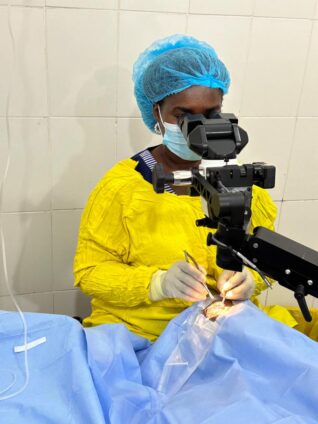
“When a child’s vision is compromised, so is their future.” These are the words of Maame Gyasiwaa Boa-Antwi, an ophthalmologist at Komfo Anokye Teaching Hospital (KATH) Eye Centre, speaking on World Sight Day about the issue of child eye health.
In a world where children are expected to thrive academically and socially, compromised vision becomes a barrier that affects aspects of their development.
Her call to action marks the importance of addressing eye health as early as possible.
"Children who struggle with vision problems often fall behind in school because they can't see the board or read their textbooks. It’s also about the physical impairment and the ripple effect on their cognitive development and self-esteem."
She mentioned that while parents and teachers may dismiss these issues as learning difficulties or behavioural problems, the root cause is often a simple, untreated vision problem.
The hidden impact of poor vision on children
In Ghana, like many parts of the world, eye health in children remains an overlooked area of healthcare.
Statistics show that one in four children in school could have vision problems, yet the majority of these issues go undiagnosed.
For Maame Gyasiwaa, this is both a medical and societal issue.
"If we want a generation of leaders who are academically excellent and socially adjusted, then child eye health cannot be ignored," she stated.
She recounted a recent case involving a young boy whose performance in school had dropped. "His teachers thought he was lazy and his parents were at a loss. After a simple eye exam revealed severe nearsightedness, corrective lenses were prescribed for him. it was like seeing a different child, He went from being withdrawn and quiet to participating actively in class."
The role of routine screening
A part of the challenge is access.
Maame Gyasiwaa explained that routine eye screening for children is not widespread, especially in rural and underserved communities where healthcare facilities are limited.
"We need to make routine eye screenings a priority in our healthcare policies. By the time many of these children are diagnosed, they may have already suffered years of unnecessary difficulties."
Programs targeted at early intervention, such as school-based screenings are important.
She called for a collaborative approach involving healthcare providers, educators, and policymakers to ensure these screenings are integrated into the school health system.
“We can’t rely on parents to spot these issues because, oftentimes, they might not recognize the symptoms themselves,” she said.
Eye health as a public health concern
Maame Gyasiwaa also mentioned the broader public health implications of child eye health.
In Ghana, refractive error conditions like nearsightedness, farsightedness, and astigmatism are common but remain largely untreated.
The consequences extend beyond academics.
Children with untreated eye conditions are more likely to face social exclusion and developmental delays.
She pointed out that by failing to prioritise child eye health, society incurs greater costs in the long run. "It’s a cycle that puts children in a disadvantageous position. A child who cannot learn effectively becomes an adult who may struggle to find gainful employment or fully participate in society," she cautioned.
Maame Gyasiwaa believes addressing this issue is a form of preventive care that could reduce future healthcare costs and improve the overall well-being of the population.
Raising awareness, the role of parents and communities
Parents play a role, but they often lack the knowledge to identify early warning signs.
She urged parents to be vigilant and take action if their child complains of headaches, frequently squints, or has difficulty focusing on distant objects.
"These signs might seem trivial, but they could indicate a serious problem," she said.
She also encouraged communities to actively participate in health outreach programs and support initiatives that educate families about the importance of child eye health.
Moving forward, collaborative efforts needed
Maame Gyaiswaa is optimistic despite the challenges.
She believes that with collective effort, Ghana can make improvements in child eye health.
"The work cannot be left to ophthalmologists alone, We need teachers to be our eyes in the classroom and policymakers to implement comprehensive school health programs that include vision screening."
Latest Stories
-
GNFS contains fire outbreak at Teshie Lekma Road near Lekma Hospital
6 hours -
Samia Nkrumah rejects the narrative that Ghanaians were happy after Nkrumah’s overthrow
7 hours -
A Mother’s pain: Tribute by Ivan Baidoo’s mother
7 hours -
‘Forgive us for staying away’ — Samia Nkrumah leads family back to Nkroful, pledges to preserve Nkrumah’s legacy
7 hours -
Ernest Nuamah scores twice as Lyon beat Rennes
7 hours -
‘My dear Ivan’ – A father’s tribute to a son tragically killed
7 hours -
GNPC Explorco advances Voltaian Basin drilling preparations with 13.5km access road
8 hours -
Cabinet approves facility manager for Borteyman Sports Complex – Kofi Adams
8 hours -
Sanitation is improving; critics may be ‘living in another world’ – Salaga South MP replies Bekwai MP
9 hours -
Government must do more to tackle sanitation crisis – Bekwai MP
9 hours -
World Cleanup Day: GFF begins sanitation education in local communities
9 hours -
EU Ambassador, IGP discuss stronger cooperation on policing and security
9 hours -
Africa Nations Volleyball Championship: Ghana set up quarterfinal clash with Cameroon after beating Chad
9 hours -
Meet Dr Benjamin Appiah Osei — Ghana’s three-time tourism awards winner
10 hours -
UEFA & CONCACAF demand Fifa pays $10m to all 211 members
10 hours