

Audio By Carbonatix
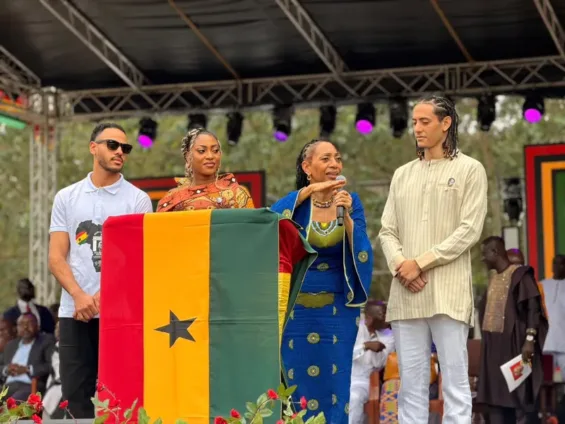
Samia Yaba Nkrumah has rejected narratives suggesting that Ghanaians universally welcomed the overthrow of her father, Ghana’s first President, Osagyefo Dr Kwame Nkrumah, in 1966.
Speaking at the 2026 NkrumahFest at Nkroful in the Ellembelle District of the Western Region, Samia described such accounts as part of what she considers negative narratives about Nkrumah’s legacy.
She recalled the destruction of Nkrumah’s statue following the overthrow of his government, including the severing of the head of the statue that stood at what is now the Kwame Nkrumah Memorial Park and Museum in Accra.
According to her, the destruction of the monument and celebrations surrounding the overthrow should not be interpreted as representing the feelings of all Ghanaians.
“That negative propaganda that Osagyefo when he left, Ghanaians were happy is not true,” she said.
Samia expressed appreciation to individuals and organisations working to document what she considers a more accurate account of Nkrumah’s life and political legacy.
She also pointed to the unveiling of a new statue of Nkrumah at a roundabout in Sunyani as an indication, in her view, of renewed interest in the former President’s ideas.
Samia said the unveiling was particularly significant to her because of the contrast between the new monument and the earlier destruction of Nkrumah’s statue.
“When we unveiled the statue at the roundabout, I realised that yes, we are going to rise. Nzimaland will rise, Africa will rise, Ghana will rise, and Africans everywhere are going to rise,” she said.
She stressed that the importance of such monuments was not in the statues themselves but in the ideas they are intended to represent.
According to her, the symbols should serve as reminders of ideas that can inspire confidence, strength and freedom.
Samia also pushed back against descriptions of Nkrumah as an isolationist or a rigid leader whose ideas were disconnected from the wider world.
She argued that his commitment to Ghanaian nationalism and Pan-Africanism did not prevent him from developing relationships with people from different countries and continents.
“They say he was an isolationist. They say he was dogmatic, rigid in his ideas. Let me tell you, this is not true,” she said.
She argued that Nkrumah’s international relationships demonstrated that his Ghanaian nationalism existed alongside a broader Pan-African outlook.
Samia said the Nkrumah family’s renewed involvement in NkrumahFest was partly aimed at ensuring that younger generations have the opportunity to examine his ideas and legacy beyond what she described as negative historical narratives.
She said the family wanted to help reconnect young Ghanaians and Africans with Nkrumah’s philosophy and his vision for the continent.
Latest Stories
-
Ghana housing finance conference adopts communiqué to improve affordable housing access
3 hours -
Special Initiatives Minister urges Wa Technical Institute to enrol more girls as EU-backed solar training lab opens
3 hours -
In the matter of my first year at the Bar
4 hours -
ActionAid Ghana calls for an end to child marriage, greater investment in girls’ rights
4 hours -
Newsfile to tackle World Cup visa scandal, beach demolitions, education strikes, BRICS bid
4 hours -
UK-Ghana Trade & Investment Summit: Trade Resource Centre to help businesses maximise UK-Ghana trade opportunities
4 hours -
Embassy of Denmark celebrates World Maritime Day
4 hours -
Linking LEAP to productive inclusion could cut extreme poverty by 2030 – UNICEF
6 hours -
Trade Ministry backs use of creative arts to rehabilitate prison inmates
6 hours -
Negotiations with government to continue despite strike suspension – GNAT
6 hours -
‘Ghana cannot afford to waste public resources; every cedi has a job’ – Ato Forson
6 hours -
Ghana expects economic boost as World Assemblies of God Congress brings 10,000 delegates to Accra
6 hours -
Joy in Nayilifong as Farouk Aliu Mahama donates 100kVA transformer to improve power supply
6 hours -
Chief Justice urges employers to tackle mental health stigma in workplaces
7 hours -
Analysis: Ghana’s yellow fever numbers reveal a gap between vaccination and protection
7 hours