

Audio By Carbonatix
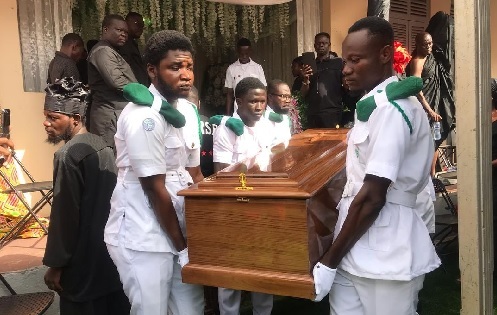
The legendary Teddy Osei, renowned for his role in the Afro-pop band Osibisa, was laid to rest following a body viewing and final funeral rites held at his family residence in Chiriapatre, Kumasi, on Saturday, April 5, 2025.
A burial mass was held at the St. Peter's Cathedral Basilica, near Fante Newtown in Kumasi, after the body viewing, where family members, friends, and loved ones gathered to mourn and celebrate his life.
Born Francis Kwabena Osei on December 17, 1935, and better known as Teddy Osei, he was a Ghanaian musician celebrated for his talents as a saxophonist, drummer, and vocalist. Osei was the founder and leader of Osibisa, the iconic Afro-pop band formed in 1969.
Osibisa’s legacy includes timeless hits such as Woyaya (1971), with the famous lyrics "We are going... Heaven knows where we're going... We know we will," as well as Sunshine Day and Dance The Body Music.
Teddy Osei leaves behind three daughters—Matilda, Agnes, and Shanta—as well as several grandchildren and great-grandchildren.
Widow
In a heartfelt tribute, Benedicta Adu-Poku honored her late husband, Kwabena Teddy Osei, saying, "Today, I pay a glorious tribute to my dear husband, Kwabena Teddy Osei.
As the Book of Romans clearly expresses, our love endures even though you are no longer with me. Your song—We are going, heaven knows where we are going—continues to echo in my heart."

She also shared that, despite Teddy’s busy schedule and constant travel due to his music career, it never affected the strength and unity of their family.
"If not on tour, he always made time for me and those were very precious times together. I will carry your love with me always, until we meet again"., she soberly said.
Biography
Osei was born in Kumasi, the Ashanti Regional capital. At birth, he was christened "Francis" by his parents - Micheal Kyekyere and Josephine Kyekyere - who were Roman Catholics.
He was the second of seven children. Osei was named after the Ashanti King Osei Tutu I. Osei's father was an amateur musician who played the horn in the local church band, thus exposing Teddy to music at an early age.
He was introduced to traditional music instruments by his school teacher , and played the bass drum in the school band. He also frequently visited the Ashanti Palace, where he occasionally learned folk songs from visiting musicians.
Music career
Following his graduation, Osei worked as an office help for a year, before moving to Sekondi to study craftsmanship at a college. Sekondi was an important commercial and cultural hub, where he encountered a number of modern musicians and genres.
During this time, he was by Ghana's First President Osagyefo Dr Kwame Nkrumah, and supported his political party and its campaign against British colonialism.

After completing his degree, he returned to Kumasi and worked as a building inspector for a brief while, before choosing to become a professional musician.
Teddy created a semi-professional band along with his brother, Mac Tontoh of blessed memory, and some friends.The band was known as "Comets", and became successful in Ghana, recording with Philip West Africa and playing for a radio show.
Their music was inspired by "Highlife," a genre derived from a fusion of European and African influences. Comets, enjoyed brief popularity before Osei travelled to London in 1962.
He received a grant from the Ghanaian government to study at a private music and drama school for three years , before being forced to leave by a regime change in Ghana.
In 1969, he founded Osibisa along with several other musicians. The band remained popular through the 1980s and 90s, and continues to perform till date.
Stardom
In 1969, Teddy Osei, Sol Amarfio, and Mac Tontoh came together with other musicians, that they had been previously acquainted with to form Osibisa.
The new band derived its name from "Osibisaaba", the name given to the style of music that was a fusion of "palm wine" music and traditional Fante fisherman's traditional music.

In its early stages , Osibisa had neither an agent nor a manager. The band played at psychedelic venues around London while it tried to find financial support.
During the period, Osei played flute, African drums, as well as, saxophone.
The band became an instant success, producing several songs that reached the British top-ten. They were even more popular when playing live.
During the late 1970s they played on several international tours to India, Japan, Australia, New Zealand and several African countries.
In 1980, the band played at a concert celebrating the Independence of Zimbabwe.
Latest Stories
-
Power restoration fault suspected in Kumasi Central Market fire
3 hours -
The 7-foot giant of Ngleshie Amanfro: Seven-foot Ghanaian Ephraim Saawa dreams of joining the national basketball team
3 hours -
Government promises support for Kumasi Central Market fire victims
4 hours -
Vibes The Movie: Big Ghun’s Ghanaian film earns five nominations at 2026 REFFA
4 hours -
MamaCare CEO warns unresolved conflicts among health workers could undermine maternal and neonatal care
4 hours -
Health professionals urged to translate medical knowledge into practice to save mothers
5 hours -
Conflicts among care providers linked to maternal, neonatal deaths – Expert
6 hours -
GIS marks 10th TIME conference, champions improved teaching practices
6 hours -
BRICS Or Balance? What Ghana’s bid really means
7 hours -
GPRTU wants full TRAFFITECH-GH implementation to start in 2027
7 hours -
Mahama announces plans to import electric wheelchairs for PWDs
7 hours -
KGL U17 Colts 2026: Western beat Prempeh Elite Academy to set up final final with Greater Accra Region
7 hours -
Late Solanke strike salvages 10-man Spurs draw at Man United
8 hours -
Gender Ministry to monitor welfare of Nana Akua Addo’s children amid domestic violence case
8 hours -
Benedict Okyere Yeboah: Ghana’s football problem goes beyond sacking a coach
8 hours