

Audio By Carbonatix
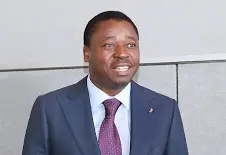
Togolese President Faure Gnassingbé has been sworn in as the first-ever Chairman of the Council of Ministers, assuming the highest executive position in the country following a contentious transition from a presidential to a parliamentary system.
This development marks a significant political transformation in the small West African nation, where Gnassingbé’s family has held power for nearly six decades.
The constitutional reform, passed amid strong opposition and public outcry, has redefined Togo’s governance structure, with executive authority now vested in the Chair of the Council of Ministers, while the presidency becomes a largely ceremonial role.
In a parallel move, the Togolese National Assembly has elected Jean-Lucien Kwassi Lanyo Savi de Tové, a former Minister of Trade (2007–2009) and seasoned opposition figure, as President of the Republic.
Under the new constitution, his role is largely symbolic, stripped of executive powers.
The revised constitution, adopted by the National Assembly in April 2024 and officially promulgated the following month, stipulates that the Chairman of the Council of Ministers must come from the majority party in Parliament.
That position currently belongs to Gnassingbé’s Union for the Republic (UNIR) party, which secured 108 out of 113 seats in legislative elections last year, elections widely condemned by the opposition as a “masquerade”.
Critics argue that the constitutional overhaul is a calculated manoeuvre by Gnassingbé to extend his grip on power indefinitely, especially as his final presidential term under the old constitution approaches its end in 2025.
“Fully aware that his current mandate is his last under the previous system, Faure Gnassingbé, with the support of a National Assembly whose mandate has already expired, engineered this reform to retain power indefinitely,” said Professor Aimé Gogué, leader of the opposition Alliance for Democracy and Integral Development (ADDI). “Under this new parliamentary arrangement, he can rule for decades, unchecked.”
The reform has drawn strong condemnation from opposition parties and civil society organisations, locally and internationally, who view the process as undemocratic and designed to consolidate authoritarian rule.
Gnassingbé, who turns 59 on 6th June, first assumed the presidency in 2005 following the death of his father, Gnassingbé Eyadéma, who had ruled Togo with an iron fist for 38 years.
As the political dynamics shift under the new parliamentary framework, questions remain about democratic accountability, institutional legitimacy, and the future of opposition politics in Togo.
Latest Stories
-
Inflation rises to 5.0% in August 2026
7 minutes -
US pounds Iran, Tehran strikes back at bases in biggest exchange since July
8 minutes -
Ghana Water to receive extra revenue if non-revenue water falls below 40% – PURC
12 minutes -
Air pollution sickens traders at Tema Station in Korle Klottey
13 minutes -
Ghana Water uncovers 685 illegal connections in Greater Accra, recovers GH¢6.5m
15 minutes -
Gianni Infantino commends football development drive in Ghana after meeting with Simeon-Okraku
15 minutes -
Ghana secures major South Deepwater Tano deal as government seeks more oil investment
15 minutes -
Government to push major reforms to make Ghana’s upstream oil sector more competitive
17 minutes -
Energy Minister wants oil investments to create more Ghanaian jobs, businesses
18 minutes -
Ghana Water produces 219 million gallons daily against a 350 million-gallon demand – GWL CEO
19 minutes -
Consumers partly bear cost of Ghana Water’s water losses through tariffs – PURC
19 minutes -
Shamima Muslim will not contest Wa Central NDC primary – Husband clears the air
25 minutes -
Accra Mayor inspects Aayalolo cluster, private basic school and announces additional works
28 minutes -
Ghana Water’s non-revenue water remains above PURC target despite improvement
30 minutes -
Ghana Water must adopt advanced metering technology to track consumption – PURC
34 minutes