

Audio By Carbonatix
The recommendations emanating from the National Economic Dialogue are beginning to yield positive results for the Ghanaian economy, providing the path for the country’s economic growth.
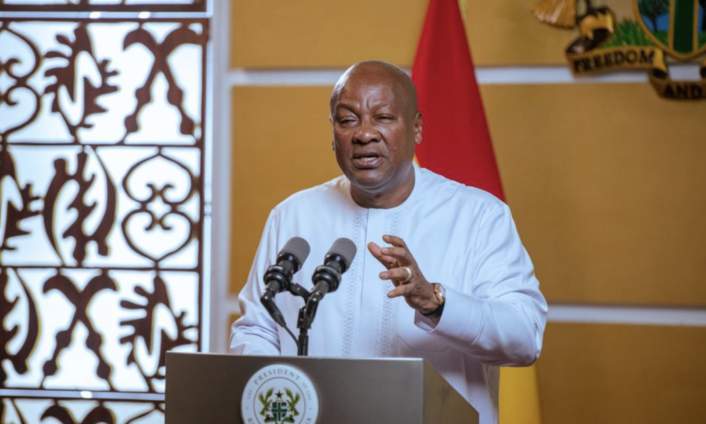
Addressing the nation in a televised speech on Wednesday to mark the Government’s first 120 days in office, President John Dramani Mahama highlighted the crucial step provided through the dialogue in understanding the state of the economy and building consensus on the path forward.
Convened on March 3 – 4 at the Accra International Conference Centre, the dialogue brought together a wide array of stakeholders; private sector, civil society organisations, traditional authorities, and academia to deliberate on revamping the economy.
They gave a comprehensive report and clear recommendations, which aims at restoring macroeconomic stability and boosting confidence in the local economy.
“The implementation of these recommendations is already underway and is showing promising signs,” President Mahama said.
“The currency is becoming fairly stable, inflation is inching downwards, and we have reduced the excessive borrowing that had become a trademark of past governments.”
President Mahama pointed to the amendment of the Public Financial Management Act 2016 (Act 921) to introduce a debt rule aimed at reducing the debt-to-GDP ratio to 45 per cent by 2024.
It is also to establish an operational rule for an annual primary surplus of at least 1.5 per cent of GDP.
The amendment, he emphasised, allowed for the creation of an independent fiscal council to monitor adherence to those rules, which was executed ahead of the September deadline under the IMF-supported programme.
President Mahama underscored the significance of the sanctions now associated with breaches of fiscal rules, extending responsibility beyond the Minister of Finance to all heads of government entities contributing to fiscal slippages.
The National Economic Dialogue also provided valuable advice on promoting industrialised agriculture and aligning skills development with national priorities, areas the President affirmed his government was taking seriously.
He highlighted the successful repeal of the e-levy, the levy on betting winnings, and the emissions levy, as promised within the first 90 days.
He expressed confidence that the continued implementation of the recommendations would lead to a more stable, prosperous, and resilient Ghanaian economy.
The President noted that the stalled efforts to abolish other tax measures like the COVID levy was due to the existing International Monetary Fund programme.
Thus, the COVID-19 levy would be included in the overall VAT rationalisation exercise scheduled for September, he said.
Latest Stories
-
GSE showed strong performance in August 2026 despite recording more stock losses
2 hours -
If CJ needs ethics law to know SOE comments were wrong, he may not be worthy of office – Arthur Kennedy
3 hours -
Stop touring state agencies and focus on the Judiciary’s problems – Arthur Kennedy to CJ
3 hours -
Apologise and don’t do it again – Arthur Kennedy to Chief Justice over SOE comments
3 hours -
Chief Justice remains committed to judicial independence, justice and equality – Judicial Service
4 hours -
Ghana concludes evacuation of citizens from South Africa; total returnees reach 1,900 – Ablakwa
4 hours -
Africa must define its own green transition path – Prof Fatima Denton
4 hours -
WASSCE 2026: English Language performance falls to 62.4% – WAEC
5 hours -
WASSCE 2026: Social Studies records sharp rebound as Maths, Science also improve
5 hours -
2026 WASSCE entry rises by 11% as 512,862 candidates sit exams
5 hours -
WASSCE 2026: English Language performance falls to 62.4% – WAEC
5 hours -
WAEC cancels 2026 WASSCE results of 8,295 candidates over examination irregularities
6 hours -
WAEC releases provisional 2026 WASSCE results for 512,862 candidates
6 hours -
CJ’s remarks on SOEs were made in good faith, not to undermine judicial independence – Judicial Service
9 hours -
Bright Future Alliance pays courtesy call on Akufo-Addo, invites him to African Leaders of Influence Lectureship Series
9 hours