


Audio By Carbonatix
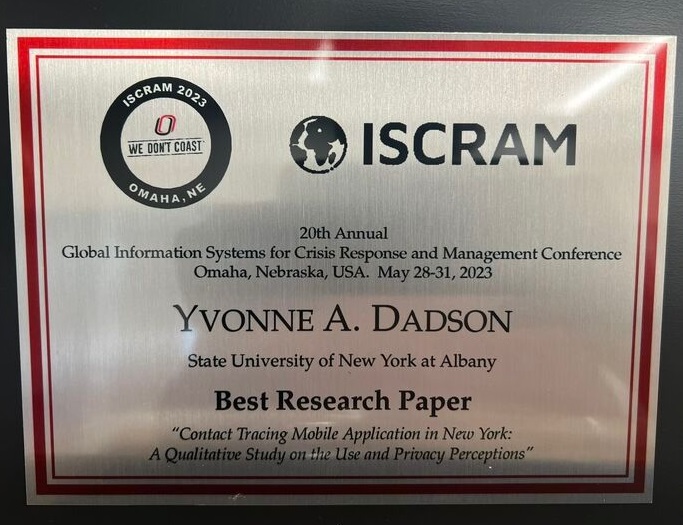
Once again, the international stage has become the proving ground for the exceptional talents of Ghanaian youth, as Yvonne Appiah Dadson, a Ghanaian scholar, recently received the prestigious “Best Paper Award” at the 20th Annual Global Conference on Information Systems for Crisis Response and Management (ISCRAM 2023) in Omaha, Nebraska, USA.
Currently pursuing her doctorate in Information Science at the University at Albany, State University of New York, Dadson’s award-winning research, “Contact Tracing Mobile Applications in New York: A Qualitative Study on the Use and Privacy Perceptions”, was hailed by global experts for its depth and originality.
Her study explored how a diverse range of New Yorkers engaged with COVID-19 contact tracing apps, analysing public attitudes, privacy worries, and the broader social impact of pandemic technologies.
She paid special attention to the influence of race, age, and trust—factors that shape technology adoption and effectiveness in public health interventions.
The research, which involved collaboration across disciplinary lines, offers vital insights that are not just relevant to countries like the United States but are critically needed in Ghana as well.
Its lessons on trust, inclusivity, and the cultural context of health technologies are particularly significant for Ghana’s own efforts to deploy digital solutions for crisis management.
But Dadson’s achievement also raises a larger, more uncomfortable question: why do our brightest minds so often flourish abroad, while struggling to find the same recognition and support at home?\
ISCRAM is not just another conference on the academic calendar—it is a premier, highly selective forum that draws the brightest minds from leading international institutions, governments, and NGOs, converging to share groundbreaking advances in emergency management and information systems.
Since its creation, ISCRAM has evolved into a global nexus where research rigour meets real-world impact, underpinning society’s ability to respond effectively to disasters and crises in all their forms.
Imagine the transformative impact had Ghana’s own Dadson been able to conduct her award-winning research on the use and privacy perceptions of contact tracing mobile applications within Ghana during the COVID-19 crisis from 2020 to 2023.
Drawing on her expertise, Dadson’s research could have provided Ghana with valuable, context-specific insights into the diverse factors influencing the adoption of digital health tools across the country’s urban and rural communities.
Ghana’s experience with COVID-19 saw significant infection rates, especially in major urban centres like Accra and Kumasi, prompting swift government interventions including lockdowns, border closures, mandatory mask mandates, and the introduction of technology-based measures such as the GH COVID-19 Tracker App. However, Ghana’s digital contact tracing efforts also faced challenges: varying smartphone penetration, public apprehension about digital surveillance, privacy concerns, and misinformation.
Her work has sparked conversations on the need for culturally nuanced, privacy-sensitive technology adoption—an especially pressing issue as Ghana and other African countries continue to strengthen digital public health infrastructure.
Had Dadson’s qualitative, demographic-informed research taken place in Ghana, it could have shed light on the real-life barriers and motivators influencing Ghanaians’ attitudes towards digital contact tracing, particularly regarding age, ethnic background, and levels of trust in government-led programmes.
Such evidence would have been invaluable for designing effective communication strategies, privacy safeguards, and legislative frameworks tailored to Ghana’s socio-cultural landscape, thereby improving app uptake and overall pandemic response efficacy.
We are never going to complain enough about how we keep losing our scholars to the West. But let’s return to Dadson for a moment.
The impact of this work ripples far beyond New York. For one, it offers a roadmap for future public health crises: if adoption is critical to the efficacy of digital contact tracing, the path forward must be both culturally aware and demographically tailored.
If Dadson’s pioneering research had been rooted in Ghana, the nation would have stood to gain stronger public trust in digital health, higher app adoption rates, and a more informed, resilient approach to managing health crises—reinforcing Ghana’s leadership in digital health innovation within Africa.
Latest Stories
-
Who’s Emelia Affi Agbenyo, the 43-year-old newly sworn-in Deputy EC Chair?
30 minutes -
Haruna Iddrisu calls for limits on annual university accommodation fee increases
1 hour -
Today’s front pages: Tuesday, October 13, 2026
2 hours -
Wealth Over Water: How Galamsey Is Threatening Ghana’s Water Security
2 hours -
LA 2028: Black Queens pumped up for second leg of Mauritius tie
3 hours -
LA 2028: Black Queens hold final training session ahead of second leg against Mauritius
3 hours -
Standards are not Seasonal: What the EC appointments teach both sides
3 hours -
King Mohammed VI urges private sector to create youth jobs and spread benefits of growth
3 hours -
KGL U17 Colts 2026: Greater Accra win title after penalties win over Western Region
3 hours -
UK Investment Roadshow opens in London to advance UK-Ghana growth partnership
4 hours -
Assemblies of God requires pastors to resign before entering partisan politics – Rev. Wengam
4 hours -
Ghana targets 20% annual reduction in maternal deaths – Health Minister
4 hours -
Cyber attacks in Africa grow faster than global rate, report finds
4 hours -
Ghana signs UAE deal to create 5,000 overseas jobs
4 hours -
One Million Coders Programme targets 100,000 digital jobs in two years – Sam George
4 hours