

Audio By Carbonatix
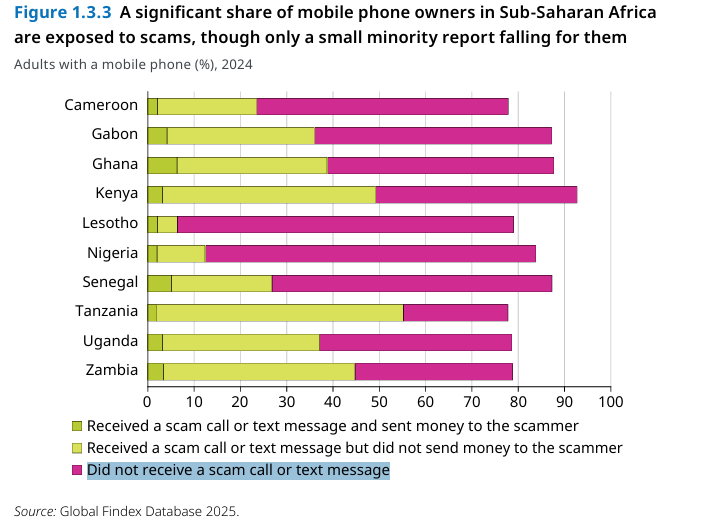
Nearly, 8.0% of Ghanaians who use mobile phones received a scam call or text message and sent money to the scammer.
According to the 2025 Global Findex Report by the World Bank, about 32% of Ghanaians who use mobile phones, also received a scam call or text message but did not send money to the scammer.
Also, about 48% did not receive a scam call or text message.
The report said adults who are exposed to a digital scam are asked if they sent money to their scammer.
“In a few economies, however, mobile phone owners have both high levels of exposure to scams or extortion and a high tendency to send funds, including Gabon, Ghana, and Senegal”, it explained.
It added that women are not overall more likely than men to receive scams or extortion attempts or to send money in response.
The report continued that consumer awareness about scams and the methods of scammers has shown promise for increasing people’s ability to avoid them.
For example, a study in Uganda that employed interactive games, delivered through interactive voice response, to teach people about fraud decreased the shares of both women and men falling for scams.
Opportunities Exist to Increase Responsible Digital Use
Though the Global Findex 2025 Digital Connectivity Tracker shows that a relatively small share of people experiences such harassment, any level is unacceptable. International efforts to address issues surrounding such violence include the UN’s Global Digital Compact, which aims to establish principles for an open, free, and secure digital future that respects human rights.
Globally, the report mentioned that only 53 out of 190 economies reviewed in one study impose criminal penalties for offenses associated with cyber harassment.
It is therefore calling for legal frameworks to revolve to recognise online harassment and treat it with the same seriousness as physical harassment.
“At the same time, tailored training programs in digital literacy for vulnerable populations— particularly women, adolescent girls, and marginalized communities—can help build preventive capacity by teaching users to recognize warning signs and employ privacy-enhancing settings on their mobile phones”, it added.
Finally, it wants accessible, confidential reporting channels with transparent processes for handling cases can enable victims to seek help without stigma.
Latest Stories
-
NSMQ Final: St Augustine’s get GH¢110,000 motivational package from old boys
15 minutes -
AFCON 2027: Ghana has no business doing football if we can’t beat Somalia and The Gambia to qualify – George Afriyie
33 minutes -
Starlets to face Togo on October 10 in U-17 AFCON qualifying campaign
43 minutes -
FIFA U-20 World Cup: Princesses showed character-Head Coach
49 minutes -
PBee releases new single ‘Lose My Mind’ featuring SIICIE today
1 hour -
Many have been dismissed – Interior Minister exposes forged WASSCE results in security recruitment
1 hour -
NCA clears MTN, Telecel, Goal for next stage of 5G spectrum licensing
1 hour -
Father demands probe into death of Central University student in motorway crash
2 hours -
Transport Minister orders urgent action to tackle surge in port congestion
2 hours -
NPP national executive election: Here are the ballot positions
2 hours -
Court orders police to file disclosures in Labone robbery case
2 hours -
Central Regional Minister lauds Gomoa Central Assembly for effective utilisation of Common Fund
2 hours -
What must gov’ts do to make food systems drive job creation in Africa? – Fareeda Mustapha asks Rwanda’s Kagame
2 hours -
Gender Minister calls for equitable gender roles to support girls’ development
2 hours -
Prioritise rural businesses in Women’s Bank – NETRIGHT urges gov’t
2 hours