

Audio By Carbonatix
Three global institutions have announced coordinated measures to stabilise energy markets and support vulnerable countries amid the Middle East conflict.
The measures include policy advice and financial support at global and country levels to address the impact of the crisis, which disproportionately affects energy importers and low-income countries.
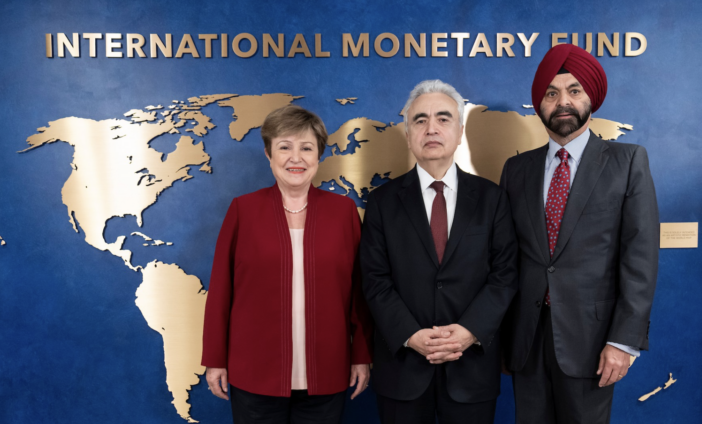
The International Energy Agency (IEA), International Monetary Fund (IMF) and World Bank Group (WBG) said this in a joint statement issued at the end of their meeting in Washington.
They noted that the shock had led to higher oil, gas and fertiliser prices, raising concerns about food security and job losses, while some oil and gas producers in the Middle East were also experiencing sharp declines in export revenue.
“The situation remains very uncertain, and shipping through the Strait of Hormuz is yet to normalise. Even after a resumption of regular shipping flows through the Strait, it will take time for global supplies of key commodities to move back towards their pre-conflict levels.
“Our teams are working closely, including at country level, to leverage our respective expertise and help countries through tailored policy advice and, in the case of the IMF and World Bank, financial support where needed,” they stated.
The institutions encouraged energy diversification as a long-term solution through investments in renewable energy and regional interconnections to reduce reliance on volatile fossil fuel markets.
Food security was identified as a key concern, with the World Bank preparing targeted financing for agricultural resilience, while the IMF was advising on fiscal measures such as subsidies for vulnerable households and support for fertiliser imports.
On job protection, the institutions said they were coordinating with national authorities to design employment programmes to cushion displaced workers and support recovery in tourism and services.
They said their collaboration would focus on active engagement with governments to implement solutions aimed at improving food security, energy stability and job creation.
The institutions also highlighted the need for continuous monitoring and flexibility, noting that responses would be adjusted as conditions evolve to ensure effectiveness.
“We will continue to monitor closely and assess the impact of the war on energy markets, the global economy and individual countries, and to coordinate our response and support to our member countries – working with, and drawing on, other international organizations’ expertise as needed to lay the foundations for a resilient recovery that delivers stability, growth and jobs,” they said.
Latest Stories
-
Ghana will secure Tullow tax revenues while protecting Jubilee, TEN investments – Ato Forson
1 second -
Ghana wins $393m Tullow tax arbitration as tribunal upholds GRA assessment
4 minutes -
Gender Minister assures women’s group of action on Affirmative Action, Development Bank
48 minutes -
Over 2,000 teachers in Dormaa comply with strike – GNAT Secretary
58 minutes -
Food Buffer Stock seeks stronger liquidity buffer despite record profit
1 hour -
LPG investments key to achieving 50% access target by 2030 – Energy Minister
1 hour -
Jinapor: New LPG terminal strengthens Ghana’s energy security
1 hour -
Agbodza directs road agencies to fast-track design approvals to prevent project delays
1 hour -
Housing Minister urges stakeholders to prioritise quality education in Banda District
1 hour -
Government redeems pledge to complete abandoned projects – Kofi Buah
1 hour -
Sam George calls for Black Stars disbandment, GFA dissolution after Gambia defeat
1 hour -
Bunkpurugu MP urges action to curb network disruptions in Northern Ghana
1 hour -
Education Minister calls for evidence-based response to learning crisis in West Africa
2 hours -
NPA reaffirms regulatory support as Puma Energy deepens investment in LPG and CRM
2 hours -
Ketu South NDC clears 73 aspirants for constituency elections
2 hours