

Audio By Carbonatix
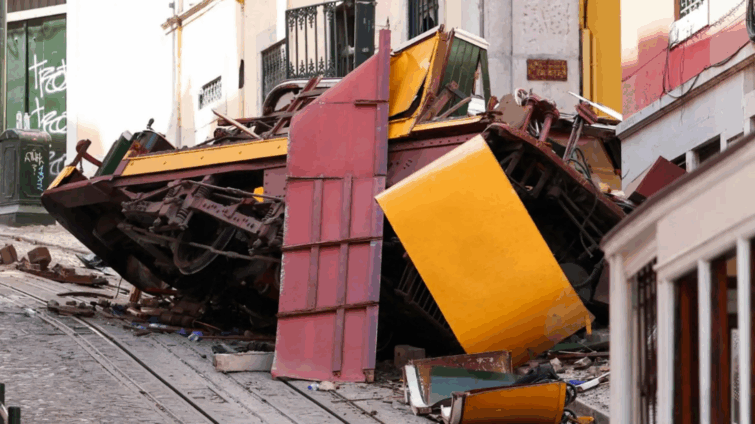
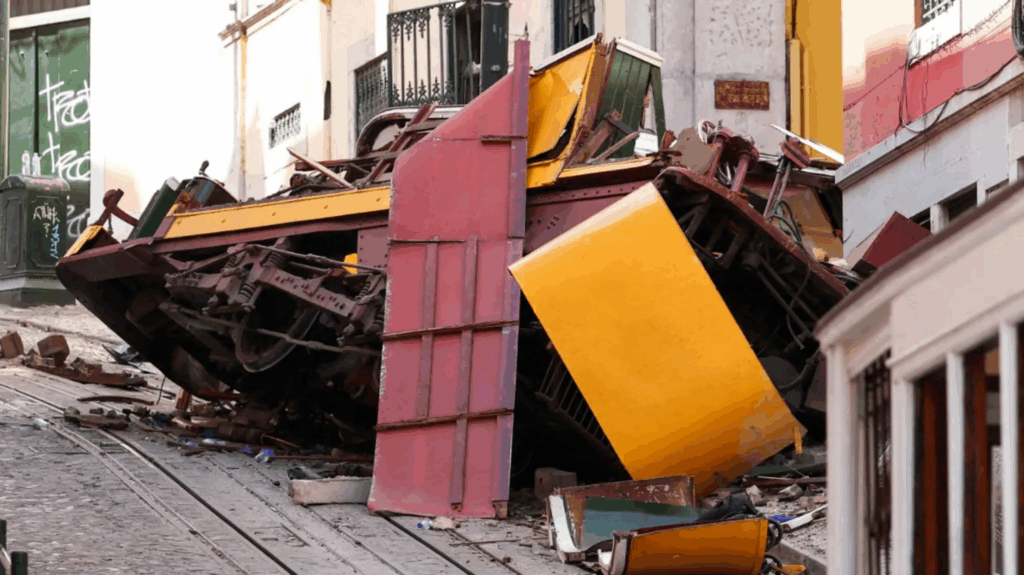
Portuguese officials investigating Wednesday's deadly funicular crash in Lisbon say a cable along the railway's route snapped, but the rest of the mechanism was functioning properly.
"After examining the wreckage at the site, it was immediately determined that the cable connecting the two carriages had given way," a statement by the national transport safety office said.
The brakeman tried to apply emergency brakes but failed to prevent the derailment, the investigators add.
Sixteen people died and about 20 were injured when the upper carriage of the iconic yellow Glória funicular railway crashed into a building.
Five of those killed were Portuguese along with three Britons, two South Koreans, two Canadians, an American, a Ukrainian, a Swiss and a French national, police said.
The 140-year-old funicular is designed to travel up and down Lisbon's steep slopes, and is an important form of transport for the city's residents - and a popular tourist attraction.
Although the brakeman activated the pneumatic brakes and a manual brake when the cable came loose, it is not clear whether another, automatic brake came on as it was supposed to, the report states.
It says the carriage was travelling at about 60km/h (37mph) when it hit the building.
The seven-page statement also says the cable was only 337 days into its expected 600-day operational life.
It is still unclear how many victims were travelling on the carriage, which can hold about 40 passengers, and how many were on the street, the document states.
Six of those injured were admitted to intensive care, while three sustained minor injuries.
The investigators stress they have not reached "valid conclusions" about the cause of the crash and will provide a full preliminary report within 45 days.
Portugal's Prime Minister, Luis Montenegro, described the incident as "one of the biggest tragedies of our recent past".
Latest Stories
-
EPA launches second awareness campaign ahead of Styrofoam ban
21 minutes -
Africa targets 3 million more health workers by 2035 – WHO explains what it could mean for patients
31 minutes -
Maintain January 2027 deadline for Styrofoam ban – Zanetor urges EPA
47 minutes -
Key moments in trial of Lindsay Clancy, the mother accused of murdering her three children
49 minutes -
Collapsed glacier likely caused deadly Nepal-Tibet floods, scientists say
1 hour -
The Cyrus Lesson: Why Ghana must look beyond religion in choosing its next leader
2 hours -
I have no problem with public tribunals; they’re constitutional – Anthony Forson
2 hours -
GRA boss supports mothers’ hostel, donates pickup to Upper Denkyira East Police
2 hours -
NSMQ 2026: St. John’s School beat Benkum SHS, Nandom SHS to secure quarter-finals spot
2 hours -
Minifootball Association of Ghana unveils women’s national team ahead of inaugural AFCON
2 hours -
Appointments Committee recommends approval of three Supreme Court nominees
2 hours -
NSMQ 2026: St. Hubert Minor Sem. reclaims lost seed, sends Mawuli School packing to book quarter-final spot
2 hours -
Beyond “what do you bring to the table?”: Rethinking what partners bring to relationships
2 hours -
NSMQ 2026: Mfantsiman Girls’ back in the quarter-finals after 10 years, snatches spot from St. James
2 hours -
Education Ministry to amend law to restore faith-based representation on GES Council
2 hours