

Audio By Carbonatix
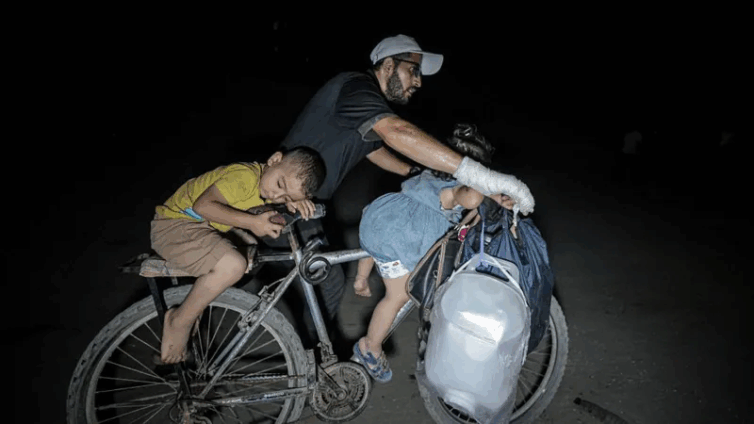
Thousands of families are attempting to flee Gaza City as the Israeli military confirms it has begun ground operations that are part of its large-scale assault aimed at occupying the city.
Lina al-Maghrebi, 32, a mother of three from the city's Sheikh Radwan neighbourhood told the BBC she had resisted leaving her home - despite the danger - until she received a phone call from an Israeli officer ordering her to evacuate.
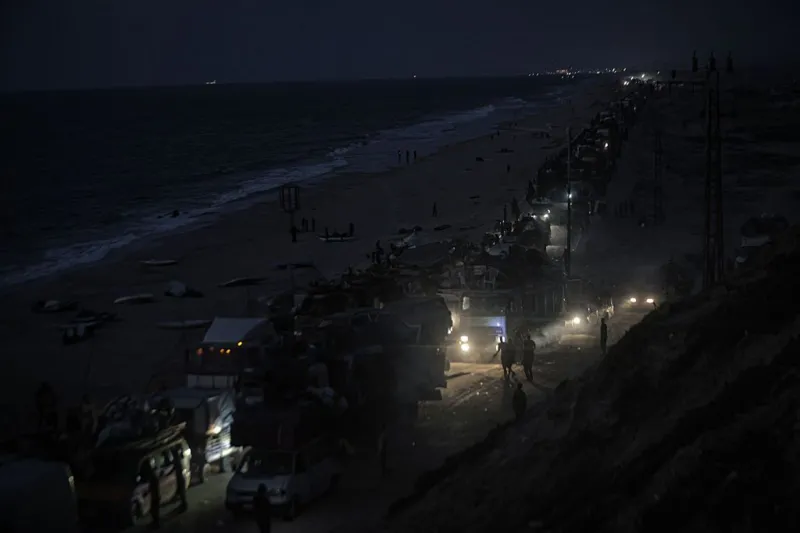
"I was forced to sell my jewellery to cover the cost of displacement and a tent," she said. "It took us 10 hours to reach Khan Younis, and we paid 3,500 shekels (£735) for the ride. The line of cars and trucks seemed endless."
Israeli Prime Minister Benjamin Netanyahu said a "powerful operation" had been launched in Gaza City, which he described as Hamas's last major stronghold.
The Israeli military has designated al-Rashid coastal road as the only permitted route for civilians to use to evacuate. Many have described severe congestion, endless queues of cars and trucks, and long delays, with families stranded on the roadside while airstrikes continue overhead.
The operation has drawn widespread international condemnation, including from the UN human rights chief and German foreign minister.
UK Foreign Secretary Yvette Cooper called the offensive "utterly reckless and appalling", saying it would "only bring more bloodshed, kill more innocent civilians and endanger the remaining hostages".
But US Secretary of State Marco Rubio appeared to offer tacit support for Israel's operation during a joint press conference with Netanyahu on Monday, saying the US preferred a negotiated end to the war, but that "sometimes when you're dealing with a group of savages like Hamas, that's not possible".
Israel's ramped up offensive comes as a United Nations commission of inquiry released a report on Tuesday that says Israel is committing genocide against Palestinians in Gaza. Israel categorically rejected the report.
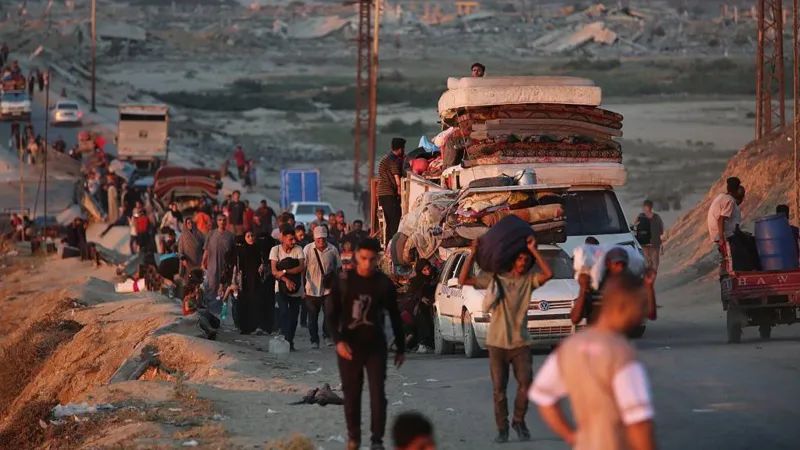
Nivin Imad al-Din, 38, a mother of five, said she fled south after Israeli warplanes dropped evacuation leaflets in her neighbourhood, though her husband refused to leave their home.
"I couldn't take my furniture with me because I couldn't afford the cost of a large truck," she explained. "Leaving everything behind was the hardest decision I've ever made."
The cost of displacement has surged far beyond the reach of most households. Residents said renting a small truck now costs around 3,000 shekels (£630), while a tent for five people sells for about 4,000 shekels (£840). With most families deprived of income since the war began, some are forced to walk for miles or remain in their homes despite the risks.
Overnight into Tuesday, Israeli warplanes carried out a wave of heavy airstrikes across Gaza City, with concentrated bombardment on the central al-Daraj neighbourhood, the Beach refugee camp in the west, and Sheikh Radwan in the north.
The attacks were accompanied by artillery fire, drone fire and helicopter gunship activity.
The Israel Defense Forces said it was "gradually" moving into Gaza City as part of the "next phase" of its offensive.
It said air and ground forces would be part of this next stage of the military's operation, with the number of troops increasing day-by-day.
Residents described the overnight strikes as "hell".
Ghazi al-Aloul, a displaced resident from northern Gaza, told the BBC he is now sleeping at the entrance of al-Quds Hospital in Tel al-Hawa, southwest Gaza.
"I did not choose this," he said. "I was forced after leaving the home where my family and I had been sheltering for nearly a month after fleeing the north".
"The bombardment has been insane for hours, and the army is threatening to demolish several residential buildings in the area."
Sami Abu Dalal, from al-Daraj in central Gaza, described the night as "extremely difficult".
"Whole residential blocks were levelled on top of their inhabitants, leaving many dead, missing, or injured," he said.
He said Israel was advancing on three fronts - and was accompanied by the use ofbooby-trapped vehicles, intense airstrikes, and heavy shelling. Meanwhile, Apache helicopters hovered over different parts of the city, firing continuously.
Latest Stories
-
LA 2028: Black Queens hold final training session ahead of second leg against Mauritius
12 minutes -
Standards are not Seasonal: What the EC appointments teach both sides
25 minutes -
King Mohammed VI urges private sector to create youth jobs and spread benefits of growth
26 minutes -
KGL U17 Colts 2026: Greater Accra win title after penalties win over Western Region
26 minutes -
UK Investment Roadshow opens in London to advance UK-Ghana growth partnership
37 minutes -
Assemblies of God requires pastors to resign before entering partisan politics – Rev. Wengam
47 minutes -
Ghana targets 20% annual reduction in maternal deaths – Health Minister
52 minutes -
Cyber attacks in Africa grow faster than global rate, report finds
54 minutes -
Ghana signs UAE deal to create 5,000 overseas jobs
1 hour -
One Million Coders Programme targets 100,000 digital jobs in two years – Sam George
1 hour -
John Jinapor, Italian Ambassador explore opportunities for energy sector investment
1 hour -
NHIA seeks legal reforms to support Free Primary Healthcare
1 hour -
Beatrice Annan defends Afi Agbenyo’s EC appointment, cites record of gender advocacy
1 hour -
Ghana seeks investment deals in Bangkok amid global economic crises
1 hour -
IMF raises Ghana’s 2026 growth forecast to 5.7%, sees inflation falling to 4.8%
1 hour