

Audio By Carbonatix
A trio of scientists have been given the 2025 Nobel Prize in chemistry for the development of “metal-organic frameworks,” a new form of molecular architecture likened to something from the Harry Potter novels.
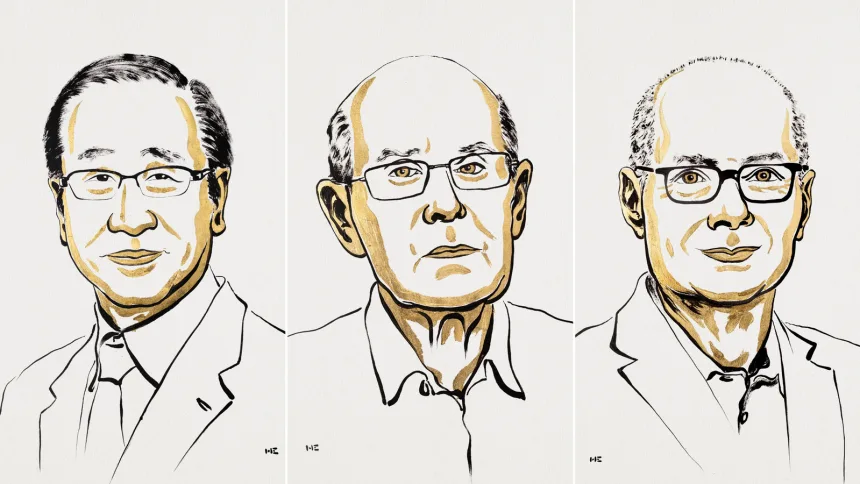
Susumu Kitagawa, Richard Robson and Omar Yaghi will share the prize for providing chemists “with new opportunities for solving some of the challenges” the field faces, the Nobel Committee announced Wednesday at a ceremony in Stockholm, Sweden.
Announcing the prize, Heiner Linke, chair of the Nobel Committee for Chemistry, said the laureates had found ways to make completely new materials “with large cavities” inside that function “like rooms in a hotel, so that guest molecules can enter and exit again from the same material.”
He said the chemistry functions like Hermione Granger’s handbag in the Harry Potter books, which appears small on the outside but is large on the inside.
“It can store huge amounts of gas in a tiny volume,” Linke explained. “Metal-organic frameworks have enormous potential, bringing previously unforeseen opportunities for custom-made materials with new functions.”
The committee praised the laureates for creating molecular constructions with large spaces through which gases and other chemicals can flow.
“These constructions, metal-organic frameworks, can be used to harvest water from desert air, capture carbon dioxide, store toxic gases or catalyse chemical reactions,” it said.
The inception of these new materials came when Robson, a professor at the University of Melbourne, Australia, was teaching students in 1974 about molecular structures by turning wooden balls into models of atoms.
When deciding where to drill holes in the wooden balls, Robson realized that a huge amount of chemical information depended on the position of the holes. He wondered what would happen if he linked together different types of molecules rather than individual atoms, and whether this could create new types of materials.
Although Robson took more than a decade to put his theory to the test, his experiments in the 1980s proved his hunch was correct. Using copper, Robson showed that the molecules organized themselves into a regular molecular structure – like how carbon atoms band together to form a diamond.
BREAKING NEWS
— The Nobel Prize (@NobelPrize) October 2, 2023
The 2023 #NobelPrize in Physiology or Medicine has been awarded to Katalin Karikó and Drew Weissman for their discoveries concerning nucleoside base modifications that enabled the development of effective mRNA vaccines against COVID-19. pic.twitter.com/Y62uJDlNMj
But unlike diamonds, where the molecular structure is extremely compact, Robson’s material contained a huge number of large cavities, suggesting this could lead to the creation of new materials.
Kitagawa, a professor at Kyoto University in Japan, built on Robson’s findings. Initially, Kitagawa was not convinced by the practical uses of these materials, but the committee said the chemist’s career has been driven by finding “the usefulness of useless.” Kitagawa began to research the potential for creating porous molecular structures, presenting his first one in 1992. Even then, research funders were not overly impressed
It was not until 1997 that Kitagawa made his first major breakthrough, developing a new molecule that could absorb and release methane, nitrogen and oxygen.
Meanwhile, at Arizona State University, Yaghi – who moved to the US from Jordan aged 15 – used Kitagawa’s and Robson’s research to develop a completely new metal-organic framework, MOF-5, which the committee said “became a classic” in the field of chemistry. Even when empty, this structure can be heated to 570 degrees Fahrenheit (300 degrees Celsius) without collapsing.
“A couple of grams of MOF-5 holds an area as big as a football pitch,” the committee said.
These properties allowed Yaghi’s research group to suck water from the desert air of Arizona.
“During the night, their MOF material captured water vapor from the air. When dawn came and the sun heated the material, they were able to collect the water,” the committee said.
The laureates’ research has a vast array of real-world uses, and could provide a way to combat climate change by capturing carbon dioxide from the atmosphere.
Other uses include removing “forever chemicals” from water and breaking down traces of pharmaceuticals in the environment.
Last year, the prize was awarded to a trio of scientists who used artificial intelligence to “crack” the code of almost all known proteins, the “chemical tools of life.”
Among them was Demis Hassabis, CEO of Google DeepMind in London, whose work helped develop an AI model to predict the complex structures of proteins – a problem that had been unsolved for 50 years.
In 2023, the prize was shared by three researchers who worked to discover and develop quantum dots, used in LED lights and TV screens, as well as by surgeons when removing cancer tissue.
Latest Stories
-
Power restoration fault suspected in Kumasi Central Market fire
50 minutes -
The 7-foot giant of Ngleshie Amanfro: Seven-foot Ghanaian Ephraim Saawa dreams of joining the national basketball team
1 hour -
Government promises support for Kumasi Central Market fire victims
2 hours -
Vibes The Movie: Big Ghun’s Ghanaian film earns five nominations at 2026 REFFA
2 hours -
MamaCare CEO warns unresolved conflicts among health workers could undermine maternal and neonatal care
2 hours -
Health professionals urged to translate medical knowledge into practice to save mothers
3 hours -
Conflicts among care providers linked to maternal, neonatal deaths – Expert
4 hours -
GIS marks 10th TIME conference, champions improved teaching practices
4 hours -
BRICS Or Balance? What Ghana’s bid really means
5 hours -
GPRTU wants full TRAFFITECH-GH implementation to start in 2027
5 hours -
Mahama announces plans to import electric wheelchairs for PWDs
5 hours -
KGL U17 Colts 2026: Western beat Prempeh Elite Academy to set up final final with Greater Accra Region
5 hours -
Late Solanke strike salvages 10-man Spurs draw at Man United
6 hours -
Gender Ministry to monitor welfare of Nana Akua Addo’s children amid domestic violence case
6 hours -
Benedict Okyere Yeboah: Ghana’s football problem goes beyond sacking a coach
6 hours