

Audio By Carbonatix
Our elders warned us that the man who fetches water with a woven basket should not curse the river when he arrives home thirsty.
Yet, the modern African geopolitical strategy consists almost entirely of parading our leaking baskets before the international community, demanding that the river apologise for the holes. We have substituted the hard, uncompromising engineering of statecraft for the intoxicating theatre of grievance. We have mastered the vocabulary of liberation while remaining utterly subservient to the mathematics of extraction.
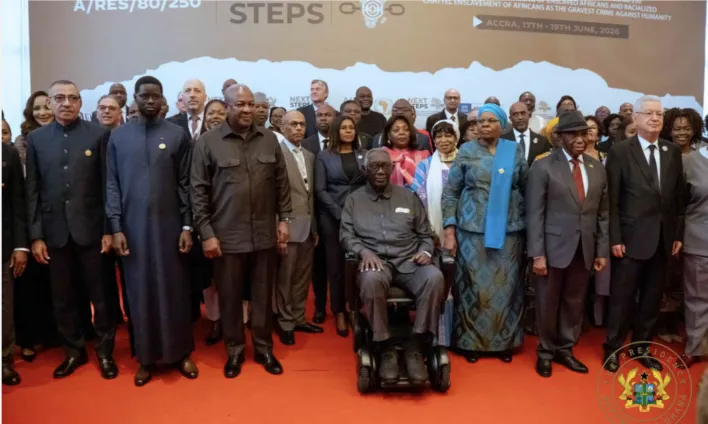
Earlier this week, a section of the global political elite descended upon Accra for the Next Steps Conference, yielding a rhetorically magnificent yet structurally hollow text known as the Accra Next Steps Commitments.
It is a document of soaring rhetoric, built upon the unprecedented UN General Assembly Resolution A/RES/80/250, which rightfully declares the trafficking and racialised chattel enslavement of Africans as the gravest crime against humanity.
French President Emmanuel Macron, in a moment of either profound insight or calculated deflection, declared that reparations must “not be reduced to a cheque.”
He is entirely correct, though entirely for the wrong reasons. A cheque is a transaction. What Africa requires is a demolition.
If we examine the Accra Commitments through the cold, structural lens of modern political economy, we find a masterpiece of geopolitical diagnosis wrapped in the fatal paralysis of the post-colonial state.
The document elegantly dissects the ongoing structural violence of the global north. It demands the transformation of the global economic architecture (Pillar VII), calls for UN-led sovereign debt resolution to alleviate constrained fiscal space (Pillar VIII), and insists on digital justice in the age of artificial intelligence (Pillar XI).
It rightly identifies that the contemporary international debt apparatus is merely the transatlantic slave trade reinvented as a spreadsheet, a mechanism designed to siphon wealth from the periphery to the centre perpetually.
Yet, what is the chosen weaponry of this grand declaration? The lexicon of the powerless. The document pleads: We call upon… We urge… We request…. It commits to dialogue and consultations on the establishment and operationalisation of a Global Reparations Fund.
This is the ultimate systemic trap. To appeal to the architects of global finance to dismantle a system they explicitly engineered for their own supremacy is magical thinking of the highest order.
It is akin to asking the casino to voluntarily surrender the house edge, or pleading with the arsonist to supervise the fire department politely. The global north will never fund the structural independence of the global south. To wait for them to do so is to remain in intellectual bondage.
And here we must confront the tragicomedy of our own making: the internal rot of the compound. We cannot simply point an accusatory finger across the Atlantic when three fingers point back at our own capitals.
When the colonial masters retreated, they did not dismantle the extractive machinery; they merely handed over the keys.
We replaced the white colonial governors with our own brothers, who now pilot the machinery of extraction with spectacular, terrifying efficiency. They attend high-level consultative conferences, they draft majestic resolutions, and they don bespoke suits to demand the restitution of cultural heritage.
And then, they return home to siphon public funds into opaque contracts and offshore accounts.
What a monumental paradox! We have leaders performing to the gallery of international approval, demanding apologies for historical extraction, while presently executing the domestic exploitation of their own citizens.
They demand that the West stop exploiting Africa, while they treat their own national treasuries as personal ATMs. We have not defeated imperialism; we have merely domesticated it.
This domestic corruption is especially devastating because the nature of global wealth has changed. True emancipation from mental slavery requires understanding the mechanics of the modern world.
Development is not a nostalgic exercise in memorialisation. It is cold, hard, unyielding institutional competence.
You cannot reform an economy that was explicitly built for drainage. The modern vaults beneath our feet are no longer just bauxite, gold, and crude oil. The ultimate sovereign assets are our human capital, our untaxed domestic revenues, and our data.
Yet, we allow these vaults to leak unguarded. We surrender our digital infrastructure to foreign tech monopolies, export our raw talent, and buy back the finished algorithms at a premium, all while establishing High-Level Global Advisory Councils to debate the semantics of our disadvantage.
A man whose house is on fire does not sit in the ashes drafting a resolution to condemn the matchstick. He puts out the fire.
Today, that fire is not just the spectacular dereliction of economic duty by our custodians; it is a profound moral rot that mocks our historical grievances.
As Wole Soyinka so devastatingly warned at the Accra conference, we are attempting to invoice the global north for historical chattel enslavement while actively supervising extant slave markets on our own soil.
It is the ultimate hypocrisy of the post-colonial state to demand reparations for the transatlantic trafficking of our ancestors, while paying no heed to the modern kidnapping, trafficking, and exploitation of our own children across the continent today. We have localised the very terror we are asking the world to apologise for.
How can we demand justice for history when we are currently manufacturing the same human misery?
True reparative justice will never arrive in a diplomatic pouch. The United Nations will not grant it. It is forged in the crucible of absolute, uncompromising domestic accountability.
It requires enforcing radical transparency in public procurement, so that not a single pesewa vanishes into the abyss of bureaucratic leakage.
It means aggressively decentralising the energy grid to break the monopolies that throttle our industrial potential.
It necessitates jailing the environmental terrorists who pillage our ecological heritage, regardless of their political lineage.
It demands that we build uncompromised health and educational infrastructures, and constitutionally mandate that those who govern us must actually use them.
Furthermore, it requires an awakened citizenry that flatly refuses to tolerate this grand-scale theft, bridging the gap between passive observation and active reclamation of the state.
But above all, it demands that we ruthlessly dismantle the contemporary slave markets we tolerate within our borders. Until we stop doing to our own people what the colonial master did to our ancestors, we will remain the most eloquent, well-documented hypocrites at the banquet of global capitalism.
The rain is still beating us. But the umbrella is, and always has been, in our own hands.
Latest Stories
-
The 7-foot giant of Ngleshie Amanfro: Seven-foot Ghanaian Ephraim Saawa dreams of joining the national basketball team
31 minutes -
Government promises support for Kumasi Central Market fire victims
37 minutes -
Vibes The Movie: Big Ghun’s Ghanaian film earns five nominations at 2026 REFFA
1 hour -
MamaCare CEO warns unresolved conflicts among health workers could undermine maternal and neonatal care
2 hours -
Health professionals urged to translate medical knowledge into practice to save mothers
2 hours -
Conflicts among care providers linked to maternal, neonatal deaths – Expert
3 hours -
GIS marks 10th TIME conference, champions improved teaching practices
3 hours -
BRICS Or Balance? What Ghana’s bid really means
4 hours -
GPRTU wants full TRAFFITECH-GH implementation to start in 2027
4 hours -
Mahama announces plans to import electric wheelchairs for PWDs
4 hours -
KGL U17 Colts 2026: Western beat Prempeh Elite Academy to set up final final with Greater Accra Region
4 hours -
Late Solanke strike salvages 10-man Spurs draw at Man United
5 hours -
Gender Ministry to monitor welfare of Nana Akua Addo’s children amid domestic violence case
5 hours -
Benedict Okyere Yeboah: Ghana’s football problem goes beyond sacking a coach
5 hours -
GPL 2026/27: Darkwah Wiafe’s winner sees All Blacks beat Kotoko
5 hours