

Audio By Carbonatix
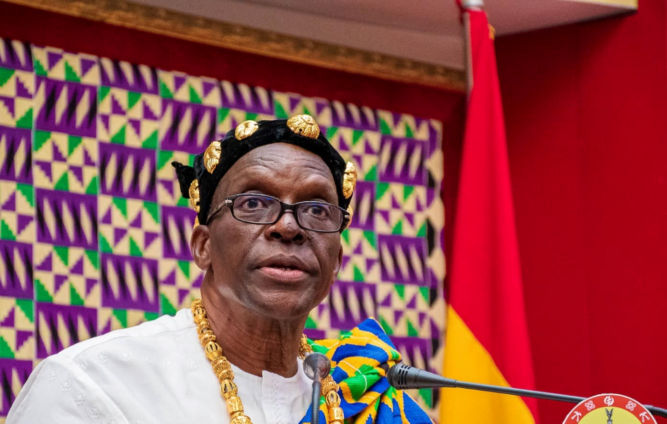
The Speaker of Parliament, Alban Bagbin, has delivered a powerful and critical assessment of the proposed 2026 Budget Statement, cautioning that the fiscal plan must serve as the primary catalyst for fundamentally transforming Ghana's economy and dismantling the nation's reliance on perpetual external financial support.
Speaking at a crucial Post-Budget Workshop in Accra on Saturday, November 15, attended by legislators and key financial stakeholders, the Speaker framed the budget not merely as an accounting document but as a decisive "roadmap for self-reliance and long-term growth."
His remarks come as Ghana faces continued pressure to stabilize its economy and enhance domestic resource mobilization.
In a pointed commentary directed at the core issue of fiscal policy implementation across the continent, Speaker Bagbin invoked a widely accepted critique of African governance, urging Ghanaian lawmakers to ensure the 2026 budget reflects sound management principles.
“A common refrain echoes across Africa: ‘Africa is not poor, it is poorly managed, and the budget is the clearest expression of that management.’ At this pivotal moment, our budget must serve as a primary instrument for transforming Ghana’s economic paradigm,” he said.
The statement implies that the 2026 Budget, which was presented by Finance Minister Dr. Cassiel Ato Forson on November 13, 2025 (as indicated in the budget document metadata), must be free of the structural weaknesses and political influences that have hampered previous fiscal policies.
Mr Bagbin stressed that the policy direction laid out in the 2026 fiscal plan must prioritize domestic resilience over dependency. Ghana's economy has historically struggled with external shocks, fluctuating commodity prices (like cocoa and gold), and high debt-to-GDP ratios, often necessitating bailouts and concessional lending from international bodies.
He urged the legislative body to scrutinize the budget’s provisions to ensure they actively foster internal economic drivers.
“The policies contained in this budget must steer us away from dependency towards a resilient, domestically driven economy. Honorable members, data tells a clear and urgent story. Reform cannot wait,” Mr Bagbin concluded.
The Speaker's warning serves as a call to action for Parliamentarians to rigorously analyze key budget components—including domestic revenue targets, local industrialization incentives, and expenditure management frameworks—to ensure the 2026 budget is truly the instrument of economic transformation that Ghana needs.
Latest Stories
-
Mahama cuts sod for Sentuo Group’s Airport Garden City project, over 3,000 jobs anticipated
11 seconds -
Most Ghanaians who fault double-track back new schools, 38.4% reject borrowing – IEA poll
10 minutes -
Sentuo Airport Garden City project will help bridge Ghana’s housing deficit – Housing Minister
19 minutes -
NSA distances itself from $623,000 World Cup visa allegations
20 minutes -
Offinso Traditional Council seeks support to fight unemployment and underdevelopment
25 minutes -
54.3% Ghanaians support gov’t borrowing to build more SHS infrastructure – IEA survey
42 minutes -
NDC orders members to halt premature parliamentary campaigns or face sanctions
1 hour -
Gov’t to ensure Ghanaian businesses benefit from Sentuo Airport Garden City project – Ofosu-Adjare
1 hour -
Nana Oye Bampoe Addo leads female government delegation to Asantehemaa
1 hour -
GES declares September 25 National Continuous Professional Development Day
1 hour -
64.7% of Ghanaians say double-track system has worsened SHS education – IEA poll
1 hour -
Terry Johnson set for ‘All White Service’ and live DVD recording on September 21
1 hour -
Ghanaian youth should think twice before accepting Russia’s invitation
1 hour -
Management of Coachhene Sports Club pays courtesy call on Sports Minister
1 hour -
miLife Insurance LTD wins Life Insurance Company of the Year 2025
1 hour