

Audio By Carbonatix
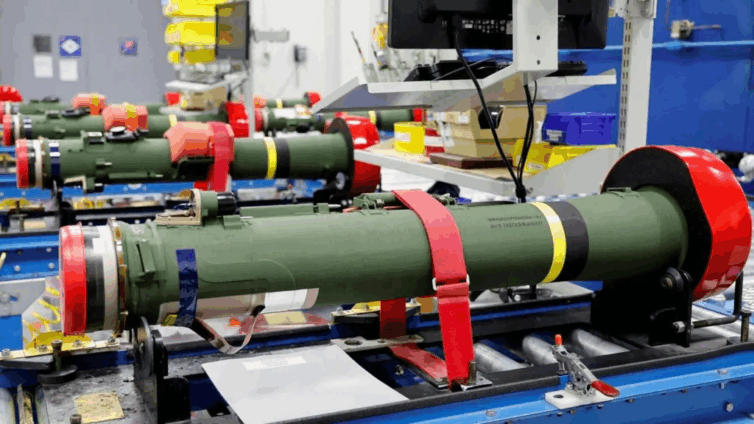
The US has approved two arms sales to India worth $92.8m (£71m), including Javelin anti-tank missiles and Excalibur precision artillery projectiles, the US state department says.
It comes nine months after India's Prime Minister Narendra Modi met Donald Trump in Washington, where both leaders committed to "advance defence ties".
In October, it led to the signing of a framework agreement to expand defence co-operation over the next 10 years.
The move comes as India seeks to diversify arms supplies away from Russia, amid reports that Trump urged it to buy more US-made weapons.
While Russia remains India's top source for arms supply, its share has dropped from 62% to 34% between 2017 and 2023 as India shifts toward US procurement.
India's defence trade with the US, on the other hand, has surged from near zero to $20bn, making the US its third-largest arms supplier, after Russia and France.
The Department of State's Defense Security Co-operation Agency (DSCA) said the weapons will "improve India's capability to meet current and future threats".
In a statement it said a $45.7m sale of the Javelin Missile System, including 100 FGM-148 Javelin rounds, one "fly-to-buy" missile and 25 lightweight command launch units, had been cleared.
The package also covers simulation rounds, trainers, spare parts, technical assistance and other logistical support.
In a separate notification, the department approved a $47.1m sale of up to 216 M982A1 Excalibur tactical projectiles, along with fire-control systems, primers, propellant charges, technical data and repair services.
The proposed sales would "support the foreign policy and national security objectives of the United States" by strengthening its strategic relationship with India, the DSCA said, describing it as "an important force for political stability, peace, and economic progress" in the Indo-Pacific and South Asia.
The DSCA said that India would have "no difficulty absorbing" the equipment into its armed forces.
The development coincides with the two countries trying to close a trade deal and tide over tensions after Trump slapped 50% tariffs on India, including a 25% penalty for buying Russian oil and arms.
But the tensions appear to be gradually letting up after months of uncertainty.
Latest Stories
-
Government has improved sanitation in one-and-a-half years — Salaga South MP
1 hour -
Nkwanta North Assembly to appear before Parliament over DACF sanitation spending
1 hour -
Mourinho prints out ‘red card’ incidents after Real lose derby
2 hours -
Atletico beat 10-man Real in feisty Madrid derby
2 hours -
Twelve Tribes of Israel Ghana to mark 40 years with anniversary celebration
2 hours -
GPL 2026/27: Hearts held by Bechem as Kotoko, Samartex share spoils
3 hours -
My Story (Kwaku Antwi-Boasiako)
3 hours -
We expect growth rate to re-accelerate in second-half of 2026 – IC Insights
3 hours -
The ungodliness and unrighteousness underlying the National Cathedral mess!
3 hours -
T-bills auction: Government fails to achieve target; yield on 91-day-bill remains unchanged
3 hours -
It’s Ghana’s shame to denigrate Nkrumah when the whole world honours him as African of the Century – Asiedu Nketiah
3 hours -
No other nationalist can compare to Nkrumah – Asiedu Nketiah
4 hours -
Collateral Registry: Foreign banks accounted for GH¢19.9bn of secured credit in quarter 2, 2026
4 hours -
This government should expect scrutiny – Asiedu Nketiah
4 hours -
Two-year-old girl dies in domestic fire at Cantonments
5 hours