

Audio By Carbonatix
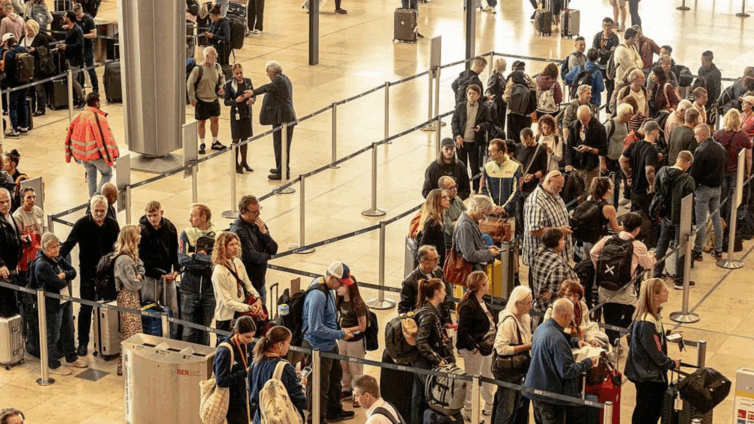
There are warnings of queues at passport control at European airports during the upcoming holiday periods, as the rollout of a new biometric border system continues.
Passengers have already reported hours-long waits at some destinations during busy periods due to the new systems.
A group representing airports said there was a risk of five- to six-hour queues over the summer.
However, the European Commission said it would be possible to suspend the new system at peak times until September.
Videos posted on social media over the past week show three-hour queues at Geneva Airport's passport control.
Geneva always gets busy during winter as skiers, Brits among them, head for the slopes.
But the airport is blaming the new Entry-Exit System (EES) at border control for "congestion... particularly on Saturdays during the busy ski season".
A spokesperson said implementing EES had been a "major challenge for Swiss customs and Geneva Airport".
The spokesman said measures to try to make the process smoother included putting on more staff.
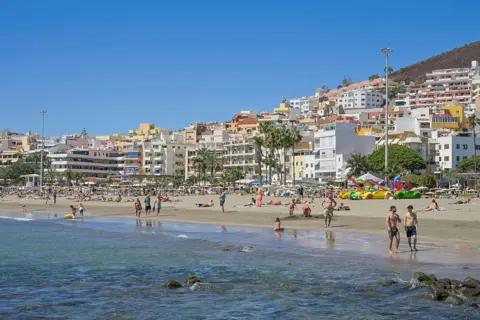
Long waits have been reported at Tenerife, in the Canary Islands, too.
Andrew Knight runs Sanasty Car Hire at Tenerife airport. Most of his customers are from the UK. Many of those arriving for winter sunshine have got stuck in long lines of passengers trying to get through the border kiosks.
Those who have arrived at quieter times have progressed through passport control quickly, but when multiple aircraft have landed in short succession, queues have built up.
Some passengers are getting through passport control in about 20 minutes, while others are experiencing one-and-a-half- to two-hour delays due to system issues. A few times, the systems have gone down, so it's really hit and miss."
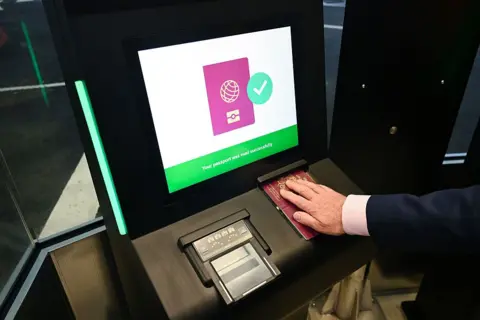
The digital Entry Exit System will eventually replace ink stamps on passports.
It requires non-EU citizens to provide fingerprints and a photo, and have their passport scanned, the first time they cross a border within the Schengen free-movement zone. This registration lasts three years.
Air travellers do it upon arrival at European airports, usually with an automated machine or kiosk. The details are verified on future entries.
The system is midway through a gradual introduction period that began in October.
At the moment, half of the border points are expected to operate EES, with at least a third of non-EU passengers using it.
Julia Lo Bue-Said, who runs the travel agent network Advantage Partnership, said, "Without question, the new system has created even more bottlenecks and pinch points [in places] that were already challenged."
Border process takes longer
Olivier Jankovec is the director general of Airports Council International Europe, which represents more than 600 airports.
He told the BBC the passenger processing time at border control had increased by "four to five times" under EES, with people typically waiting up to two hours.
Jankovec said problems included not enough border staff and some machines not working.
He fears the situation will worsen when large numbers of holidaymakers register over Easter and summer.
Markus Lammert, European Commission Spokesperson for Internal Affairs, says 23m entries and exits have already been registered under EES, and there have been 12,000 refusals of entry.
He insisted the system has operated "largely without issues", but said member states would continue to work on improvements.
From 10 April, EES is meant to be in use at every border point, for every eligible passenger.
However, countries can partially suspend EES operations where necessary over the summer, until September.
Jankovec said this would be necessary to cope if "the situation becomes unsustainable at border control".
Without it, and if issues around the equipment and border guard numbers didn't improve, he warned of five-to-six-hour waiting times.
The group said close coordination was needed with border control authorities to make sure they could suspend the system "in a timely manner".
On Thursday, the travel association ABTA said border authorities were underusing their ability to reduce checks when necessary, which had led to passengers being "caught up in lengthy delays".
ABTA said that, in addition to implementing contingency measures, destinations and border authorities need to do more to plan for peak travel periods.
Julia Lo Bue-Said advised people to come prepared for long waits over the February half-term and beyond.
"Plan for the worst", she advises, especially at peak times. "Make sure you've got some refreshments, make sure you've got something to keep [small children] occupied".
Correction 5 February 2026: The story has been updated to correct the name of Andrew Knight's business, which is Sanasty Car Hire.
Latest Stories
-
Thara Mills Simmonds named 2026 Forty Under 40 Achiever in Education
3 minutes -
Ghana deepens diaspora diplomacy: Embassy pledges enhanced consular support for Ohio communities in Columbus
11 minutes -
Ghana’s maternal health success story at risk without rural incentives – UNFPA
11 minutes -
Gaps in suicide data affect prevention interventions in Ghana – Accra Psychiatric Hospital MD
12 minutes -
Ghana Armed Forces to participate in Accra-Kumasi Expressway construction – Mahama
12 minutes -
Use chiefs to stop disputes from flooding Ghana’s courts – Deputy AG to governing council of ADR
26 minutes -
Four arrested as police bust alleged kidnapping, torture and extortion syndicate
28 minutes -
NPA increases price floor from September 16; petrol to sell at GH¢16, diesel at GH¢16.77
49 minutes -
OMJ fufils BECEPIP schorlaship promise, awards 12 learners
54 minutes -
Photos: GAF hands over 175.6km right-of-way for Accra-Kumasi Expressway construction to gov’t
56 minutes -
Accra-Kumasi Expressway to be operated and maintained for 50 years through toll revenue
60 minutes -
LGA holds Landmark Conference, AGM and Elections as the Committee on Politics and Elections emerges as the Overall Best Committee for 2025/2026.
1 hour -
JSALK Beverages pays medical bills of struggling nursing mothers at Nkawie-Toase Hospital
1 hour -
Accra-Kumasi Expressway to be operated as business to recover taxpayers’ investment – CEO
1 hour -
UNFPA calls for presidential intervention as maternal deaths reach crisis levels
1 hour