

Audio By Carbonatix
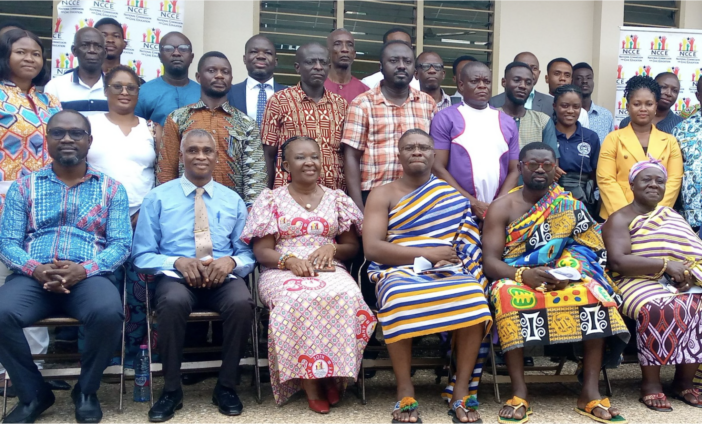
Stakeholders of the Regional consultations on Ghana’s Draft Model Law on Political Finance have met in Koforidua in the Eastern Region, to examine the proposed legislation and offer feedback to strengthen its final version.
The forum organised by the Centre for Democratic Development Ghana (CDD Ghana) in partnership with the National Commission for Civic Education (NCCE), with support from the UK’s Foreign, Commonwealth and Development Office (FCDO).
The engagement brought together civil society organisations, political actors, traditional leaders, journalists, and regulatory bodies to assess the content, implications, and enforcement structure of the draft political finance bill.
Addressing participants, Mr Frederick Adu Gyamfi, Director of Programmes at CDD Ghana, said the draft law was developed with FCDO support to bring Ghana’s political financing rules closer to international standards.
He said weak regulations had allowed money to play an outsized role in elections, fuelling vote-buying, the abuse of state resources, and practices that undermine accountability and public trust.
He noted that such behaviour often resulted in abandoned development projects, poor service delivery, and the election of candidates based more on financial strength than competence.
“The high cost of politics creates an exclusionary environment that disadvantages women, youth and people with disabilities,” he added.
Mr Adu Gyamfi outlined several gaps in the current political finance system, including the absence of contribution ceilings, no spending limits for campaigns, and the lack of mandatory disclosure or verification of donor identities.
He said Ghana’s Constitution required political parties to publish financial accounts, but enforcement remainded weak.
Restrictions on foreign funding applied only to parties, not candidates, and no expliciterules to prevent the abuse of incumbency and state resources during campaign periods.
He said the proposed law would address these weaknesses by regulating campaign spending and strengthening transparency.
It would also prevent the misuse of public resources, introduce public funding mechanisms, and establish tougher enforcement procedures and sanctions.
He explained that the bill suggested setting up an Independent Electoral Financing and Enforcement Authority to oversee, check, and review all political funding activities, led by a Chief Enforcement Officer.
Under the draft law, all candidates and political parties would be required to operate dedicated campaign bank accounts through which all campaign transactions must pass, subject to periodic and forensic audits.
The authority would set campaign spending limits based on factors such as geography, population, infrastructure, and the type of election.
These limits would apply to primaries, by elections and general elections.
Another key proposal is the establishment of a Public Campaign Fund. Candidates who secure at least five per cent of valid votes would qualify for reimbursement at GH¢10 per vote, reducing reliance on private financiers.
The bill also proposes firm measures against the abuse of incumbency, including bans on the use of public resources for political campaigns.
It places restrictions on mixing official duties with campaign activities and provides protections against the coercion of public servants and violations may attract fines, disqualifications, or other penalties.
It sets out detailed sanctions, including fines of up to 5,000 penalty units, triple-value penalties for illegal contributions, forfeiture of unlawfully obtained funds, and possible criminal liability.
The draft also introduces the electronic filing of reports, a public political finance database, and regular publication of spending data and violations.
Mr Adu Gyamfi said the new law, along with other reforms, would close major regulatory gaps, strengthen oversight, protect electoral integrity, and deepen democratic governance.
In her remarks, Ms Ophelia Nana Yaa Ankrah, Eastern Regional Director of the NCCE, stated that transparency, enforcement, and equitable funding mechanisms were critical to ensuring that Ghana’s democracy served all citizens.
Stronger political finance accountability, she said, would also help rebuild public confidence in elections.
Nana Afia Nyamaa II, Apesemaka Hemaa of the New Juaben Traditional Area, urged parents to instill moral discipline in their children.
She called on the Ministry of Education to incorporate themes such as integrity, ethical leadership, and the dangers of corruption into civic and moral education curricula to help raise responsible future leaders.
The regional forum is part of a nationwide effort to build public consensus and support for comprehensive reforms to regulate political financing in Ghana.
Latest Stories
-
Ghana’s BRICS move requires clear strategy to manage risks – Godfred Bokpin
54 minutes -
Pay teachers realistic income – Duncan Amoah to gov’t
1 hour -
Bechem to become chicken capital of Ghana – Mahama projects
1 hour -
Gov’t targets recruitment of 16,500 health professionals in 2026
2 hours -
Two-week strike will not derail academic calendar – GNAT President
2 hours -
Headmaster detained after BBC investigation into alleged sexual abuse of students
2 hours -
GNAT pushes for clear implementation procedures of teachers’ conditions of service
2 hours -
Recurrent strikes threaten quality of education and academic calendars – Prof Bokpin
2 hours -
‘Cockroach’ group leaders among hundreds detained in Delhi protest
2 hours -
Don’t let speed of information become your judgement – CJ tells new lawyers
3 hours -
World Cup visa scandal: People have leveraged public office to facilitate fraud – Senyo Hosi
3 hours -
Glut! Farmers count losses as prices crash, customers happy
4 hours -
GSA postpones auction of unserviceable vehicles
4 hours -
Man charged with attempted murder after stabbing
4 hours -
World Cup visa scandal: Senyo Hosi says issue goes beyond calls for Sports Minister’s resignation
4 hours