

Audio By Carbonatix
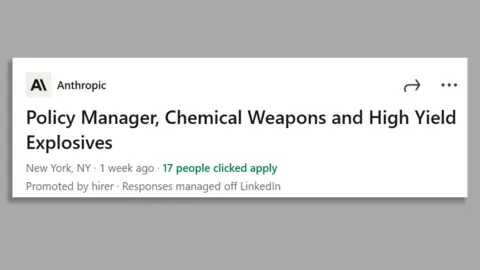
The US artificial intelligence (AI) firm Anthropic is looking to hire a chemical weapons and high-yield explosives expert to try to prevent "catastrophic misuse" of its software.
In other words, it fears that its AI tools might tell someone how to make chemical or radioactive weapons, and wants an expert to ensure its guardrails are sufficiently robust.
In the LinkedIn recruitment post, the firm says applicants should have at least five years' experience in "chemical weapons and/or explosives defence" and knowledge of "radiological dispersal devices" – also known as dirty bombs.
The firm told the BBC the role was similar to jobs in other sensitive areas that it has already created.
Anthropic is not the only AI firm adopting this strategy.
A similar position has been advertised by ChatGPT developer OpenAI. On its careers website, it lists a job vacancy for a researcher in "biological and chemical risks", with a salary of up to $455,000 (£335,000), almost double that offered by Anthropic.
But some experts are alarmed by the risks of this approach, warning that it gives AI tools information about weapons - even if they have been instructed not to use it.
"Is it ever safe to use AI systems to handle sensitive chemicals and explosives information, including dirty bombs and other radiological weapons?" said Dr Stephanie Hare, tech researcher and co-presenter of the BBC's AI Decoded TV programme.
"There is no international treaty or other regulation for this type of work and the use of AI with these types of weapons. All of this is happening out of sight."
The AI industry has repeatedly warned of the potential existential threats posed by its technology, yet there has been no attempt to slow its progress.
The issue has gained urgency as the US government calls on AI firms while launching war in Iran and military operations in Venezuela.
Anthropic is taking legal action against the US Department of Defence, which designated it a supply chain risk when the firm insisted its systems must not be used in either fully autonomous weapons or mass surveillance of Americans.
Anthropic co-founder Dario Amodei wrote in February that he didn't think the technology was good enough yet, and should not be used for these purposes.
The White House said the US military would not be governed by tech companies.
The risk label puts the US company in the same boat as the Chinese telecoms firm Huawei, which was similarly blacklisted over different national security concerns.
OpenAI said it agreed with Anthropic's position but then negotiated its own contract with the US government, which it says has not yet begun.
Anthropic's AI assistant, called Claude, has not yet been phased out and is still embedded in systems provided by Palantir, being deployed by the US in the US-Israel-Iran war.
Latest Stories
-
Ghana’s BRICS bid must be guided by national interest – International Affairs Analyst
9 minutes -
Journalists look back on a decade of breast cancer reporting in Ghana
48 minutes -
President Mahama ends Resetting Ghana tour of Ahafo Region
3 hours -
African negotiators seek delivery of climate commitments at COP31
3 hours -
BoG develops AI rules for financial sector
3 hours -
‘Big Push’: Government assures contractors of prompt payments
3 hours -
Court fines miner for breaking into gold buying shop
3 hours -
Tarkwa court jails labourer for three years over GH¢123,000 theft
4 hours -
GAEC must retain nuclear scientists for Ghana’s nuclear ambitions – Minister
4 hours -
Man reportedly mistaken for game and shot by hunter dead in forest
4 hours -
19-year-old mason jailed 15 years for defiling seven-year-old pupil
5 hours -
Ghana’s banking sector assets rise 20.47% to GH¢500.2bn – BoG Governor
5 hours -
22 injured as Sprinter bus overturns at Sege after tyre burst
5 hours -
UN housing expert urges Ghana to strengthen Rent Control Department amid housing affordability concerns
5 hours -
Delta-BCI partnership reaches 166,000 people with breast cancer education
5 hours