

Audio By Carbonatix
Earlier this month, my country celebrated its 69th Independence Day. In my address to the nation, I invoked the courage and conviction of our founding leaders, who stood firm in the face of immense adversity to secure our freedom. Kwame Nkrumah reminded us that political independence without transforming the global systems that shape our economies and opportunities remains incomplete.
It is in that spirit that, later this month, Ghana will table a resolution at the United Nations General Assembly calling for the formal recognition of one of the greatest moral tragedies in human history: the transatlantic trafficking and enslavement of Africans as a crime against humanity, and the need for a process of repair.
This initiative is not Ghana’s alone. It carries the support of the African Union, the Caribbean Community (CARICOM), and a growing coalition of countries across the Global South. Together, we seek not to reopen old wounds, but to acknowledge them honestly—and to work collectively toward healing and justice in ways that strengthen our shared future.
The call for reparatory justice is not new. It is rooted in a long, continuous tradition of resistance, advocacy, and moral reasoning spanning centuries. From early African leaders who protested the capture and sale of their people, to the struggles of the Haitian Revolution, to the post-independence movements that reshaped the modern world, the demand for justice has endured.
In recent decades, this tradition has taken institutional form. The 1993 Abuja Proclamation recognised the enslavement and trafficking of Africans as an unprecedented crime. The CARICOM Reparations Commission has articulated a comprehensive framework for reparatory justice. The Accra Proclamation of 2023 reaffirmed Africa’s collective commitment to this cause. The African Union has now declared 2026 to 2035 as the Decade of Action on Reparations and African Heritage, underscoring the urgency and legitimacy of this global conversation.
Our proposal at the United Nations builds on these foundations. It seeks to move the international community from acknowledgement to action—from recognition of historical injustice to a structured dialogue on repair.
This is not about assigning collective guilt to present generations. Nor is it about revisiting history in a spirit of division. Rather, it is about understanding how historical injustices have shaped contemporary inequalities and how a more honest reckoning can contribute to a fairer, more inclusive global order.
The transatlantic slave trade and the system it sustained disrupted societies, extracted human and economic value on an unprecedented scale, and left enduring legacies that continue to influence patterns of development, opportunity, and vulnerability across the world. Recognising this history fully is essential—not only for Africa and its diaspora, but for humanity as a whole.
The international community has, in the past, taken important steps. The Durban Declaration and Programme of Action in 2001 acknowledged the transatlantic slave trade as a crime against humanity. Yet, more remains to be done to translate that recognition into meaningful dialogue and practical pathways for repair.
Africa brings to this conversation a perspective shaped by its own intellectual and moral traditions—one that holds that injustice does not simply fade with time, but requires deliberate effort to address and redress. This perspective aligns with the broader principles of international law and human rights, which affirm that certain wrongs demand enduring accountability.
At the heart of this effort is a commitment to partnership. The process we envision is one of engagement—bringing together states, institutions, scholars, and communities to explore constructive and forward-looking approaches to reparatory justice. These may include investments in education, health, cultural restoration, and economic opportunity, designed to close enduring gaps and build shared prosperity.
We must also recognise the human dimension of this history, including how systems of enslavement entrenched inequalities that affected generations, particularly women and families. A full accounting of this past requires us to acknowledge these dimensions and to ensure that any process of repair is inclusive and comprehensive.
The world today faces many interconnected challenges—from inequality and underdevelopment to climate change and global instability. Addressing historical injustices is not separate from these challenges; it is part of building the trust and cooperation necessary to confront them together.
Ghana’s initiative at the United Nations is therefore an invitation—an invitation to engage in honest reflection, constructive dialogue, and collective action. It is an invitation to move beyond acknowledgement toward meaningful steps that strengthen justice, dignity, and shared progress.
For centuries, the voices calling for justice have endured—across continents, across generations, and across institutions. Today, we have an opportunity to listen, to respond, and to act.
A crime of this magnitude calls not only for remembrance but for responsibility. And in meeting that responsibility together, we take a step toward a more just and united world.
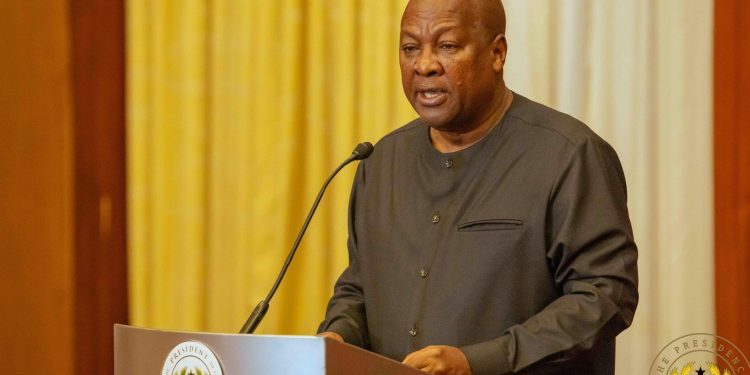
President John Dramani Mahama is the President of the Republic of Ghana.
Latest Stories
-
Daily Insight for CEOs: Capital allocation as a CEO responsibility.
2 minutes -
GWL water sales grow faster than production in Q1 2026 -PURC
10 minutes -
I don’t like Stonebwoy’s approach to issues – DJ Slim
12 minutes -
Ghana Water Limited records 49.2% non-revenue water in Q1 2026
14 minutes -
Force-feeding children can cause serious complications —Paediatrician warns
33 minutes -
Mahama warns board chairpersons against taking over executive roles
35 minutes -
Only 61 state entities submitted audited accounts on time in 2025 – Mahama
39 minutes -
BoG warns against return to FATF grey list as financial crime risks rise
45 minutes -
Remembering 9/11: The day terror struck America and changed the world forever
55 minutes -
Mismanagement of public affairs fading trust in government, religious leaders—Ayariga
56 minutes -
Presumption of corruption should apply to unexplained wealth – Kissi Agyebeng
57 minutes -
Survival is not success for state-owned enterprises – Mahama
1 hour -
Mahama challenges SOEs to turn financial gains into lasting operational efficiency
1 hour -
Conviction should not be required to recover unexplained wealth – Agyebeng
1 hour -
Persistent SOE losses will no longer be absorbed by national budget – Mahama
1 hour