

Audio By Carbonatix
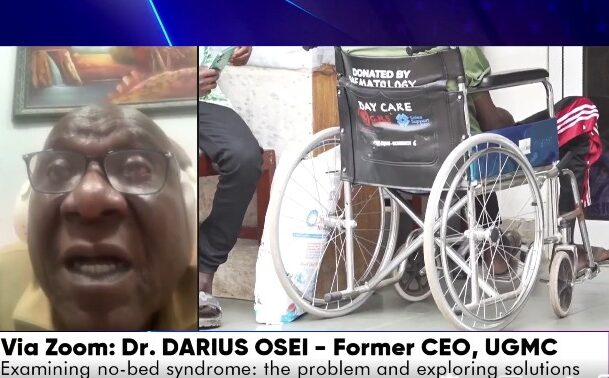
The former Chief Executive Officer of the University of Ghana Medical Centre (UGMC), Dr Darius Osei, has revealed how he watched helplessly as his niece died due to chronic gaps in the country's emergency care system.
Speaking during a high-stakes JoyNews dialogue on national emergency care delivery on Thursday, 2nd April 2026, Dr Osei laid bare the agonising reality of a healthcare system where even the highest-ranking medical administrators are not immune to the consequences of dysfunctional hospital systems.
Dr Osei recounted the final moments of his niece, a university student, whose life was cut short despite being under supervision in one of Ghana’s top hospitals.
He described a chaotic four-hour ordeal in the emergency ward, where his medical expertise could not save his own relative, who had been rushed to a different hospital.
“I realised, and I lost a patient, that is my niece, who was in the university,” Dr Osei shared with a visible sense of grief. “I stood by her in the emergency; we spent four hours. I was sent to go to the lab to bring the bottle, and I brought it and then, you know, up and down. And so finally, I lost my niece.”
The former CEO’s account highlights a recurring nightmare for many Ghanaians, where the system requires relatives or others to act as errand runners for basic laboratory consumables while their loved ones are in critical condition.
The tragedy serves as a damning indictment of the current emergency protocols.
If a former CEO of a multi-million-dollar medical facility like UGMC was reduced to chasing lab bottles while his niece’s life ebbed away, it raises harrowing questions about the fate of ordinary citizens without such connections.
The "up and down" movement described by Dr Osei refers to the fragmented nature of Ghanaian emergency care, where patients are often held in limbo while families or friends navigate the procurement of a hospital card, folder, medication and other essentials, as well as upfront payment for services before health officials deliver care.
Dr Osei’s testimony aligns with broader calls from emergency specialists for a "One-Stop-Shop" ER model.
Under this model, all essential services, including laboratory work, imaging, and pharmacy, are situated within the emergency department to eliminate the time-wasting "up and down" movements that often prove fatal during the golden hour.
Additionally, Dr Osei has called for the elimination of instant payments before service delivery, highlighting the importance of saving lives instead of chasing cash.
Latest Stories
-
Billionaire Man United owner says he has lost confidence in the UK
4 hours -
I have experienced racism a thousand times – Lamine Yamal
4 hours -
Ipswich Town investigates racist abuse of Fatawu
4 hours -
Man City battle past Sunderland in eight-goal thriller
4 hours -
Neville calls Man Utd ‘pathetic’ – but Carrick maintains belief
5 hours -
Cunha rescues point for Man United at Fulham
5 hours -
Government has improved sanitation in one-and-a-half years — Salaga South MP
5 hours -
Impressive defence behind Iraola’s solid Liverpool start
5 hours -
Nkwanta North Assembly to appear before Parliament over DACF sanitation spending
5 hours -
PSG beat Marseille for second league win of the season
5 hours -
Mourinho prints out ‘red card’ incidents after Real lose derby
5 hours -
Atletico beat 10-man Real in feisty Madrid derby
5 hours -
Twelve Tribes of Israel Ghana to mark 40 years with anniversary celebration
6 hours -
GPL 2026/27: Hearts held by Bechem as Kotoko, Samartex share spoils
6 hours -
My Story (Kwaku Antwi-Boasiako)
6 hours