

Audio By Carbonatix
Three global institutions have announced coordinated measures to stabilise energy markets and support vulnerable countries amid the Middle East conflict.
The measures include policy advice and financial support at global and country levels to address the impact of the crisis, which disproportionately affects energy importers and low-income countries.
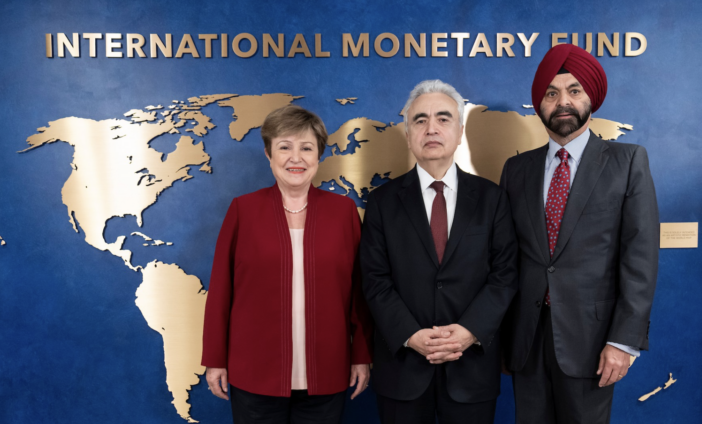
The International Energy Agency (IEA), International Monetary Fund (IMF) and World Bank Group (WBG) said this in a joint statement issued at the end of their meeting in Washington.
They noted that the shock had led to higher oil, gas and fertiliser prices, raising concerns about food security and job losses, while some oil and gas producers in the Middle East were also experiencing sharp declines in export revenue.
“The situation remains very uncertain, and shipping through the Strait of Hormuz is yet to normalise. Even after a resumption of regular shipping flows through the Strait, it will take time for global supplies of key commodities to move back towards their pre-conflict levels.
“Our teams are working closely, including at country level, to leverage our respective expertise and help countries through tailored policy advice and, in the case of the IMF and World Bank, financial support where needed,” they stated.
The institutions encouraged energy diversification as a long-term solution through investments in renewable energy and regional interconnections to reduce reliance on volatile fossil fuel markets.
Food security was identified as a key concern, with the World Bank preparing targeted financing for agricultural resilience, while the IMF was advising on fiscal measures such as subsidies for vulnerable households and support for fertiliser imports.
On job protection, the institutions said they were coordinating with national authorities to design employment programmes to cushion displaced workers and support recovery in tourism and services.
They said their collaboration would focus on active engagement with governments to implement solutions aimed at improving food security, energy stability and job creation.
The institutions also highlighted the need for continuous monitoring and flexibility, noting that responses would be adjusted as conditions evolve to ensure effectiveness.
“We will continue to monitor closely and assess the impact of the war on energy markets, the global economy and individual countries, and to coordinate our response and support to our member countries – working with, and drawing on, other international organizations’ expertise as needed to lay the foundations for a resilient recovery that delivers stability, growth and jobs,” they said.
Latest Stories
-
Governed differently: The political economy of state absence in Africa
1 hour -
Boakye Agyarko vows to rebuild NPP as over 50 constituency chairpersons back his chairmanship bid
1 hour -
APL poll puts Bawumia ahead of seven potential NDC contenders
2 hours -
Character, jobs and cost of living: APL poll shows what voters will use to decide 2028 election
2 hours -
Vieira named new Senegal head coach
4 hours -
Global borrowing costs hit fresh highs on oil, AI and inflation
4 hours -
American Airlines to bring back TV screens on US flights
4 hours -
Carney’s final chance to convince Trump as US-Canada trade deadline looms
4 hours -
BOSTenergies meets fuel tanker drivers over their concerns at the Kumasi depot
4 hours -
X1 Energy Drink-backed DOL Super Cup ends with Ebusua Dwarfs crowned champions
4 hours -
Disney and ABC sue Trump’s media regulator to stop early licence renewal
4 hours -
Luv FM High School Debate: Prempeh dethroned as CHRISSEC and KUHIS ignite quarter-final path
4 hours -
British couple on honeymoon killed in helicopter crash on Greek island
5 hours -
George Opare Addo to lead National Youth Forum in Accra
5 hours -
ECG invested GH¢710,965 in infrastructure replacement across Greater Accra – PURC
5 hours