

Audio By Carbonatix
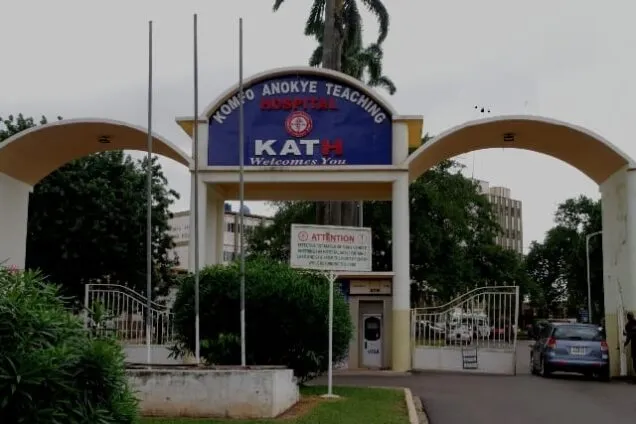
The Chief Executive Officer of Komfo Anokye Teaching Hospital, Dr Paa Kwesi Baidoo, has attributed the persistent “No Bed Syndrome” and severe congestion at the facility to multiple abandoned infrastructure projects, some of which date back nearly two decades.
Speaking at the hospital’s end-of-year performance review, Dr Baidoo painted a worrying picture of a facility operating far beyond its intended capacity, largely due to delays in completing key expansion projects that were originally designed to support its growing patient load.
“These projects were factored into the operations of the hospital for many years. The delay in completing them is now having a significant impact on healthcare delivery,” he stated.
According to him, one of the most affected areas is the sickle cell and blood services unit, which was designed to function as a major centre for treatment and research.
However, the incomplete nature of the project has forced the hospital to relocate services to a much smaller temporary space, drastically limiting its capacity.
“We have a sickle cell and blood centre project which has stalled. Currently, the blood services unit is operating from a small space under the C Block, while sickle cell services are also constrained,” he explained.
“If you have a facility that should accommodate about 200 to 300 patients but you are now limited to a space that contains only about 20, then you can clearly see the impact on service delivery,” he added.
Dr Baidoo further highlighted the stalled psychiatric project, describing it as another critical gap in the hospital’s infrastructure, especially at a time when demand for mental health services continues to increase.
“The psychiatry project has been abandoned, and this is affecting our ability to deliver essential services. Mental health care is not optional—many people require these services daily,” he noted.
He stressed that the combined effect of these stalled projects has significantly contributed to congestion within the hospital, forcing staff to improvise in order to manage overwhelming patient numbers.
The situation, he said, has led to the continued phenomenon of “No Bed Syndrome,” where patients are received but cannot immediately be assigned beds due to lack of space.
“You often hear about ‘No Bed Syndrome.’ At Komfo Anokye, we don’t turn patients away easily. We struggle to accommodate everyone who comes because we are the only tertiary facility serving this region and beyond,” he explained.
“If you ask patients to go home, where are they going? For many of them, that could mean losing their lives. So we are compelled to manage them, even under very difficult conditions,” he added.
Dr Baidoo revealed that in many instances, patients are left on stretchers in overcrowded wards, creating frustration among patients and their relatives, who sometimes misinterpret the situation as negligence or deliberate delay.
“You find patients on stretchers, shouting and sometimes insulting staff. In some cases, there is even physical abuse because they think the delays are intentional,” he said.
He warned that the situation is taking a heavy toll on healthcare workers, leading to mental stress, fatigue and burnout among staff.
“It leads to serious mental stress and burnout among our staff. These are the realities we face daily, and it does not support effective service delivery,” he lamented.
The KATH CEO used the platform to appeal to government, development partners and other stakeholders to urgently support the completion of the abandoned projects to ease pressure on the facility.
“We are appealing to all stakeholders to support us complete these projects. That is the only way we can improve infrastructure and deliver quality healthcare,” he urged.
Despite the constraints, Dr Baidoo disclosed that the hospital has taken steps to strengthen service delivery using its own resources.
He said KATH has invested over GH¢10 million from its Internally Generated Funds to procure essential medical equipment, including ICU beds, patient monitors and ECG machines, to enhance specialist care.
“With our internally generated funds, we have procured critical equipment to support care. But infrastructure remains a major challenge that requires urgent attention,” he added.
Komfo Anokye Teaching Hospital remains one of Ghana’s busiest referral centres, serving the Ashanti Region and several parts of the middle and northern belts, making the completion of these projects critical to improving healthcare delivery nationwide.
Latest Stories
-
10 arrested in illegal mining operations at Kpali
12 minutes -
“Styrofoam ban is first phase of single-use plastics crackdown” – EPA
24 minutes -
US Treasury’s Bessent faces G20 diplomacy test amid tariffs, Iran war, bond turmoil
26 minutes -
One dead, several injured as fire ravages parts of Abotaose Market
28 minutes -
Accra ranks among world’s top 20 cities for nightlife in 2026
2 hours -
Police arrest two suspects over murder of Yidani chief and son
2 hours -
How Albert Bondah, Fredima, Socrate Safo, Counselor Lutterodt engineered Dan Kwaku Yeboah’s comedy show
2 hours -
Yidani chief’s murder: Police arrest two suspects following intelligence tip-off
2 hours -
Government to connect 206 Volta communities to national grid within six months – Energy Minister
3 hours -
Petrol, diesel and LPG prices expected to rise marginally in September – COPEC
3 hours -
Canada installs large Lake Ontario sign in latest jab at US
3 hours -
Energy Minister commends Roads Minister for massive road projects in Volta Region
3 hours -
Executive support professionals must reposition as strategic partners – Centre for Executive Development
4 hours -
Ablakwa calls for end to African conflicts, urges leaders to create jobs
4 hours -
NSMQ 2026: Prempeh College withstands late Keta SHTS push to grab first semi-final spot
4 hours