

Audio By Carbonatix
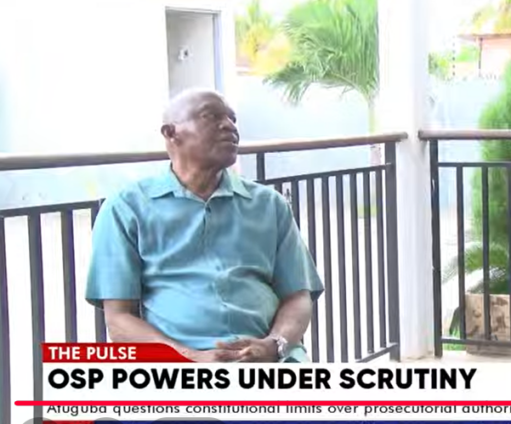
Civil society organisations expressing concern over the legal limitations currently facing the Office of the Special Prosecutor (OSP) are reacting to a law that was enacted on their behalf, retired Supreme Court Justice William Atuguba has said.
Speaking in an interview with Joy News’ Gemma Appiah, Justice Atuguba said while he understands the frustration of civil society groups, their concerns must still be weighed against the requirement to operate strictly within the law.
“Whatever popular the OSP’s cause is, if it is not legally sanctionable, the law is made on behalf of the public by the elected representatives,” he said. “It is not the government’s law. It is their own law that is being enforced.”
His comments come amid growing debate over a recent High Court ruling, which held that the OSP cannot prosecute corruption-related cases without authorisation from the Attorney-General.
Civil society organisations have described the decision as a setback for anti-corruption efforts, warning that it could weaken the independence of the OSP.
Some CSOs argue that the ruling effectively places the Office of the Special Prosecutor under the control of the executive, since the Attorney-General is a government appointee. They warn that this could create a conflict of interest in cases involving public officials.
The OSP, established under the Office of the Special Prosecutor Act during the Akufo-Addo administration, was designed to operate independently in investigating and prosecuting corruption-related offences involving public officeholders.
Justice Atuguba did not dismiss the concerns raised by civil society groups, but stressed that the matter remains before the Supreme Court, which is yet to provide a final interpretation of the constitutional questions at stake.
He explained that the High Court ruling remains valid for now, but could either be upheld or overturned by the apex court. Once that happens, he said, it would form the proper basis for public discussion and policy reflection.
The OSP has already filed an appeal and is seeking a stay of execution of the High Court ruling, which would allow it to continue operations while the Supreme Court deliberates.
For Justice Atuguba, however, the key issue remains adherence to due process.
He maintains that regardless of public sentiment or institutional expectations, constitutional disputes must ultimately be resolved by the Supreme Court, whose ruling will be final and binding.
Latest Stories
-
John Dumelo joins corporate Ghana at JoySports Invitational Tournament 2026
31 minutes -
Preview: JoySports Invitational Tournament 2026 promises a day of sport, fitness and big prizes
40 minutes -
“Gov’t owes me GH¢5m” — Shatta Wale fumes over “total disrespect”
1 hour -
NSMQ 2026: Accra Academy books quarter-final spot, sends Holy Child packing after fierce battle
2 hours -
NSMQ 2026: University Practice stages late comeback to retain seed as Presby SHS, Adeiso suffer one-point heartbreak
2 hours -
The Luckiest CEO Adutwun eyes back-to-back CEO shootout crown at JoySports Invitational
2 hours -
NSMQ 2026: Tie-break agony as Bishop Herman steals quarter-final spot from Asanteman SHS
2 hours -
Ahmadiyya elders urged to lead moral crusade in digital age, warns against rising religious tensions
2 hours -
Baptist Church equips youth to navigate AI and digital era with Biblical values
3 hours -
When giving life becomes a matter of life and death: Ghana’s maternal mortality crisis
3 hours -
SankofaFresh uses technology to cut post-harvest losses and connect farmers to markets
3 hours -
Democracy Is Not For Sale: EC Deputy Director warns against money, bribery in elections
3 hours -
Constitutional reform remains my lifelong mission – Barker-Vormawor after appointment
3 hours -
This Saturday on Newsfile: OSP’s AKSA suspects, political thugs, ministerial reshuffle & CRC report to take centre stage
4 hours -
Bolgatanga Girls restores boarding status of student allegedly defiled by watchmen
4 hours