

Audio By Carbonatix
Director of Enterprise Business and Wholesale at Telecel Ghana, Tawa Bolarin, has encouraged African governments and industry leaders to open markets and harmonise digital infrastructure policies to accelerate growth.
Speaking during a panel discussion at the 11th Ghana Female CEO Summit in Accra on the topic, Women Building Africa’s Digital Ecosystem, Innovation and Inclusive Growth, she argued that the continent’s next wave of economic growth depends on moving beyond basic connectivity to full participation in the digital economy.
“We need to ensure growth beyond our local environment and make access to markets, financial transactions and movement across the continent easier and without barriers,” Ms Bolarin said.
She stressed that it would deepen regional trade and accelerate digital transformation in African economies, where millions remain excluded from online commerce despite rapid network expansion.
“If we look at today and five years ago, connectivity borders on access and that hasn’t changed. Three-quarters of Ghana is covered by connectivity, but smartphone penetration is at 46 per cent because half don’t have access to smart devices. If we can tackle that, more people can equally access and participate in the digital ecosystem,” she said.
According to industry estimates, mobile broadband now reaches most of Ghana’s population, yet smartphone adoption and digital literacy remain uneven, particularly among women, rural communities and small businesses.
The data shows that though infrastructure coverage has expanded sharply, meaningful digital participation still lags.
Ms Bolarin said that the challenge extends beyond infrastructure and hinges on people building the requisite digital literacy and skills.
She pointed to the widening gap between internet access and productive digital participation, particularly among small businesses and women-led enterprises.
“People have access to the internet but don’t have the knowledge to convert that into a business tool. Technology keeps moving at a rapid pace, and the agility to be able to keep up with that pace requires commitment and support if we want more people to participate in the digital economy,” she said.
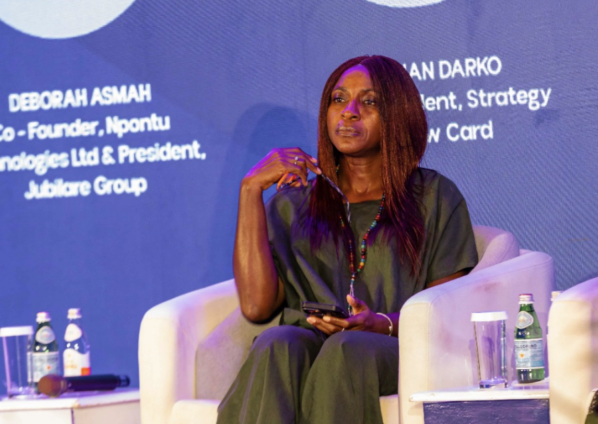
The panel discussion brought together some of Ghana’s leading women in technology, telecommunications and digital finance to examine how Africa can build a more inclusive digital economy.
Moderated by Akosua Annobil of Tech in Ghana, the panel also featured Deborah Asmah of Mpontu Technologies and Jubilare Group, Gillian Darko of Yellow Card, and Estelle Akofio-Sowah of CSquared Ghana.
The discussions centred on connectivity, digital infrastructure, women-led innovation, fintech collaboration, and strategies to expand digital access across underserved communities.
The summit, now in its 11th year, has become one of Ghana’s influential gatherings of women executives, policymakers and entrepreneurs.
Held under the theme Women Driving Sustainable Business for a Resilient Africa, this year’s event focused on how female leaders are shaping growth across sectors, including technology, finance, manufacturing and telecommunications.
Latest Stories
-
Government has improved sanitation in one-and-a-half years — Salaga South MP
4 hours -
Nkwanta North Assembly to appear before Parliament over DACF sanitation spending
4 hours -
Mourinho prints out ‘red card’ incidents after Real lose derby
5 hours -
Atletico beat 10-man Real in feisty Madrid derby
5 hours -
Twelve Tribes of Israel Ghana to mark 40 years with anniversary celebration
5 hours -
GPL 2026/27: Hearts held by Bechem as Kotoko, Samartex share spoils
6 hours -
My Story (Kwaku Antwi-Boasiako)
6 hours -
We expect growth rate to re-accelerate in second-half of 2026 – IC Insights
6 hours -
The ungodliness and unrighteousness underlying the National Cathedral mess!
6 hours -
T-bills auction: Government fails to achieve target; yield on 91-day-bill remains unchanged
6 hours -
It’s Ghana’s shame to denigrate Nkrumah when the whole world honours him as African of the Century – Asiedu Nketiah
6 hours -
No other nationalist can compare to Nkrumah – Asiedu Nketiah
6 hours -
Collateral Registry: Foreign banks accounted for GH¢19.9bn of secured credit in quarter 2, 2026
6 hours -
This government should expect scrutiny – Asiedu Nketiah
7 hours -
Two-year-old girl dies in domestic fire at Cantonments
8 hours