

Audio By Carbonatix
Ghana has mined gold for over a century while also sitting on vast bauxite and manganese. About 15 years ago, it began commercial petroleum production when crude oil first flowed from the offshore Jubilee Field in December 2010. Now, Ghana is racing to stake a claim in lithium and other critical minerals.
Yet one question keeps coming back: Who really benefits from this wealth?
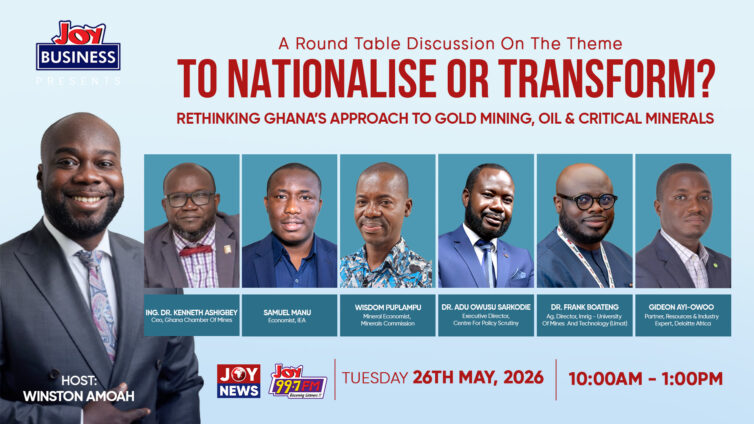
As calls grow for greater Ghanaian control of the extractive sector, Joy Business is convening a national dialogue to examine whether ownership alone is enough to transform the country.
The high-level discussion, titled “To Nationalise or Transform? Rethinking Ghana’s Approach to Mining, Oil and Critical Minerals,” brings together voices from industry, policy, academia, and governance.
At the heart of the debate: Will greater Ghanaian ownership automatically mean better national outcomes, or does the country need deeper reforms in governance, financing, industrialisation, and accountability?
The discussion comes as resource nationalism gains momentum across Africa, driven by rising commodity prices and demands for local participation. For Ghana, the debate is urgent as the government pushes stronger local participation while global demand for critical minerals intensifies.
The panel reflects the issue’s complexity.
The Institute of Economic Affairs (IEA) is leading the push for nationalisation, represented by economist Samuel Manu, who will focus on ownership models, sovereign wealth, and whether a Ghanaian-led extractive industry alone can actually finance long-term growth and development.
Ing. Dr. Kenneth Ashigbey from the Ghana Chamber of Mines strongly opposes the blunt calls for nationalization and will bring the industry perspective – investor confidence, competitiveness, and what resource nationalism actually means for mining operations on the ground.
Wisdom Puplampu of the Minerals Commission will provide regulatory perspectives on Ghana’s extractive framework, local content policies, and mineral governance.
Dr. Adu Owusu Sarkodie of the Centre for Policy Scrutiny will address accountability, transparency, and how Ghana can avoid elite capture while maximising national benefit.
Dr. Frank Boateng, Acting Director of the Institute of Mineral Resource Investment and Governance at the University of Mines and Technology (UMaT), will examine global lessons from resource-rich countries and what Ghana can learn from countries that pursued nationalisation, strategic partnerships, and local industrialisation.
Providing broader continental and global industry insight will be Gideon Ayi-Owoo, Partner and Resources & Industry Expert at Deloitte Africa, who is expected to discuss financing realities, investment trends, critical minerals strategy, and how Ghana can remain globally competitive while increasing local value retention.
Unlike many public conversations, this dialogue aims to move beyond rhetoric. Joy Business says a major outcome will be a policy brief capturing key recommendations. That brief will go to government, state institutions, and the public.
The initiative is part of Joy Business’ commitment to shaping Ghana’s economic conversation. The dialogue airs live on JoyNews TV, Joy FM, and JoyNews social media handles
Latest Stories
-
Two-year-old girl dies in domestic fire at Cantonments
36 minutes -
Asiedu Nketiah urges better working conditions for journalists
45 minutes -
JoyNews’ Precious Semevoh wins climate change reporting award at Bono GJA Awards
52 minutes -
Kumasi Central Market phase 2 to begin in October after years of abandonment
57 minutes -
Sentuo offers fuel supply reassurance as NPA sees steady output through December
2 hours -
Ghanaian smock showcased at Lesotho Tourism Summit
2 hours -
Four pupils to one desk: The painful plight of schools in New Juaben North
3 hours -
Ipswich launch investigation into racist abuse of Abdul Fatawu
3 hours -
Arrest of Techiman nurse is purely political persecution – ‘Ghana Jollof’
3 hours -
Isak nets winner as Liverpool edge Bournemouth
4 hours -
I dare gov’t of Ghana to extradite me; they can never do it – ‘Ghana Jollof’ speaks
4 hours -
Semenyo scores twice as Manchester City beat Sunderland 5-3 in eight-goal thriller
4 hours -
Parliament calls for government-private sector collaboration to improve waste management
4 hours -
Volta Region described as cleanest so far in Parliament’s nationwide sanitation monitoring
4 hours -
Parliament urges MMDAs to enforce sanitation bylaws to curb indiscriminate waste disposal
4 hours