

Audio By Carbonatix
The Ministry of Health, Parliament and the United Nations Population Fund (UNFPA) have intensified efforts to eliminate obstetric fistula in Ghana after new figures revealed that less than one-third of affected women received treatment over the past decade.
Data from health facilities across the country show that 3,688 cases of obstetric fistula were recorded between 2016 and 2025, but only 1,096 women underwent reparative surgery during the period.
Obstetric fistula, a severe childbirth injury that causes continuous leakage of urine or faeces, often leaves women facing social isolation, stigma and long-term health complications.
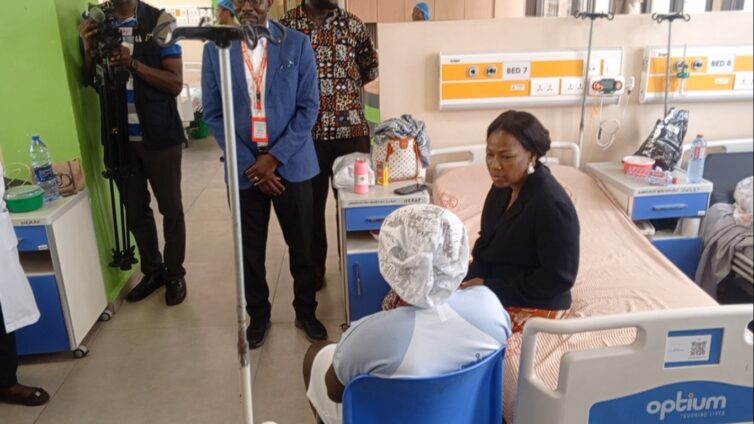
The alarming figures were highlighted during a visit by a high-level delegation from the Ministry of Health, Parliament and UNFPA to the Komfo Anokye Teaching Hospital (KATH) in Kumasi.
The visit formed part of activities marking the International Day to End Obstetric Fistula and sought to assess ongoing treatment efforts, engage survivors and healthcare workers, and explore sustainable solutions to the growing challenge.
UNFPA Country Representative for Ghana, Wilfred Ochan, said Ghana continues to record about 845 new fistula cases every year while treatment capacity remains significantly lower.
“All these shows that there’s still work for us to do to move women into care,” he said.
“On average 845 women get fistula every year. If we look at 10 years back, there is a backlog because we are repairing only about 200 cases a year. There is an estimated backlog between 10,000 and 12,000.”
According to health authorities, prolonged and obstructed labour without timely access to emergency obstetric care remains the leading cause of the condition.
They estimate that approximately 3,000 cases of prolonged obstructed labour occur annually in communities across the country.
Medical experts also expressed concern about a growing number of fistula cases resulting from surgical complications.
Officials disclosed that up to 22 per cent of cases currently managed at repair centres are linked to obstetric and gynaecological procedures, highlighting the need for enhanced surgical training and quality assurance.
Deputy Minister for Health, Grace Ayensu-Danquah, announced plans to establish dedicated obstetric fistula treatment centres across the country to improve access to care.
She said the government is exploring the development of a specialised facility at KATH that would combine treatment, training and research under one roof.
“As one of the things I have discussed with UNFPA is to acquire a standalone facility for fistula treatment,” she said.
“The one at Yendi is showing progress. We would like something similar for Komfo Anokye so we can train, provide equipment and add more specialists.”
She noted that a dedicated centre of excellence would help increase cure rates, reduce recurrence and strengthen specialist capacity nationwide.
The Parliamentary Caucus on Population and Development and the Parliamentary Select Committee on Health have also pledged support for the initiative.
Chairperson of the Population and Development Caucus, Patricia Appiagyei, called for accelerated policy interventions and expanded specialist training.
“There has been a recommendation that we need a separate unit to address fistula issues. This should include a training centre to increase the number of doctors who can treat fistula,” she said.
Chairman of the Health Committee, Mark Kurt Nawaane, assured that Parliament would advocate strongly for greater government support.
“We have understood the situation. The Health Select Committee is going to champion this cause and press on the Executive to take this issue very seriously,” he said.
As part of immediate interventions, UNFPA has committed funding for free surgical repair procedures for 200 women this year.
Experts estimate that Ghana must perform about 2,249 fistula repairs annually between now and 2030 to clear the existing backlog and achieve elimination targets.
Key recommendations include establishing a national fistula registry, expanding year-round surgical services, increasing access to treatment in underserved regions, strengthening funding mechanisms and improving community-based case detection through the Community-based Health Planning and Services (CHPS) programme.
Health authorities say without urgent action, the number of untreated women will continue to grow despite ongoing efforts to reduce new cases.
Latest Stories
-
Police arrest suspect over jewellery theft during fire outbreak
1 hour -
EOCO returns Hanan’s £6,700, GH¢2,750 and devices after defence challenge
1 hour -
Opplift Youth Entrepreneurs Summit 2026 equips entrepreneurs with skills, mentorship and support
2 hours -
Rival clubs want range of punishments for Man City
2 hours -
Tear gas in Paris and Marseille as school protests grow across France
2 hours -
Kane inspires England to win over Czech Republic in UEFA Nations League
2 hours -
Finland orders halt to work on two Google data centres
2 hours -
Substitute Merino scores twice as Spain win in Croatia
3 hours -
Ronaldo wants Portugal ‘punishment’ but not retiring
3 hours -
White House defends Trump comment to let Iran ‘take out’ LA and San Diego
3 hours -
Asos confirms hackers sent ‘unauthorised’ notification to app users
3 hours -
US televangelist Jim Bakker, disgraced from sex scandal and fraud, dies at 86
3 hours -
Congolese-born golfer to represent Ghana at Turkish Airlines World Cup grand final
3 hours -
Amazon wins global rights to stream Emmys in six-year deal
3 hours -
European Film Festival returns to Ghana after a 5-year break
3 hours