

Audio By Carbonatix
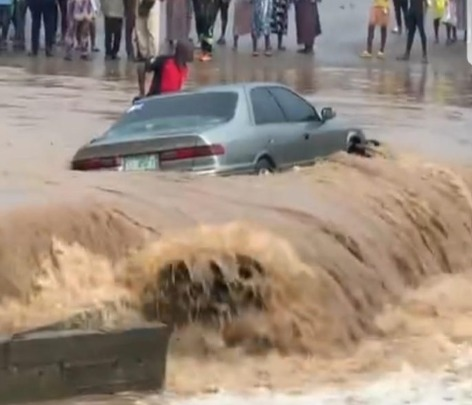
The Ghana Institution of Engineering (GhIE) has called for an urgent overhaul of Ghana’s stormwater management policies, warning that the country’s current drainage systems are no longer capable of addressing the realities of rapid urbanisation, climate variability, and increasing flood risks.
The call follows growing evidence that conventional drainage infrastructure, designed primarily to move storm water downstream as quickly as possible, has become inadequate for modern urban environments, particularly in Accra and other rapidly expanding metropolitan areas.
According to a policy brief presented by the Institution, Ghana’s cities can no longer rely on traditional, centralized, conveyance-based drainage systems. Rapid urban expansion, widespread paving of land surfaces, poor waste management practices, and increasing rainfall intensity have significantly exceeded the capacity of existing drainage networks.
“Flooding in Accra is no longer simply a seasonal occurrence. It is increasingly becoming a structural challenge driven by rapid urbanisation, loss of natural infiltration areas, and fragmented management systems,” the policy brief notes.
The Institution observed that flooding incidents have become more frequent and severe over the past decade, occurring even during periods of relatively low rainfall. This suggests that the problem extends beyond climate change and reflects deeper weaknesses within existing stormwater management systems.
The Institution highlighted that many drains have effectively become conduits for solid waste, reducing hydraulic capacity and compromising their intended function. The policy brief also noted that hydraulic constraints within the Odaw-Korle drainage system continue to contribute to recurring flood events across parts of the capital.
The document further identifies institutional fragmentation as a major obstacle to effective flood management. Responsibilities are spread across multiple agencies, while administrative boundaries often do not align with natural drainage basins, making coordinated catchment-wide planning difficult.
To address these challenges, GhIE is advocating a transition towards decentralized, nature-based storm water management systems that mimic natural hydrological processes. Recommended interventions include permeable pavements, bioswales, rain gardens, green roofs, detention systems, infiltration facilities, riparian buffers, and rainwater harvesting.
The Institution is also calling for a National Post-Development Runoff Control Policy to ensure that new developments do not generate runoff volumes and peak flows beyond pre-development conditions.
In addition, GhIE recommends a National Rainwater Harvesting Policy, stronger enforcement of land-use regulations, catchment-based planning units, protection of waterway buffer zones, and greater private-sector participation in green infrastructure development.
According to GhIE, adopting these measures could significantly reduce flood frequency and severity, improve water quality, lower long-term infrastructure costs, create green jobs, and strengthen Ghana’s resilience to climate change.
“The evidence is clear,” the report concludes. “Ghana must shift from downstream, conveyance-based engineering to upstream, decentralized, nature-mimicking stormwater management. The time for policy reform is now.”
The recommendations align with the best global practices in sustainable urban drainage and support the achievement of the United Nations Sustainable Development Goals, particularly SDG 6 (Clean Water and Sanitation) and SDG 11 (Sustainable Cities and Communities).
Latest Stories
-
Mr President, Ghana was mentioned at the UN; why aren’t we talking about it?
46 minutes -
Accra to convene Africa’s regulators and markets on tokenisation at AVAS 2026
49 minutes -
The Paradox of Plenty — When every smartphone becomes a newsroom
1 hour -
GTA sensitises taxi drivers in ‘Know Ghana’ tourism campaign
3 hours -
Archbishop Agyinasare calls for responsible speech amid growing social media abuse
3 hours -
‘It will be inexcusable for gov’t not to honour payment of teachers’ arrears by 30th October’ – Haruna Iddrisu
3 hours -
Forbes’ World’s Best Employers 2026: No Ghanaian firm ranked among 900 companies
3 hours -
Electronic processing of teachers’ data: ‘The decision is the Controller’s’ – GES boss
3 hours -
Teachers’ Strike: Haruna Iddrisu questions paper-based processing of promoted teachers’ data
3 hours -
Savannah Region: Kunfusi bridge collapses again, leaving nearly 4,000 residents cut off
3 hours -
Teachers’ strike: GES targets Monday deadline to submit promotion data to Controller
3 hours -
Inflation to average 11.3% in 2027 – Fitch Solutions
4 hours -
‘I didn’t campaign for NDC to come and do this nonsense’ – Kpebu on EOCO’s conduct
4 hours -
Fitch Solutions maintains policy rate forecast of 14% by December 2026
4 hours -
Diaspora Nasara Caucus congratulates Mohammed Ali Suraj, new NPP executives
6 hours