

Audio By Carbonatix
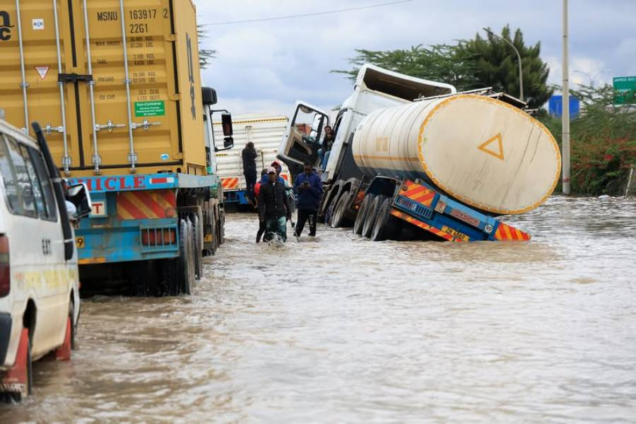
The Government has pledged to intensify efforts to address the country's persistent flooding challenges following widespread devastation caused by recent heavy rains in Accra and other parts of the country.
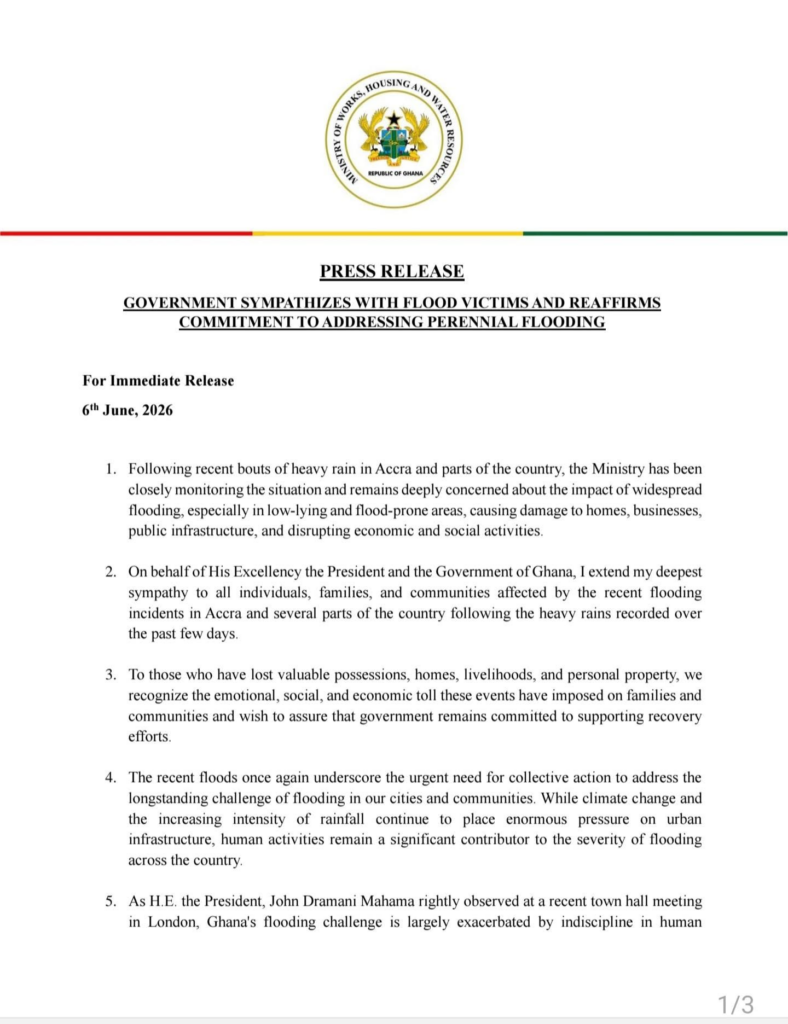
In a press release issued on Saturday by the Ministry of Works, Housing and Water Resources, the Government expressed deep concern over the impact of the floods, which have damaged homes, businesses and public infrastructure while disrupting economic and social activities in many affected communities.
The Ministry said it had been closely monitoring developments since the onset of the heavy rains and acknowledged the significant hardship being endured by thousands of residents living in low-lying and flood-prone areas.
On behalf of President John Dramani Mahama and the Government of Ghana, the Minister extended heartfelt sympathy to individuals, families and communities affected by the disaster.
The statement recognised the emotional, social and economic burden imposed on victims who have lost homes, personal belongings, livelihoods and other valuable possessions.
"Government remains committed to supporting recovery efforts and assisting affected families and communities as they rebuild their lives," the statement said.
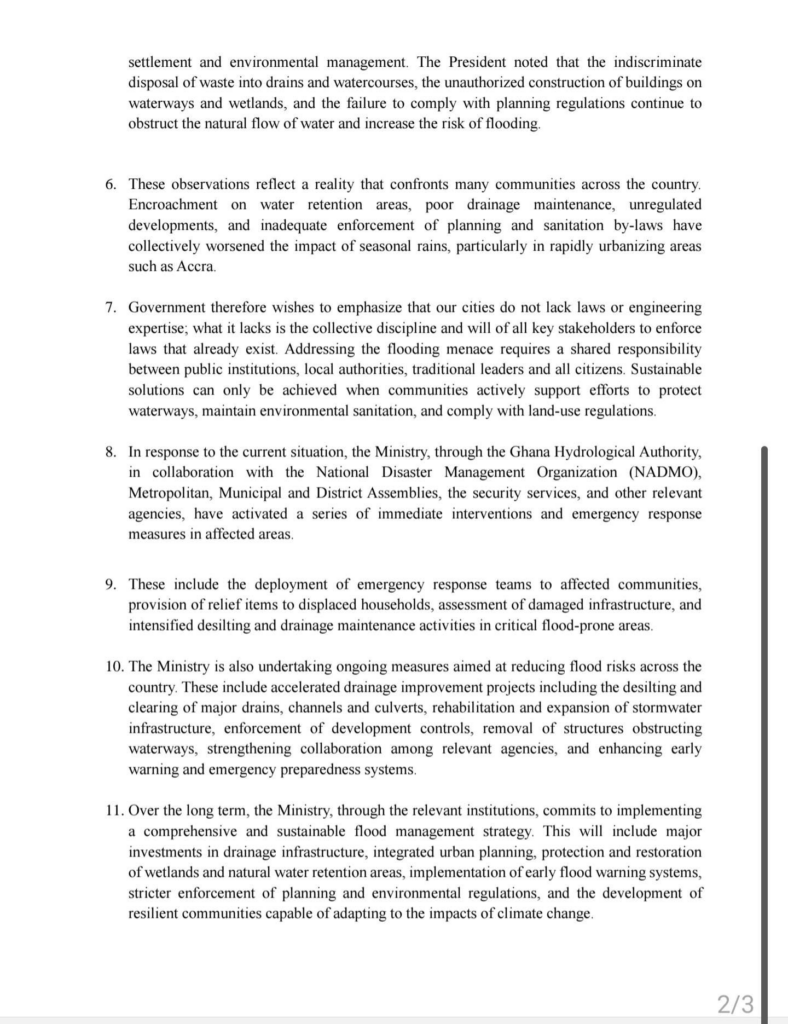
While acknowledging that climate change and increasingly intense rainfall patterns continue to exert significant pressure on urban infrastructure, the Government stressed that human activities remain a major factor contributing to the severity of flooding across the country.
According to the Ministry, indiscriminate disposal of waste into drains and watercourses, unauthorised construction on waterways and wetlands, and persistent disregard for planning regulations continue to obstruct the natural flow of water, thereby increasing the likelihood and impact of flooding.
The statement referenced comments made by President Mahama during a recent town hall meeting in London, where he observed that Ghana's perennial flooding problem is largely exacerbated by poor environmental practices and indiscipline in human settlement planning.
The President reportedly highlighted the widespread dumping of refuse into drainage systems and the unchecked development of structures on waterways as key contributors to recurring flood disasters.
The Ministry further noted that encroachment on water retention areas, poor maintenance of drainage infrastructure, unregulated urban development and weak enforcement of planning and sanitation by-laws have collectively intensified the impact of seasonal rains, particularly in rapidly expanding urban centres such as Accra.
The Government emphasised that Ghana does not lack the legal framework or technical expertise required to address flooding. Rather, the challenge lies in ensuring effective enforcement of existing laws and securing the cooperation of all stakeholders.
Officials argued that addressing the flooding menace requires a collective effort involving central and local government institutions, traditional authorities, community leaders, developers and ordinary citizens.
The Ministry stated that sustainable flood mitigation measures can only succeed if communities actively support efforts to protect waterways, maintain environmental sanitation and comply with land-use regulations.
The statement called on Ghanaians to recognise their role in safeguarding the environment and preventing activities that contribute to flooding.
As part of immediate response measures, the Ministry announced that several agencies have been mobilised to support affected communities.
Working through the Ghana Hydrological Authority and in collaboration with the National Disaster Management Organisation (NADMO), Metropolitan, Municipal and District Assemblies, security services and other relevant institutions, the Government has activated a range of emergency interventions.
These measures include the deployment of emergency response teams, distribution of relief items to displaced households, assessment of damaged infrastructure and intensified drainage maintenance operations in flood-prone areas.
Authorities have also commenced desilting exercises and emergency clearing of blocked drains in an effort to improve water flow and minimise the risk of further flooding should additional rainfall occur.
Government officials said the interventions are aimed at providing immediate relief while laying the groundwork for long-term recovery in affected communities.
Beyond the emergency response, the Ministry outlined a number of ongoing initiatives designed to reduce flood risks across the country.
These include accelerated drainage improvement projects, large-scale desilting and clearing of major drains, channels and culverts, expansion and rehabilitation of stormwater infrastructure, stricter enforcement of development controls and the removal of structures obstructing natural waterways.
The Government also intends to strengthen coordination among relevant agencies while enhancing early warning systems and emergency preparedness mechanisms to improve the country's resilience to extreme weather events.
Officials believe these measures will significantly reduce the vulnerability of communities to future flooding and improve disaster response capabilities.
The Ministry revealed that a comprehensive and sustainable flood management strategy is being developed to address the root causes of flooding and build long-term resilience.
The strategy will involve substantial investments in drainage infrastructure, integrated urban planning, restoration and protection of wetlands and natural water retention areas, implementation of modern flood warning systems and stricter enforcement of environmental and planning regulations.
The Government also plans to promote the development of climate-resilient communities capable of adapting to increasingly severe weather conditions associated with climate change.
Officials reiterated their commitment to working closely with stakeholders across all sectors to tackle the underlying causes of flooding and create safer, more sustainable urban environments for future generations.
The Ministry appealled to citizens to support national efforts to combat flooding by adopting responsible environmental practices.
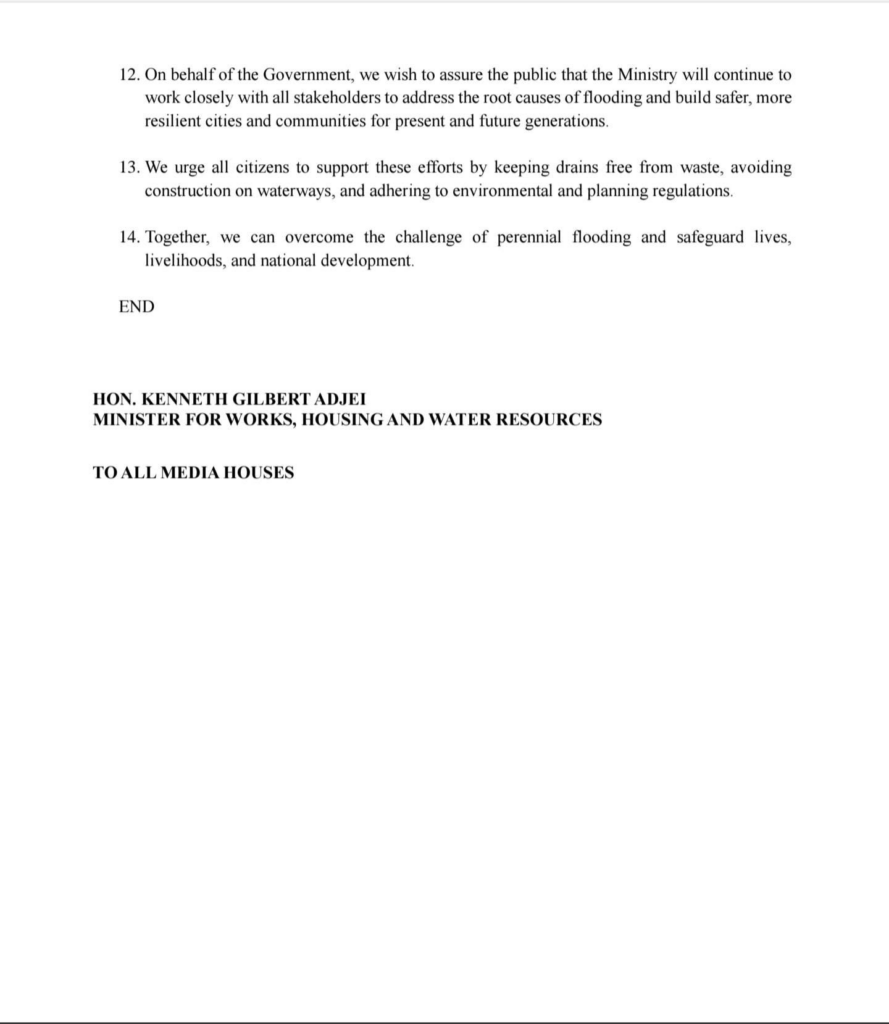
Residents were urged to keep drains free from waste, refrain from constructing buildings on waterways and comply fully with planning and environmental regulations.
The Government expressed confidence that through collective action, stronger enforcement and sustained investment in infrastructure, Ghana can overcome the challenge of perennial flooding.
"Together, we can safeguard lives, livelihoods and national development while building resilient communities capable of withstanding the impacts of climate change," the statement concluded.
Latest Stories
-
Ballon d’Or Power Rankings: Lamine Yamal leads race for Golden Ball ahead of Rodri and Kane
2 hours -
‘Nothing worked for us’ – Gideon Mensah takes responsibility for Gambia defeat
2 hours -
2026 Women’s Super Cup: FC Savannah beat Epiphany Warriors to win trophy for first time
4 hours -
Fifa accuses Uefa of ‘misinformation campaign’
4 hours -
Kane and Gordon give England victory over Czech Republic in Nations League
4 hours -
AFCON 2027Q: ‘The last time Ghana won was eight games ago’ – Carlos Queiroz
4 hours -
AFCON 2027Q: Gambia defeat doesn’t make me a loser – Carlos Queiroz
4 hours -
Yamal inspres Spain to homecoming victory over Croatia
4 hours -
2027 AFCONQ: Late goals seal 2-0 for Côte d’Ivoire against Somalia
4 hours -
I’d stick my Man City medals in bin – Keane
4 hours -
AFCON 2027Q: My resignation won’t solve Ghana football issues – Queiroz
4 hours -
Morocco call off Ghana friendly after Black Stars’ AFCON setback
4 hours -
It is time for Tuchel to offer Alexander-Arnold some trust
5 hours -
‘We have to say sorry’ – Queiroz apologises after Ghana’s humiliating defeat to Gambia
5 hours -
New Yorker identified as Yaw Boahene, 57, killed after bag was caught in subway train doors
5 hours