

Audio By Carbonatix
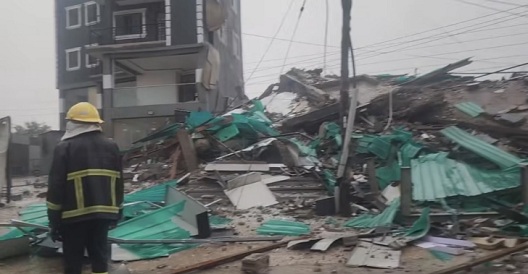
A structural engineer who inspected the site of Sunday's Avenor building collapse has raised serious concerns about the quality of concrete used in the four-storey structure, saying it visibly falls short of basic engineering standards.
Emmanuel Aidoo, a Professional Engineer with the Ghana Institution of Engineering specialising in Structural Engineering, told journalists that even from a visual assessment, the concrete in the collapsed building showed clear signs of weakness.
"Visually, from the concrete, what I'm seeing is that you can clearly see that that concrete is not in the best condition," he said.
Speaking on Joy FM's Super Morning Show, Aidoo explained that standard structural engineering requires concrete to achieve a compressive strength of at least 25 Newtons per square millimetre — a benchmark he does not believe this structure would meet.
"I don't think it will get to that particular value," he said.
He described the collapsed structure as a four-storey building — ground floor plus three additional floors — with a hidden roof, located along a road he said he travels frequently.
"This is not a single-storey building — your house or something. This is a four-storey building, so the concrete, the steel, everything has to be designed. These structures have to be engineered. You can't just use your mind to construct such buildings. It'll come back and hunt you," Aidoo said.
He added that construction on the building is believed to have begun around 2020 or 2021, making it barely six years old at the time of its collapse.
"For it to just come down, it's an issue," he said.
Aidoo noted that his observations are based on an initial visual assessment, and that formal tests — including concrete sampling and structural modelling — are yet to be conducted before definitive conclusions can be drawn.
His remarks follow a separate disclosure by fellow engineer Prince Kas-Avotri, also of the Ghana Institute of Engineers, who said the building appears to have been constructed without a permit from the Accra Metropolitan Assembly — meaning no approved architectural or engineering plans were in place to guide the construction.
The collapse, which occurred in the early hours of Sunday, June 7, killed two people and left two others hospitalised.
It is the second building collapse in Accra within a week, coming days after a similar incident at Adenta New Site on June 3rd, which claimed one life.
Latest Stories
-
Mahama directs Finance Minister to allocate GH¢1bn for Housing Fund in 2027 Budget
4 minutes -
NPP celebrates Bawumia on birthday, prays for 2028 election victory
4 minutes -
Mahama recounts ‘exhausting and frustrating’ struggle to find a home as a young spouse
10 minutes -
‘Take damaged banknotes to commercial banks for replacement’ – BoG warns against repairing cedi notes for resale
17 minutes -
Lebanon’s Hezbollah gets $200 million from Iran to help displaced, sources say
17 minutes -
Bisa Kdei to launch annual Highlife music event ‘The Convention’
18 minutes -
BoG cautions public against digital financial fraud, ‘double-your-money’ schemes
19 minutes -
WPL 2026/27: Ampem Darkoa Ladies to start title defence against Northern Ladies
30 minutes -
WPL 2026/27: Hasaacas Ladies face Army Ladies in opening round as GFA announce Southern Zone fixtures
42 minutes -
Eduwatch calls for urgent resolution of teachers’ strike and reforms
44 minutes -
Media worker, journalist remanded over alleged GH¢800k fraud
45 minutes -
Safeguard all personal, financial information, including Mobile Money PINs, ATM PINs – BoG to general public
47 minutes -
Gov’t launches roadmap to implement Social Protection Act, Regulations and Affirmative Action Regulations
47 minutes -
Photos: Pete Edochie meets GoldBod CEO Sammy Gyamfi over African youth mentorship initiative
49 minutes -
Black Maidens: Ghana’s envious record at U-17 Women’s World Cup ahead of seventh appearance
1 hour