

Audio By Carbonatix
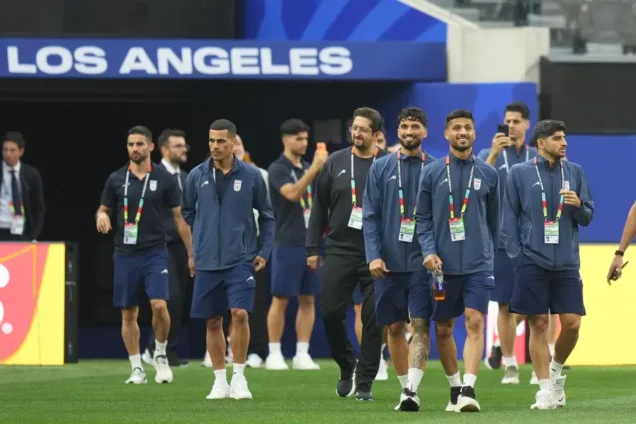
The Iranian national soccer team arrived at Los Angeles International Airport on Sunday for its first appearance at the 2026 FIFA World Cup. The squad landed and held a press conference on the same day that Washington and Tehran announced a peace agreement to end a four-month war.
For months, profound uncertainty enveloped Iran’s participation following the joint U.S.-Israeli military strikes on Iran. Shortly before 4 p.m. on Sunday, a FIFA official issued an apology to reporters gathered at SoFi Stadium near Los Angeles because the team had been delayed. Under normal circumstances, the gathering would have been a perfunctory pregame news conference. When the team’s captain and head coach finally emerged, a major hurdle had been overcome. Iran had safely made it to the United States to open its tournament campaign against New Zealand on Monday.
The situation represents one of the biggest crises in the World Cup’s near 100-year history. This is the first time a tournament host has received a participating country with which it is in active military conflict.
The squad arrived after a short flight from Tijuana, Mexico, where they had been exiled. The team moved its World Cup base camp from a sports complex in Arizona to Mexico late last month after the U.S. and Israel conducted joint strikes on Iran beginning in late February. Heavily armed security provided by Mexico's government is permanently stationed outside the team’s hotel and accompanies the squad to practice.
Despite the peace breakthrough, severe operational restrictions remain. The travel visas issued by the U.S. government limit the Iranian contingent to less than 48 hours on American soil per visit. This mandate requires the entire squad to return to Mexico immediately following each match. Iran plays New Zealand on June 15 in Los Angeles, returns to the city to face Belgium on June 21, and meets Egypt in Seattle on June 26.
The U.S.-Iran Peace Accord
Hours after the opening press conference, a major diplomatic breakthrough reframed the context of Monday's upcoming match. The United States and Tehran officially announced a deal intended to conclude the military conflict that erupted in February.
The historic agreement will be signed during a formal ceremony on Friday in Switzerland. U.S. President Donald Trump and Pakistani Prime Minister Shehbaz Sharif confirmed the upcoming diplomatic event via synchronised social media announcements on Sunday.
While the impending treaty signals an end to active military operations, soccer officials confirmed that the rigid security and travel protocols established for the Iranian squad will remain unchanged for the remainder of the group stage.
Visa Bans and Sanctions
The administrative fallout has severely impacted the team's logistical preparations and personnel. Four members of Iran's World Cup delegation won appeals against initial visa rejections, but 11 members remain banned from entering the United States.
Iran last week accused the U.S. of denying visas to "integral" members of its backroom staff after officials in Washington said players had been permitted to travel. Of the 15 delegation members initially denied U.S. visas, 10 submitted fresh applications after arriving in Mexico.
Four of those appeals succeeded, including a technical analyst and two officials from the federation's international department. The remaining six applicants were rejected again. This group includes Iran Football Federation (FFIRI) President Mehdi Taj, a vice president, two team administrators responsible for day-to-day operations, a media officer, and a security officer. A second media officer chose not to reapply.
The FFIRI had previously presented FIFA with a list of 10 conditions for participation. This list included allowing players, coaches, and officials who completed military service with the Islamic Revolutionary Guard Corps (IRGC) to enter. U.S. Secretary of State Marco Rubio said Iran's players would be welcome, but individuals with links to the IRGC could face entry restrictions. Due to these restrictions, Iran was not represented at a meeting of FIFA's annual congress in Vancouver in April after Canadian officials turned delegation members away at the border, citing IRGC links. FIFA does not limit the size of a nation's delegation, but it only covers costs for up to 50 individuals.
The visa complications extended beyond the Iranian delegation. Fans from some nations have been barred from entry, and Somali referee Omar Artan was denied entry to the United States to officiate at the World Cup.
Former FIFA president Sepp Blatter criticised the governing body over these entry issues. Blatter, 90, left his post following corruption allegations and served a six-year ban from football, though a criminal case later cleared him of the charges. He posted on social media: "A Fifa World Cup host country must guarantee two fundamental principles: the safety of the country, and the unrestricted entry of all qualified teams, officials and referees. The case of referee Omar Artan from Somalia is against one of these obligations. Fifa must never compromise the universality of football."
United States sanctions have also dismantled the ticketing infrastructure for Iranian fans. The team's group-stage ticket allocation for supporters was officially revoked by U.S. officials this week. FIFA stated that the initial sales plan would breach federal sanctions, though the governing body insists it is working to maximise opportunities for Iranian supporters to attend matches.
On Saturday, the team completed its final practice in Tijuana. The team attempted to project a unified front by forming a circle that included the officials who had been barred from travelling across the border.
Send-off in Tijuana versus Protest in Los Angeles
The joyous atmosphere that accompanied the team's departure from Mexico stood in sharp contrast to the reception in Southern California. In Tijuana, supporters lined five-deep on a packed sidewalk outside the hotel chanted "Team Melli"—Persian for "national team"—as the players walked toward their bus.
Many players waved and smiled, and some recorded the scene on their phones. One supporter held a yellow sign reading: "Iran, you will never walk alone. Mexico stands with you." A young boy perched on a pair of shoulders clutched the official Panini FIFA World Cup 2026 sticker album, open to the Iran squad page. At one point, the crowd sang in Spanish, "Iran, brother, you are Mexican now."
Iranian soccer federation President Mehdi Taj stood outside the hotel as the players left, with supporters following the bus down the street. The Iranian community in Tijuana is tiny, numbering around 20 people.
Conversely, Los Angeles is home to the largest Iranian diaspora outside of Iran, an influential community often referred to as "Tehrangeles." While the squad flew to Los Angeles, a group of protesters calling for democracy in Iran and denouncing its government rallied near the stadium in Inglewood. A small group of protesters also chanted slogans against the team as their bus arrived at the hotel in Manhattan Beach on Sunday night, and much larger protests are expected on game day.
Placards at the rally read: "No Shah - No Mullah in Iran - Regime Change by Iranians." Pictures and posters of athletes who protesters said had died after being arrested by the Iranian government lined a busy street corner.
The January domestic crackdown in Iran, which rights groups and activists say killed thousands or possibly tens of thousands, was a central catalyst for the mobilisation. “They're holding hostage their own people," said Mojgan Ramezani, 56, an Iranian American at the rally.
Another attendee, 70-year-old Hassan Haddadi, expressed frustration with international passivity. “We’re hoping to bring awareness to the western world, to somehow do something beyond just condemning, to bring an end to this regime," Haddadi said.
Some demonstrators view the squad as an extension of the state rather than a representative of the populace. Mehrdad Ali, who was born in Iran and moved to Los Angeles 26 years ago, said he would attend the match solely to protest and was indifferent to the results on the field. “I want to change the regime,” he said, wearing a T-shirt bearing the face of the former Shah of Iran, who was deposed by the 1979 revolution. “This is a government team, not the Iranian team.”
The intensely charged political environment has alienated other members of the local diaspora. Sahar Salajegheh, a dental surgeon who opposes the regime, noted that the vocal diaspora presence influenced her decision to stay away. “I might not go because of the Los Angeles diaspora,” Salajegheh said. “I don’t want to get in trouble with them. That’s the only reason I wouldn’t go, even though my friends have a ticket for me.”
Iranian soccer officials have pressed FIFA to take firm action to stop spectators from bringing in flags, clothing, or other symbols of Iran from before the Islamic Revolution of 1979.
The Impact on Sporting Focus
The combination of travel demands, visa denials, and political friction has placed a heavy burden on the roster. Head coach Amir Ghalenoei acknowledged that the preparation process had compromised the squad's technical focus.
The manager emphasised the difficulty of insulating his players from external distractions. “Without any doubt, this will impact negatively the spirit of football,” Ghalenoei said. “I have really tried to make sure that my players focus on strategy and techniques.”
Ghalenoei later stated that the players and coaching staff should not be viewed through a political lens. "I am very happy to be representing the great, proud and strong nation of Iran," Ghalenoei said through a translator at the stadium press conference. "I hope that football will bring about joy and enjoyment, and bring closer the cultures and countries."
The manager later added, "We are not political people. We are here to play football and represent the respectful people of Iran, be it the Iranians inside Iran or the Iranian diaspora."
The team's captain also expressed a desire for the tournament to fulfil its traditional role as a vehicle for global harmony.
“This kind of tension undermines that joy, and it undermines the message of FIFA and our people, which is about football and bringing about peace,” said Mehdi Taremi, the team’s star player and captain. “I think this World Cup could have provided a better atmosphere than it has, and I hope in the future it will be better for all fans, whoever they are supporting.”
A Charged Intersection of Sport and Diplomacy
As kickoff approaches, the opening match between Iran and New Zealand stands as a stark visual reminder of the thin line between international athletics and global geopolitics. For the first time in modern tournament history, a pitch will serve as the immediate meeting ground for nations transitioning away from active warfare.
Whether the newly announced peace framework will diffuse the tangible anxieties surrounding the match remains to be seen. For the players inside the stadium and the fractured diaspora community outside it, Monday's match represents far more than ninety minutes of soccer.
Latest Stories
-
Vieira named new Senegal head coach
2 hours -
Global borrowing costs hit fresh highs on oil, AI and inflation
2 hours -
American Airlines to bring back TV screens on US flights
2 hours -
Carney’s final chance to convince Trump as US-Canada trade deadline looms
2 hours -
BOSTenergies meets fuel tanker drivers over their concerns at the Kumasi depot
2 hours -
X1 Energy Drink-backed DOL Super Cup ends with Ebusua Dwarfs crowned champions
3 hours -
Disney and ABC sue Trump’s media regulator to stop early licence renewal
3 hours -
Luv FM High School Debate: Prempeh dethroned as CHRISSEC and KUHIS ignite quarter-final path
3 hours -
British couple on honeymoon killed in helicopter crash on Greek island
3 hours -
George Opare Addo to lead National Youth Forum in Accra
3 hours -
ECG invested GH¢710,965 in infrastructure replacement across Greater Accra – PURC
3 hours -
Cyber Security Authority, EY resolve satisfactorily matters relating to licence fees
3 hours -
Beyond the ribbon: Why the sport of dog showing matters for every pet owner
4 hours -
Illegal mining drives Ghanaian children from classrooms into hazardous labour
4 hours -
NACOC committed to strengthening border security – DG
4 hours