

Audio By Carbonatix
A leading Ghanaian cancer organisation, Breast Care International, has appealed for tax and duty waivers on donated medical supplies, warning that port charges are limiting access to millions of dollars' worth of medicines that could benefit patients across the country.
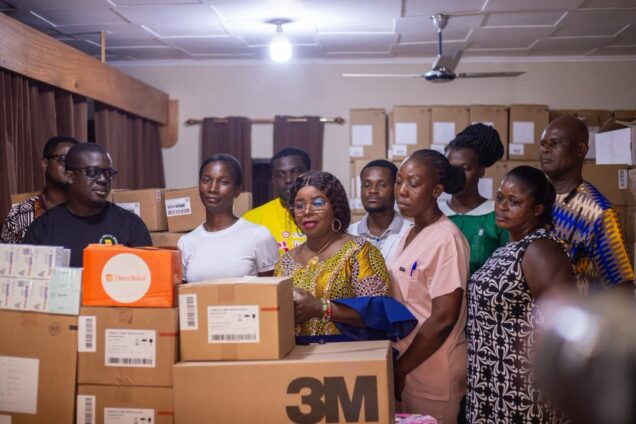
President of Breast Care International and Founder of Peace and Love Hospital, Dr Beatrice Wiafe Addai, said her organisation recently received donated medicines with a wholesale value of about $4.8m, but bringing such supplies into Ghana remains costly because of taxes, duties and handling charges at the ports.
"Items we receive now, the wholesale price is about 4.8 million US dollars. But we didn't buy. They donated to us," she said.
"What is left of us is to be given the waiver at the ports, so we can also ask for more."
According to Dr Wiafe Addai, the organisation receives branded medicines from international partners and redistributes them to hospitals and clinics that need them.
"These are branded medications. They are not generic ones," she said, adding that, the medications are quite expensive, which the ordinary Ghanaian may not be able to afford.
The medicines are shared with partner health facilities across the country whenever donations arrive.
"When we receive the medications, we also donate them to our partner institutions," she said.
"Whenever we get these items, we inform them that we have these items. So if your facility can use some, you have to come and pick them."
For some hospitals, the donations have become an important source of medicines for patients who would otherwise struggle to afford treatment.
A pharmacist at Kokofu General Hospital in the Ashanti region, Fitrught Acheampong, said many patients attending the rural facility often fail to buy prescribed medicines because of their cost.
"Most of our patients come and then you give them some medications and then because of the price, they actually do not get the drugs," he said.
"The next time they come, they realise that they're not even getting better."
According to her, patients frequently return to the hospital after failing to purchase medicines prescribed for them.
"Once you ask them, I wrote this medication, you're supposed to get them from the market and buy them, they're like, the price was too expensive and then they couldn't afford them," he said.
The Pharmacist said the donated medicines from Peace and Love Hospital have helped bridge that gap by allowing patients to receive treatment free of charge.
"We've realized that once we get these drugs, and then we're also giving them to these patients for free," he said.
Because patients no longer have to pay for the medicines, she said they are more likely to return for treatment and follow medical advice.
"The patients are now actually coming to the hospital regularly for their usual times and then they're also taking their drugs," he said.
She said the free medication has also encouraged more people in surrounding communities to seek medical care.
"They even have people that are also in their various houses who are probably sick and then they are even advocating to them that, 'Oh, you can come to Kokofu, their drugs are free'," he said.
"So, we're actually getting a lot of patients now because of these drugs that have been given to them for free. So, it's actually helping."
Among the latest donations are large quantities of contraceptives and blood-thinning medication used to prevent dangerous complications following surgery.
Dr Wiafe Addai said access to contraceptives remains critical, particularly in rural communities where women often struggle to support large families amid economic hardship.
"Some of us in the cities may think that contraceptives are nothing. But those in the communities, contraceptives are very important," she said.
"Especially when you have a woman who is giving birth to 8, 9, 10 kids and they don't even know how to take care of them." She added that, "We need to help our women to space their births."
The donation also includes anticoagulants, commonly known as blood thinners, which are used to prevent blood clots before and after major surgery.
"I think a lot of people have heard about patients who have had complications after big surgeries," she said. "After surgery, when patients are not able to move around, the blood tends to clot and these clots, when they can cause a lot of havoc. They can kill."
Dr Wiafe Addai said many patients are unable to afford the medication because of its high cost, despite its potential to prevent life-threatening complications.
"If we are able to prevent the clot from forming, we will be able to save a lot of lives," she said.
She argued that removing taxes and duties on donated medical supplies would enable organisations such as hers to bring in more medicines and equipment for health facilities across Ghana.
"Because we have to pay the cost at the ports, the handling charges, the taxes, the duty," she said. "If we will have the waiver, it will help us to ask for more drugs."
Dr Wiafe Addai said international partners like Direct Relief were willing to donate additional medicines, consumables and equipment, but the costs associated with clearing them through Ghana's ports remained a major obstacle.
"They have a lot of drugs there. They have a lot of consumables. They have a lot of equipment that they can give to us," she said. "But because of those challenges, we are not able to ask for a lot of things."
She urged authorities to make it easier for charities to access donated medical supplies, saying many Ghanaians continue to depend on them.
"Our people need them. We know that our people need these drugs," she said.
"So, we should try and make things easy for us, so we can receive more for our people to benefit from."
Latest Stories
-
Cedi stages strong recovery as dollar supply improves, demand eases
14 seconds -
Duncan-Williams warns galamsey could endanger Ghana’s future generations
59 seconds -
Fire ravages wooden structures at Tantra Hill’s Golden Door area
7 minutes -
Petrol prices to drop today with diesel up in mixed pump price review
7 minutes -
Okoe Boye will help NPP win more seats in Greater Accra – Bawumia
12 minutes -
I am open to work with everyone to win 2028 — Bawumia
18 minutes -
Peace, security practitioners tasked to deepen stakeholder collaboration
23 minutes -
Public pay system must balance fair wages with fiscal sustainability – Government
28 minutes -
Niharika Handa makes history as King Faisal’s first female Board Chair
31 minutes -
Gov’t disburses GH¢23.1bn to clear road contractors’ arrears – Roads Minister
35 minutes -
Massive crowd turns out for Brock Royal Family’s Osu Duku Walk
36 minutes -
Aboboyaa Group donates two motorcycles to NACOC Ashanti Command
41 minutes -
Sexual harassment has no place in educational institutions – Education Ministry
48 minutes -
Rev Prof Amevenku elected 15th EPCG Moderator, pledges servant leadership
54 minutes -
Military leaders urged to prepare for emerging security threats
59 minutes