

Audio By Carbonatix
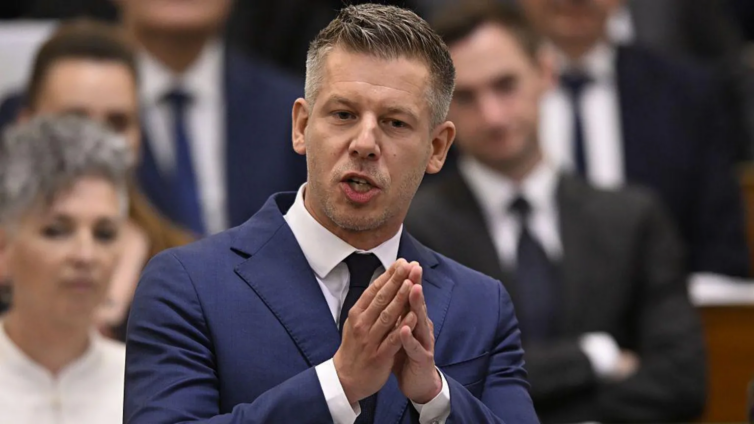
The Hungarian parliament has backed a constitutional amendment limiting a prime minister's term to eight years, fulfilling Péter Magyar's promise to prevent Viktor Orbán from becoming prime minister again.
Orbán led Hungary uninterrupted for 16 years, until the Magyar Tisza party swept him from power in April's election, winning a two-thirds majority that gives it the power to amend the constitution.
Under the change, no prime minister since 1990 can serve more than two terms in office, even if they are years apart.
Orbán's depleted Fidesz party voted against the measure, and the former prime minister, who was re-elected as its leader at the weekend, was highly critical of it.
"The Orban law has just been voted through. That was the most pressing issue. If I'm needed, I'll be here," he wrote on Facebook.
Orbán complained that Tisza had only been in power a month and that it should not be "dreaming of eight years" into the future.
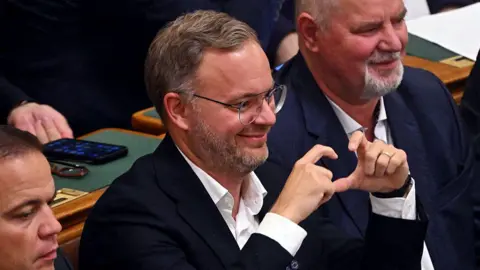
The Tisza government's so-called super-majority meant the amendment sailed through by 135 votes to 50, and the law now just needs President Tamás Sulyok's signature to pass.
Orbán's former political director, Balázs Orbán, accused Magyar of "using political power to exclude a political opponent from democratic competition".
Although the amendment to Hungary's Basic Law could, in theory, be changed by a future government with the necessary supermajority, the new provision also means that Magyar would only be able to serve as prime minister until 2034.
He took office last month with a promise to dismantle some of the highly controversial state apparatus that Fidesz put in place during its 16 years in power.
For four years running, the organisation Transparency International has labelled Hungary the most corrupt country in the European Union, and the EU withheld billions of euros in funds because of concerns over the rule of law, corruption and democratic backsliding.
Last month, the European Commission agreed to unlock €16.4bn (£14.2bn) in funding, subject to a series of reforms to combat corruption that have to go through parliament.
As well as placing a limit on a prime minister's rule, Monday's amendment scrapped a requirement for an independent agency to protect Hungary's "constitutional identity".
That signalled the end of Orbán's Sovereignty Protection Office, created in 2023 to monitor "undue political interference" by "foreign interests".
It also targets so-called "Kekva" public trust foundations created under the previous government through the transfer of state assets such as companies and education institutions.
The government intends to return the assets to the state or cut funding for institutions such as the vocational college Mathias Corvinus Collegium (MCC).
MCC has close ties to Fidesz, and its board of trustees is led by the ex-prime minister's political director, Balázs Orbán.
On Tuesday, Hungary's parliament turned its attention to further changes to the law required before some of the billions of euros withheld by the European Commission can be unfrozen.
These include boosting the role of Hungary's anti-corruption watchdog, the Integrity Authority.
Parliament also commemorated the anniversary of the execution of the leaders of Hungary's 1956 revolution against Soviet rule.
The six leaders, including then-Prime Minister Imre Nagy, were each named by Magyar, and MPs also marked the date of their 1989 reburial.
During the session, Balázs Orbán accused Magyar of pushing through reforms that left thousands of Hungarian students facing an uncertain future, prompting a clash with the prime minister.
Magyar said that in October Hungarians would mark the 70th anniversary of the 1956 revolution, which had turned over a new page in their history, becoming part of the "free world".
Latest Stories
-
Governed differently: The political economy of state absence in Africa
21 minutes -
Boakye Agyarko vows to rebuild NPP as over 50 constituency chairpersons back his chairmanship bid
36 minutes -
APL poll puts Bawumia ahead of seven potential NDC contenders
58 minutes -
Character, jobs and cost of living: APL poll shows what voters will use to decide 2028 election
1 hour -
Vieira named new Senegal head coach
3 hours -
Global borrowing costs hit fresh highs on oil, AI and inflation
3 hours -
American Airlines to bring back TV screens on US flights
3 hours -
Carney’s final chance to convince Trump as US-Canada trade deadline looms
3 hours -
BOSTenergies meets fuel tanker drivers over their concerns at the Kumasi depot
4 hours -
X1 Energy Drink-backed DOL Super Cup ends with Ebusua Dwarfs crowned champions
4 hours -
Disney and ABC sue Trump’s media regulator to stop early licence renewal
4 hours -
Luv FM High School Debate: Prempeh dethroned as CHRISSEC and KUHIS ignite quarter-final path
4 hours -
British couple on honeymoon killed in helicopter crash on Greek island
4 hours -
George Opare Addo to lead National Youth Forum in Accra
4 hours -
ECG invested GH¢710,965 in infrastructure replacement across Greater Accra – PURC
4 hours