

Audio By Carbonatix
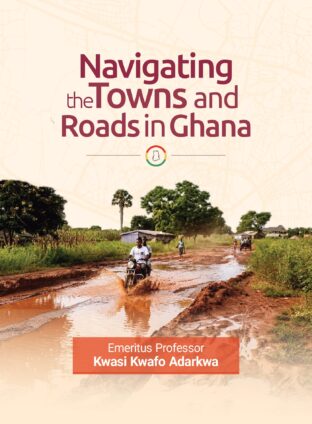
Emeritus Professor Kwasi Kwafo Adarkwa, former Vice-Chancellor of Kwame Nkrumah University of Science and Technology, Kumasi (KNUST), has written a new book that examines the state of Ghana's road network and urban development, offering what he describes as a practical tool for policymakers, planners, engineers and local authorities to address the country's growing road maintenance challenges.
The book, "Navigating the Towns and Roads in Ghana", provides a district-by-district and regional assessment of Ghana's road infrastructure, analysing road conditions, maintenance deficits, connectivity and the growth of towns across the country's 16 regions.
Speaking about the publication, Emeritus Prof. Adarkwa said the work was inspired by concerns over the deteriorating condition of many roads in Ghana despite the country's extensive road network. "We have about 42,000 kilometres of roads, and most of the time more than 50% of the network is not in good condition," he said.
He noted that poor road conditions have increased travel times and imposed significant economic costs on communities and businesses. "If you've travelled between Accra and Kumasi these days, a journey that should take four-and-a-half hours can take much longer. That is not good enough," he said.
According to Emeritus Prof. Adarkwa, the book relies largely on secondary data to document road conditions and the growth patterns of towns across the country. He said the analysis highlights how many settlements continue to expand despite having limited road access and transport connectivity.
A key feature of the publication is an algorithm developed by the author to rank all districts and regions according to the extent of their road maintenance deficits. The rankings are intended to help government agencies and local authorities identify areas requiring urgent intervention. "If you take any region, such as the Oti Region, the book gives you an idea of its structure, major economic activities, the condition of its roads and what can be done to improve them," he explained.
The book also documents examples of communities where poor roads significantly affect mobility and economic activity. Emeritus Prof. Adarkwa cited routes in parts of the Central, Ahafo and Western regions where relatively short journeys can take several hours because of deteriorated road conditions.
He said the publication was intended to support planning and decision-making by key road sector institutions, including the Ghana Highway Authority, the Department of Urban Roads and the Department of Feeder Roads. "The idea is that if the agencies see the condition of their roads, they can begin planning how to eliminate the maintenance deficit," he said.
Beyond road agencies, Emeritus Prof. Adarkwa believes the book will be valuable to district assemblies, engineers, planners, economists and students, particularly those studying transport and settlement planning, civil engineering, geography and economics.
He added that the publication seeks to raise public awareness about the relationship between road infrastructure and national development. "The general public also has a role to play. Once we become more sensitive to these issues, collectively we can begin to work towards solutions," he said.
Published by KNUST University Press, the book presents one of the most comprehensive recent assessments of Ghana's road network, revealing regional disparities in road quality and connectivity while proposing evidence-based approaches to reducing the country's substantial road maintenance backlog.
Latest Stories
-
Economy experience high but unbalanced growth from mid-2000 to 2022 debt crisis – Former 1st Deputy Governor
8 minutes -
Tell Your Story: Political, business and industry leaders to share journey with young Ghanaians
17 minutes -
‘Gold cannot save you at 2am’ – Obuobia Darko challenges mining giants to invest in healthcare
25 minutes -
Wontumi’s incarceration will not stop his chairmanship bid – Palgrave
34 minutes -
Eurobond borrowings over 2007-2021 used for budget financing; Ghana borrowed US$15.59bn – Opoku-Afari
38 minutes -
Newborn baby found in dustbin at Kasoa Main Station toilet
43 minutes -
Ghanaian skincare brand KAEME wins DHL ESG Excellence Exporter of the Year award
1 hour -
Ho Communique: Democracy Not for Sale
2 hours -
National Health Insurance Levy Uncapped: The Game Changer
2 hours -
Akwatia MP accuses Minority of shifting GoldBod debate from facts to personal attacks
2 hours -
Gov’t to spend GH¢2.8bn on secondary infrastructure as Education Minister pushes foundational learning
2 hours -
This is the result of GoldBod activities – Akim Oda MP demand answers over $1.7bn loss
2 hours -
Photos: Sammy Gyamfi at Government Accountability Series
3 hours -
Ghana School of Law SRC President-elect petitions authorities for relief for referred students
3 hours -
Promasidor Ghana unveils Onga Mix Tomato Paste, names Diana Hamilton brand ambassador
3 hours