

Audio By Carbonatix
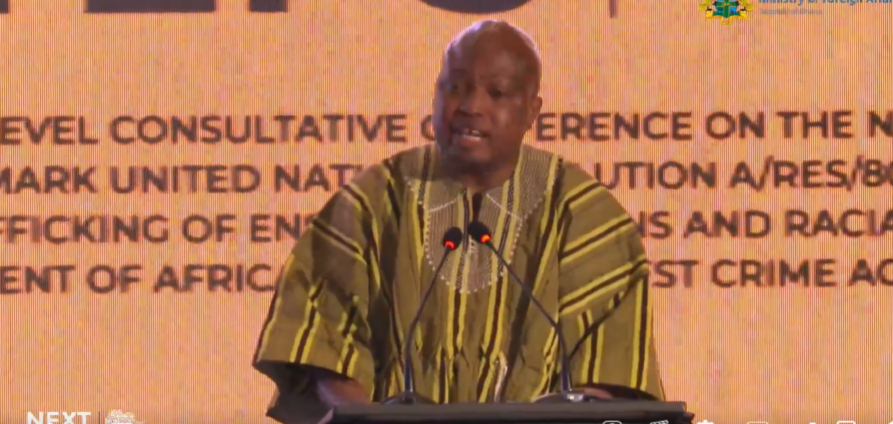
Foreign Affairs Minister Samuel Okudzeto Ablakwa has opened the High-Level Consultative Conference on Reparatory Justice in Accra with a strong historical framing of Africa’s long struggle against slavery, colonialism and racial injustice.
He said the current global push for reparatory justice should be understood as a continuation of earlier victories, arguing that history demonstrates Africa’s ability to overcome systemic injustices.
Addressing heads of state, foreign ministers, scholars and members of the African diaspora, Mr Ablakwa said the reparatory justice agenda is rooted in centuries of resistance and international transformation.
“We have won the battle against slavery, we won the battle against colonialism, we won the battle against apartheid, and we are confident that we shall win the battle against reparatory injustice. We shall win that battle,” he said.
He anchored his remarks in historical milestones, including the 1824 passage of the Consolidated Slave Trade Act in the British Parliament, which he described as a turning point in the formal abolition of slavery in Britain.
Mr Ablakwa also referenced the observance of June 19 (Juneteenth), marking the emancipation of enslaved people in the United States, saying the timing of the conference was symbolic of the broader struggle for freedom and justice.
He said these historical markers reinforce the argument that reparatory justice is aligned with long-standing global efforts to correct historical wrongs.
According to him, the transatlantic slave trade must be treated with the same moral and legal seriousness as other historical atrocities that have attracted international acknowledgement and compensation.
“Just as other atrocities receive reparatory justice, so shall the transatlantic enslavement also have its day in the court of justice,” he added.
The conference forms part of a broader diplomatic initiative by Ghana to advance global discussions on reparatory justice following the adoption of a United Nations resolution in March 2026, which declared the transatlantic slave trade a grave crime against humanity.
Organisers say the meeting is expected to move discussions beyond symbolic recognition toward the development of concrete international frameworks on restitution, apology, and historical accountability.
Latest Stories
-
British couple on honeymoon killed in helicopter crash on Greek island
3 minutes -
Man, 20, drowns while helping travellers cross Ghana-Togo border river
12 minutes -
Top 10 online bill payment platforms in Nigeria
17 minutes -
Fire destroys more than 27 wooden structures at Spintex Coastal junction
20 minutes -
GoldBod: Day of reckoning will come – Afenyo-Markin
22 minutes -
In Photos: Defence Ministry welcomes Kenneth Gilbert Adjei as new Defence Minister
33 minutes -
CSA fines EY Ghana GH¢360,000 for providing cybersecurity services without a licence
41 minutes -
Bonsu Baah scores and assists in Al Qadsiah big win in Saudi King’s Cup
41 minutes -
The Galamsey war and GWL’s fictitious and inaccurate rebuttal
54 minutes -
Afenyo-Markin demands answers over alleged GH¢22bn GoldBod loss
55 minutes -
GoldBod ‘Losses’: We’re not ignorant, we know our job – Afenyo-Markin
58 minutes -
GoldBod cannot hide behind agency role to escape accountability – Afenyo-Markin
1 hour -
‘You don’t get to keep the fees and disown the costs’ – Afenyo-Markin challenges GoldBod
1 hour -
GNPC turns 40, targets oil production recovery and $3.5bn fresh investment
1 hour -
Minority will speak boldly on GoldBod losses despite attacks – Afenyo-Markin vows
1 hour