

Audio By Carbonatix
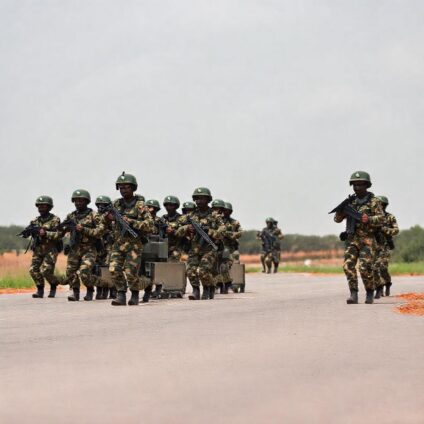
The United States has completed the withdrawal of the majority of troops deployed to Nigeria earlier this year. The deployment followed a mutual agreement between Washington and Abuja to bolster counterterrorism efforts in the Lake Chad Basin. General Dagvin Anderson, Commander of U.S. Air Forces in Africa, confirmed the withdrawal during a virtual press briefing held on Thursday in Luanda, Angola, following the 2026 African Chiefs of Defence Conference.
Success of the joint counterterrorism operation
The mission achieved significant results against extremist elements in the region. U.S. and Nigerian forces successfully executed a high-stakes operation in May that eliminated Abu-Bilal al-Minuki, a senior leader within the Islamic State West Africa Province. General Anderson stated that the operation successfully disrupted the group’s local command structure and its broader international communication network.
He noted that the mission effectively "significantly degraded" the leadership of the Islamic State in the region. The U.S. commander emphasised that the operation demonstrates how Washington aims to provide specialised capabilities to help partners lead their own security efforts. General Anderson further noted that the Lake Chad Basin operation yielded global benefits by disrupting the broader ISIS network.
Evolution of US and Nigerian military cooperation
Military partnership between the two nations intensified significantly following U.S. concerns regarding the protection of vulnerable communities. President Donald Trump had previously alleged that Islamist militants were targeting Christians in Nigeria, a claim the Nigerian government has consistently rejected. Abuja maintains that the violence is multifaceted and impacts diverse communities across the country. Despite these differing perspectives, the tactical collaboration remains intact.
While the specialised ground forces have departed, intelligence-sharing and strategic advisory roles will continue. General Anderson affirmed, "We have withdrawn much of our forces that were just there for that operation, but are continuing the partnership that Nigeria has asked for to help continue with the intelligence sharing and the understanding that’s necessary to be able to prosecute these difficult tasks."
Security challenges and future outlook
Nigeria continues to navigate a complex security landscape marked by insurgency, banditry, and criminal violence. While the joint operation targeted Islamic State affiliates in the northeast, analysts observe that the threat persists across various parts of the country. Nigerian military authorities have signalled that the departure of U.S. personnel will not hinder their operational momentum. Regional security experts suggest that while the death of a senior leader like al-Minuki causes internal organisational stress for insurgents, long-term stability will require sustained pressure and intelligence coordination. The U.S. military maintains that its commitment to regional security cooperation remains a priority for addressing transnational terrorist threats.
Strengthening regional stability across West Africa
The recent joint operation highlights the growing importance of intelligence-led security partnerships as extremist groups increasingly attempt to expand their reach across the Sahel. Analysts note that as security dynamics shift across the continent, nations like Nigeria are prioritising home-grown solutions while utilising strategic international support to address complex, cross-border threats.
For the wider African region, maintaining this balance between internal agency and technical partnership is viewed as a vital step in curbing the spread of violent extremism and safeguarding economic recovery. Strengthening these networks ensures that even as foreign troop deployments fluctuate, the collective capacity to monitor and disrupt illicit terrorist activity remains a sustained priority.
Moving forward, the long-term success of these counterterrorism efforts will likely depend on a sustainable domestic strategy that balances military pressure with comprehensive efforts to address the underlying socio-economic drivers of instability across Nigeria’s diverse regions.
Latest Stories
-
Dodowa-Afienya-Dawhenya road project to be completed by December – Contractor
12 minutes -
Galamsey fight must go beyond empty slogans; it requires conscious effort – Methodist Church
42 minutes -
GoldBod, BoG should share cost of domestic gold programme – Dr Sarkodie
43 minutes -
DGPP losses could leave taxpayers to recapitalise BoG – Prof Bokpin
57 minutes -
GAUA suspends strike ahead of August 25 meeting with Fair Wages
1 hour -
Big Push road projects targeted for completion by end of 2027 – Suhuyini
1 hour -
Early morning blackout disrupts power supply across several regions
1 hour -
Youth Ministry to publish programme data online to boost transparency
1 hour -
Oti NPP Communication Director speaks out against NDC administration
1 hour -
Be vigilant and report suspicious characters to security agencies – Peace Council
1 hour -
GIPA, GUTA agree measures to protect Ghana’s retail sector
1 hour -
NACOC committed to strengthening border security – DG
2 hours -
Bawumia engages engineers on solutions to Ghana’s development challenges
2 hours -
University of Mines and Technology opens underground demonstration Mine
2 hours -
Ghana explores traceability technology to track mined gold sources
2 hours