

Audio By Carbonatix
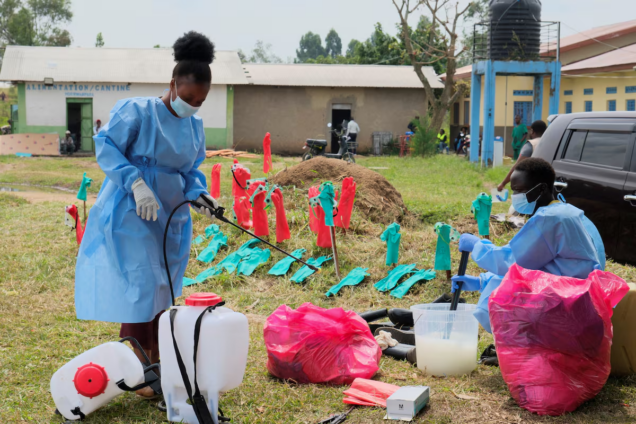
Ebola response workers in northeastern Democratic Republic of Congo staged protests outside three treatment centres on Thursday, saying they had not been paid all they were owed for their work.
The outbreak has infected 1,759 people and resulted in 600 confirmed deaths since it was declared almost two months ago, according to the latest government data released on Wednesday.
The World Health Organisation (WHO) said this week transmission of the rare form of Ebola was continuing; it kills 30% to 50% of those infected and has no vaccine or cure.
Dozens of members of Ebola response teams gathered on Thursday outside the Centre Medical Evangelique (CME), Elikya and Salama treatment centres in Bunia, the capital of Ituri Province, which is the hardest hit.
Police dispersed one of the protests, outside the CME.
It was not immediately clear whether the protests had disrupted operations at the treatment centres.
Speaking to journalists in Bunia, Health Minister Samuel Roger Kamba acknowledged there had been problems with "the human resources pillar of the response", namely with ensuring that the lists of people who needed to be paid were updated and accurate.
An official at Africa's top public health agency said at an online press conference that it was working with Congolese authorities to speed up payments to frontline health workers.
"This is very important to keep (up) the morale," Africa CDC official Wessam Mankoula said. He said the Africa CDC had provided Congo with about $2 million to support its Ebola response, some of which could be used to make "delayed payments" to health workers.
A Congolese health official, who asked not to be named as he was not authorised to speak to the press, told Reuters that talks were under way with workers who were threatening to go on strike, but that no strike had begun so far.
WORKERS SAY PAY IS LATE, DOES NOT REFLECT WORKLOAD
In a letter dated July 5 and addressed to Ituri's governor and health officials, Ebola response workers said they had not been paid for services rendered since the start of the latest Ebola outbreak, which was announced on May 15.
The letter said this had resulted in "significant socio-economic difficulties" and severely affected the workers' living conditions.
The workers also complained that compensation rates were too low relative to the risks and workload involved in the Ebola response.
They demanded an increase in daily allowances and called for the removal of income tax deductions, arguing that allowances constituted bonuses rather than salaries.
Latest Stories
-
Ghana Maritime Authority, Humanity First commission 4 boreholes in Wa to end water scarcity and keep children in class
7 minutes -
In Photos: Day Two of ‘SYPALA 2026’ focuses on governance, economic freedom and youth leadership
23 minutes -
Wontumi withdraws from NPP chairmanship race, urges support for Bawumia
42 minutes -
UCC-IEPA, CEGRAD launches free digital skills programme to empower 1,000 women in education
48 minutes -
NPP dismisses extortion allegation against Afenyo-Markin, says focus remains on GoldBod losses
1 hour -
Guinness Ghana DJ Awards 2026 set for December 4 as ‘All Out’ era begins
1 hour -
GhIE inducts 183 engineers, calls for stronger action on galamsey and infrastructure
1 hour -
Thousands of children receive free specialist care at Asafo-Boakye Specialist hospital fair
1 hour -
I’m yet to receive official confirmation of Wontumi’s Chairmanship withdrawal – Opare Ansah
1 hour -
Independent voices must be part of gold programme probe – Dr Rasheed Draman
1 hour -
ACEPA backs full probe of Domestic Gold Purchase Programme from inception
2 hours -
KNUST Statutes update sparks fresh debate as staff challenge official narrative
2 hours -
NUTE must strengthen 49 colleges, not become another public university – Eduwatch
2 hours -
Awal Mohammed files for Nasara Organiser, vows to rebuild NPP Nasara structures ahead of 2028
2 hours -
IERPP demands answers as GoldBod reports disappear from website
3 hours