

Audio By Carbonatix
One of the longest-running and most fiercely contested legal battles in Ghanaian sports has finally come to an end after the High Court delivered a landmark judgment that decisively settles the governance of amputee football in Ghana.
In a ruling expected to reshape the future administration of the sport, the High Court found in favour of the National Sports Authority (NSA) and the National Paralympic Committee (NPC) Ghana, affirming their authority over the governance and recognition of amputee football under Ghana’s national sports framework.
Delivering judgment in the case Ghana Amputee Football Federation v. National Sports Authority & Others in Commercial Court 6, Justice Jerome Noble-Nkrumah, JA, dismissed the plaintiffs’ claims in their entirety, holding that the case presented by the National Sports Authority and NPC Ghana was more probable. The Court consequently granted the reliefs sought in the defendants’ counterclaim.
The Court also awarded GH¢60,000 in costs to each of the National Sports Authority and NPC Ghana, although the two institutions had respectively sought GH¢250,000 and GH¢200,000.
In one of the most significant aspects of the ruling, the Court granted reliefs that include perpetual orders affecting the Ghana Amputee Football Federation (GAFF) and Francis Adjetey Sowah, Charles Narh Teye, John Kuku Dsane, Philip Cecil Richter and Benjamin Charles Armah, in accordance with the terms of the judgment not to associate themselves with Amputee sport in Ghana.
The decision effectively ends a dispute that has dominated amputee football administration in Ghana for well over a decade.
Court records, official correspondence, witness statements and institutional documents reviewed in connection with the proceedings indicate that the dispute dates back to 2013–2014, when disagreements emerged regarding which institution possessed the lawful mandate to administer amputee football in Ghana.
Over the years, the disagreement evolved into one of Ghana’s most protracted sports governance disputes, involving multiple court proceedings, competing institutional claims, government intervention and correspondence involving international sporting bodies.
The litigation centred on critical questions concerning which institution possessed the legal mandate to administer amputee football in Ghana, the legal recognition of competing organisations, the legitimacy of governance structures and elections, and the authority of Ghana’s national sports institutions under the country’s sports governance framework.
Throughout the proceedings, the National Sports Authority and NPC Ghana consistently maintained that amputee football falls within Ghana’s recognized national sports governance architecture.
The documentary record further shows that while the substantive case remained pending, the Commercial Division of the High Court directed the then Ministry of Youth and Sports to develop measures to ensure Ghana’s participation in international amputee football competitions.
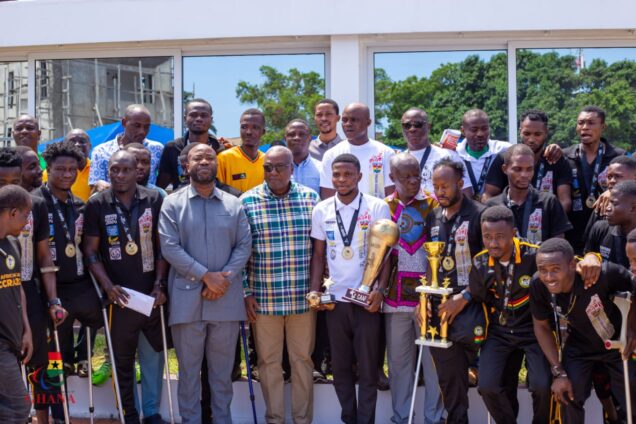
Following submissions by the Ministry, the Court approved a structured roadmap that enabled Ghana to compete at the Amputee Football World Cup while preserving the integrity of the pending litigation. The implementation of that roadmap was supervised by the Ministry with recognized roles assigned to the Samson Deen’s Led NPC Ghana.
The judgment marks a defining moment for sports governance in Ghana. By resolving years of uncertainty over institutional authority, the ruling is expected to provide greater administrative clarity, reinforce the country’s sports governance framework and allow stakeholders to concentrate on athlete development, international competitiveness and the long-term growth of amputee football.
With the legal dispute now concluded, attention is expected to shift from courtroom battles to rebuilding the sport, strengthening governance structures and creating a united platform to advance opportunities for Ghana’s amputee footballers both at home and on the international stage.
A detailed analysis of the Court’s judgment and its legal implications for sports governance in Ghana will follow after the full written decision has been reviewed.
Latest Stories
-
Kejetia Phase III pricing talks loom as government moves to restart stalled works
9 minutes -
Nchiraa Yam festival: Two killed, 14 injured as police restore calm
16 minutes -
I draw inspiration for my songs from Reggae music – Lyrical Joe
17 minutes -
AI must not replace human judgment in public spending – BoG Governor
20 minutes -
Ghana should withdraw from 2027 AFCON – Kojo Addae Mensah
30 minutes -
Team Ghana departs Accra for Angola ahead of Karting Africa Trophy
36 minutes -
AIT President Prof Clement Dzidonu urges lifelong learning as AI reshapes work and education
39 minutes -
FWSC to meet striking teacher unions on Tuesday
40 minutes -
NPP won’t force candidates to step down – Miracles Aboagye
54 minutes -
Black Stars: Building in the sinking sands
55 minutes -
Low inflation on paper, high cost of living: How Presidents Mahama and Trump are facing stark economic reality
1 hour -
NPP will negotiate with popular non-politicians to secure winnable candidates – Miracles Aboagye
1 hour -
Only 5% of Ghanaians can afford housing without support – Gov’t
1 hour -
Nigeria launches rescue after military plane crashes with 32 aboard
1 hour -
GES digitalisation already exists; restore discontinued platforms – Adutwum spokesperson
1 hour