

Audio By Carbonatix
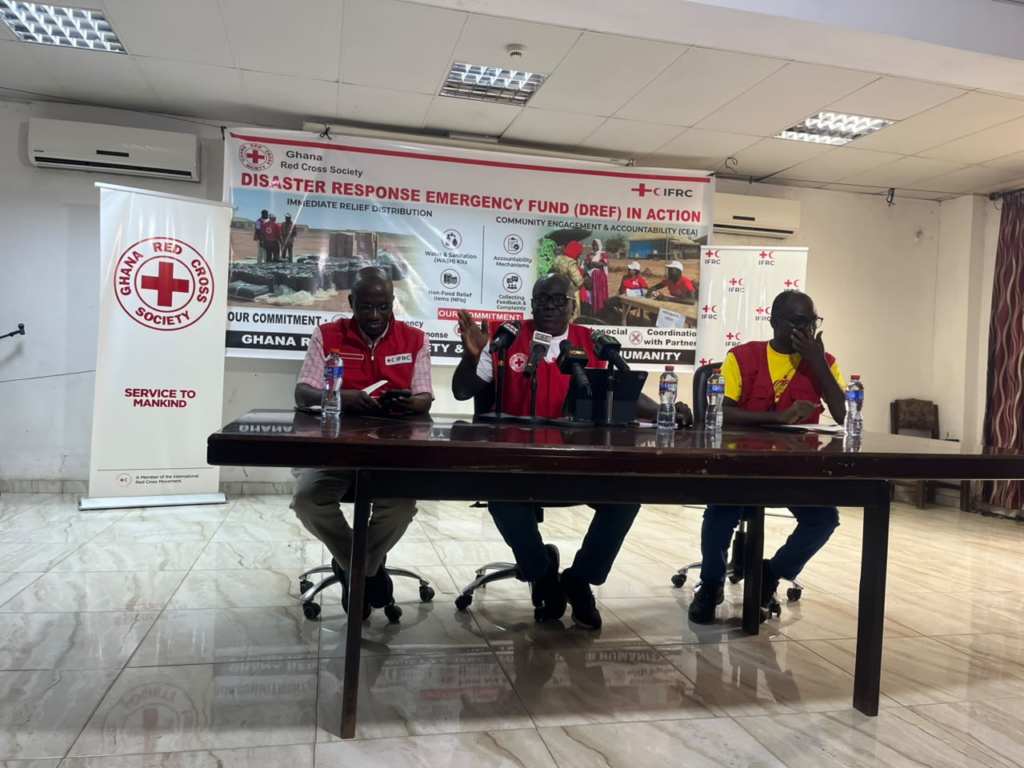
The Ghana Red Cross Society (GRCS), with support from the International Federation of Red Cross and Red Crescent Societies (IFRC), has officially launched a six-month emergency response operation valued at approximately GH¢8.3 million to provide life-saving humanitarian assistance to thousands of people affected by the devastating floods that ravaged parts of Ghana in June.
Launching the operation at a press briefing in Accra on Friday, the Secretary General of the Ghana Red Cross Society, Eric Gregory Kwatia, described the floods as one of the most severe humanitarian disasters to hit the country in recent years, stressing that the magnitude of the destruction required an urgent, coordinated and sustained response.
Speaking on behalf of the Ghana Red Cross Society and the IFRC, Mr Kwatia said the launch underscored the commitment of the global Red Cross and Red Crescent Movement to stand alongside the Government of Ghana and affected communities during one of their most difficult moments.
"We are gathered here today with a sense of urgency and a shared purpose to respond to one of the most severe flood emergencies our country has faced in recent years," he said.
"The scale of the disaster demands immediate, coordinated and life-saving action."
He explained that the operation would provide integrated humanitarian assistance to 30,000 vulnerable people across Greater Accra, Central, Volta and Western North Regions, which were hardest hit by the floods.
Mr Kwatia recounted that the disaster followed successive periods of exceptionally heavy rainfall recorded during the peak of Ghana's major rainy season in June 2026.
Although the Ghana Meteorological Agency (GMet) had issued several severe weather warnings forecasting flash floods across southern Ghana, the situation worsened dramatically during the early hours of June 29, when more than 13 hours of continuous torrential rainfall overwhelmed rivers, streams and urban drainage systems.
The unprecedented downpour resulted in widespread flooding across the four affected regions, submerging entire communities, cutting off roads, destroying homes and damaging critical infrastructure.
"The situation escalated dramatically," Mr Kwatia noted.
"Prolonged and torrential rainfall overwhelmed rivers, streams and urban drainage systems, resulting in catastrophic flooding."
Providing an overview of the humanitarian impact, the Secretary General said the floods had left a devastating trail of destruction across the country.
As of June 30, 30 people had lost their lives, more than 70 others had sustained injuries, while 30 persons remained missing.
Overall, the floods affected 69,867 people, with thousands displaced after floodwaters submerged communities and forced families to seek refuge in schools, churches and other temporary shelters.
Entire livelihoods have been wiped out as homes, businesses and farms were destroyed.
In the Central and Western Regions alone, more than 7,000 people were rendered homeless after their houses were swept away or severely damaged by floodwaters.
Roads, bridges and other public infrastructure also suffered extensive damage, hampering relief efforts and disrupting transportation and economic activity.
Mr Kwatia described the disaster as more than a collection of statistics.
"This is not just a statistical tragedy. It is a profound human crisis affecting families, children, the elderly and the most vulnerable members of our society," he emphasised.
The Secretary General warned that the floods have significantly increased the risk of disease outbreaks due to contaminated water sources and overcrowded temporary shelters.
According to him, communities now face heightened risks of waterborne diseases including cholera, acute diarrhoeal diseases, dysentery and typhoid, as well as vector-borne diseases such as malaria, which remains endemic in Ghana.
Preventing secondary health emergencies, he said, would be one of the key priorities of the emergency response.
Immediately after the floods, the Ghana Red Cross Society activated its emergency response mechanisms to support government efforts.
Mr Kwatia disclosed that the Society deployed 10 staff members and 50 volunteers to assist with search and rescue operations, administer first aid, provide psychosocial support and conduct rapid needs assessments in affected communities.
However, he acknowledged that the scale of the emergency quickly overwhelmed the organisation's immediate operational capacity.
To strengthen the response, the IFRC activated its Disaster Response Emergency Fund (DREF), enabling the Ghana Red Cross Society to implement a comprehensive, multi-sector humanitarian intervention.
"The DREF enables us to deliver a timely, coordinated and multi-sectoral humanitarian response to the most vulnerable flood-affected households," he explained.
Mr Kwatia said the emergency operation would be implemented over a six-month period at an estimated cost of GH¢8.3 million, guided by the humanitarian principles of humanity, impartiality and neutrality, while maintaining accountability and protecting the dignity of affected populations.
The intervention has been designed to provide integrated life-saving support and early recovery assistance to flood victims across the four affected regions.
Under the emergency shelter component, the Ghana Red Cross Society will distribute emergency relief items to households whose homes were destroyed.
The assistance package includes:
- 150 emergency shelter kits
- 2,000 blankets
- 2,000 kitchen sets
The items will be distributed to 2,000 of the most vulnerable households, while trained volunteers will also provide technical guidance on safer shelter construction and minor repairs to facilitate early recovery.
Recognising the financial hardship experienced by affected families, the Society will provide unconditional multi-purpose cash assistance to 1,050 vulnerable households, representing approximately 5,250 people.
Each household will receive GH¢1,200 through mobile money platforms.
Mr Kwatia said the cash transfer approach would enable beneficiaries to determine their own priority needs, whether purchasing food, paying for healthcare, repairing damaged homes or meeting other essential household expenses.
"This cash assistance empowers families to prioritise their own needs," he said. "It is dignified, efficient and promotes early recovery."
The emergency operation also includes an extensive health programme aimed at preventing disease outbreaks and addressing the psychological impact of the disaster.
Planned interventions include:
- Distribution of 2,000 insecticide-treated mosquito nets for children under five, pregnant women and older persons.
- Training and deployment of 200 volunteers in community health promotion, first aid, psychosocial support and disease surveillance.
- Production and distribution of 7,000 social and behaviour change communication materials, including posters, flyers and flip charts to promote healthy practices within affected communities.
Recognising the heightened threat posed by unsafe water and poor sanitation, the Ghana Red Cross Society has placed Water, Sanitation and Hygiene (WASH) interventions at the centre of its emergency response.
The programme will include:
- Distribution of 1,700 hygiene and dignity kits to 850 households, particularly benefiting women and girls through the provision of sanitary materials and essential hygiene supplies.
- Supply of 20,000 Aquatabs to 2,000 households to improve access to safe drinking water.
- Installation of 50 handwashing stations in schools, health facilities and markets.
- Training of 200 volunteers in hygiene promotion, infection prevention and community-led clean-up campaigns.
- Distribution of 500 sets of personal protective equipment (PPE) to volunteers and staff engaged in relief operations.
Mr Kwatia said the operation would integrate Protection, Gender and Inclusion (PGI) across every intervention to ensure equitable access to assistance.
Priority would be given to female-headed households, children, older persons and persons with disabilities.
He added that all staff and volunteers would receive training on safeguarding policies, prevention of sexual exploitation and abuse, child protection, whistleblower protection and the Society's code of conduct to uphold the highest standards of humanitarian practice.
Community Engagement and Accountability (CEA) will also form a central pillar of the operation.
The Society intends to establish community feedback and complaints mechanisms to ensure affected people can participate in decision-making and influence the delivery of humanitarian assistance.
These engagement activities are expected to directly reach 240,000 people and indirectly benefit approximately 300,000 others.
The Secretary General reaffirmed the Ghana Red Cross Society's auxiliary role to public authorities, noting that the organisation continues to work closely with the National Disaster Management Organisation (NADMO) through the National Emergency Operations Centre and district-level coordination mechanisms.
He said the partnership is intended to complement government-led interventions, avoid duplication of humanitarian assistance and maximise available resources.
Mr Kwatia also acknowledged the technical and operational support provided by the IFRC's Country Cluster Delegation, the Africa Regional Office and the Abuja Cluster.
Mr Kwatia warned that the June floods highlight Ghana's growing vulnerability to climate change and increasingly frequent extreme weather events.
He appealed to government institutions, United Nations agencies, development partners, civil society organisations, the private sector, the media and the international community to continue supporting humanitarian efforts.
"The humanitarian needs are immense and the window to act is now," he said.
"We cannot do it alone. We need your shared responsibility and commitment. By working together, we can provide immediate relief, prevent further suffering and support the early recovery of our communities."
He expressed gratitude to the people of Ghana and the international community for their solidarity, assuring flood-affected communities that the Ghana Red Cross Society would remain committed to supporting recovery efforts while strengthening disaster preparedness and resilience across the country.
"The Ghana Red Cross is here for the long haul,"
"We will continue to provide assistance and support to affected communities and strengthen disaster preparedness and resilience across our dear country," he concluded.
Latest Stories
-
Central Regional Minister urges use of religious platforms to change environmental, sanitation practices
5 minutes -
Henry Kweku Banning
6 minutes -
Execution of US murderer Christa Pike halted an hour before it was due to happen
8 minutes -
GoldBod generates US$1.87bn in FX in September, exceeds monthly target
11 minutes -
SOE comments controversy: ‘We must never abandon our humanity because of judicial office’ – CJ
21 minutes -
Samuel Kojo Brace declares intention to contest NPP parliamentary primary in Ahanta West
22 minutes -
Dr Apaak calls for evidence-based education response to emergencies
26 minutes -
Pilot may have sought to crash Israel-bound flight after stabbing other pilot, Netanyahu says
30 minutes -
Report flags potential money laundering, terrorist financing risks among Ghana’s NGOs
31 minutes -
Breast Cancer Awareness Month launched: 2,695 women die from breast cancer annually — Dr Ann-Dadzie
38 minutes -
Mahama’s proposed airline looks to South America, Caribbean as Ghana confronts mounting drug trafficking cases
54 minutes -
5% progress on Suame Interchange Phase One inadequate – Roads Minister tasks contractor to speed up work
56 minutes -
Photos: Vice President joins GAAS Awards to celebrate outstanding women leaders
57 minutes -
OSP vs Ken Ofori-Atta, SML and others: Court gives OSP four more weeks to serve Ofori-Atta with summons
59 minutes -
High Commission sends caution to Ghanaians in South Africa ahead of planned protests
1 hour